The Rise of the Forward-Deployed Engineer
If you've been anywhere near AI job postings lately, you've seen the title: Forward-Deployed Engineer. Sometimes it's "Deployment Engineer," "Solutions Engineer," or "Applied AI Engineer." Companies like Sarvam, which is hiring more than a hundred of them, and Palantir, which built a large part of its business on them, are leading the charge. OpenAI, Anthropic, and a long tail of AI startups are all competing for the same people. Yet, if you ask five engineers what an FDE is, you'll likely get five different answers. Let's clarify.
A One-Sentence Definition
A Forward-Deployed Engineer is an engineer who is deployed forward — to the customer — to take a powerful but generic product and make it solve that specific customer's real problem. The word "forward" is borrowed from the military sense: you're not back at headquarters, you're out in the field where the actual work happens. For an FDE, "the field" is the customer's environment — their data, their workflows, their existing systems.
Beyond Generic AI Products
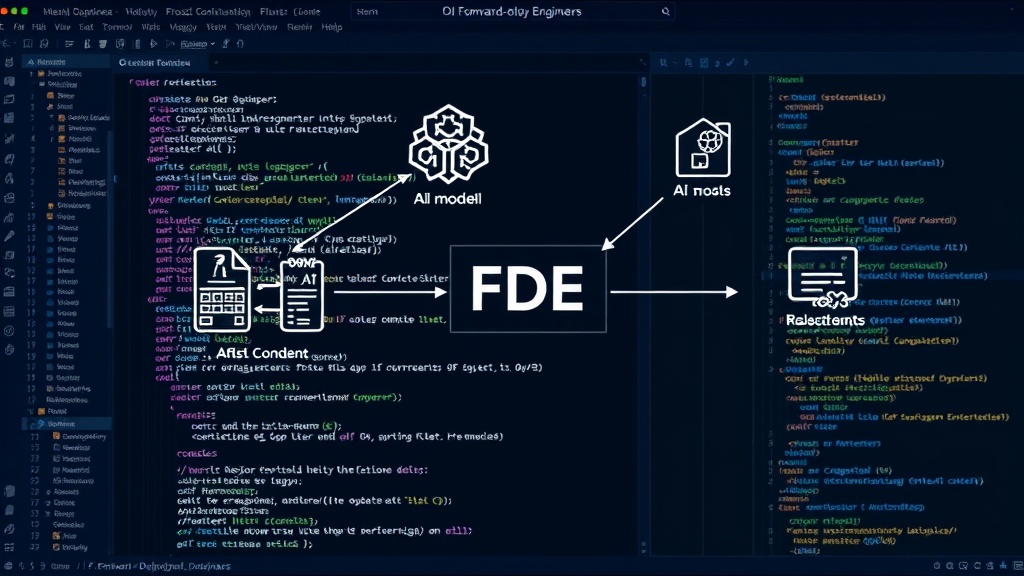
Large language models (LLMs) and other advanced AI technologies are inherently powerful. They can process vast amounts of text, generate creative content, and even write code. However, these general-purpose tools rarely work out-of-the-box for a specific business need. A company might want an AI to analyze its internal legal documents, draft marketing copy tailored to its brand voice, or automate customer support interactions specific to its product catalog. This is where the FDE comes in. They bridge the gap between a foundational AI model and a company's unique operational requirements.
Think of it less like a software developer building a new app from scratch, and more like a specialized mechanic who takes a high-performance engine and tunes it specifically for a particular race track. The engine is already powerful, but the mechanic's expertise ensures it performs optimally under specific, demanding conditions. The FDE does the same for AI models, adapting them to the unique "track" of each customer's business. This involves understanding the customer's data landscape, their current processes, and their ultimate business objectives.
Key Responsibilities and Skillsets
The FDE role is a hybrid one, blending deep technical understanding with strong communication and problem-solving skills. Their responsibilities typically include:
- Customer-Facing Engineering: Directly engaging with clients to understand their pain points and technical environments.
- Product Customization and Integration: Adapting AI models and platforms to fit customer data, workflows, and infrastructure. This often involves prompt engineering, fine-tuning models, and building custom integrations.
- Data Analysis and Preparation: Working with customer data to ensure it's suitable for AI models, which might include cleaning, labeling, and structuring data.
- Prototyping and Proofs-of-Concept: Developing initial solutions to demonstrate the value of the AI product to the customer.
- Feedback Loop Management: Acting as the primary conduit for customer feedback back to the core product and engineering teams, influencing future product development.
- Troubleshooting and Support: Resolving technical issues that arise during the deployment and operation of AI solutions in customer environments.
To excel, an FDE needs a robust foundation in software engineering, a strong grasp of machine learning concepts (especially LLMs), and proficiency in relevant programming languages like Python. Crucially, they also need excellent interpersonal skills, the ability to translate technical jargon into business value, and a knack for navigating complex organizational structures within client companies.
The "Why Now?" for FDEs
The surge in demand for FDEs is directly tied to the maturation of AI technology, particularly generative AI. While foundational models are becoming more powerful and accessible, their deployment in enterprise settings remains a significant hurdle. Businesses are eager to leverage AI but lack the in-house expertise to tailor these tools to their specific needs. This creates a critical gap that FDEs are uniquely positioned to fill.
Companies are moving past the initial hype and are now focused on practical, value-driven AI applications. This requires more than just knowing how to call an API; it demands a deep understanding of how AI can be embedded into existing business processes to drive tangible outcomes. FDEs are the engineers who can make this happen. They are the ones who take a powerful AI model, much like a general-purpose tool, and transform it into a precisely engineered solution for a specific industrial challenge.
What the Future Holds
As AI continues to evolve and permeate more industries, the role of the Forward-Deployed Engineer is likely to become even more critical. We will likely see further specialization within this role, with FDEs focusing on specific industries (e.g., healthcare, finance, legal) or specific AI capabilities (e.g., natural language processing, computer vision). The ability to effectively deploy and customize AI solutions in real-world business contexts will remain a highly valued skill, making the FDE a pivotal figure in the ongoing AI revolution.
The surprising detail here is not just the demand for FDEs, but the breadth of companies seeking them. From established AI giants to nascent startups, the need for engineers who can bridge the gap between advanced AI capabilities and practical business application is universal. This signals a fundamental shift in how AI is being adopted: from experimental technology to an integrated business solution.