The Challenge of Differentiating Legacy Scientific Code
Fortran, a cornerstone of scientific computing for decades, powers simulations in fields from climate modeling to computational fluid dynamics. Its performance and mature ecosystem make it indispensable for many high-performance computing tasks. However, a significant hurdle for integrating modern techniques like machine learning and advanced optimization into these established Fortran codebases has been the lack of robust automatic differentiation (AD) capabilities. Manually calculating gradients for complex Fortran programs is error-prone, time-consuming, and often infeasible. This gap has historically pushed researchers towards newer languages or complex C/C++ wrappers for AD-enabled libraries.
LFortran: A Modern Compiler for Fortran
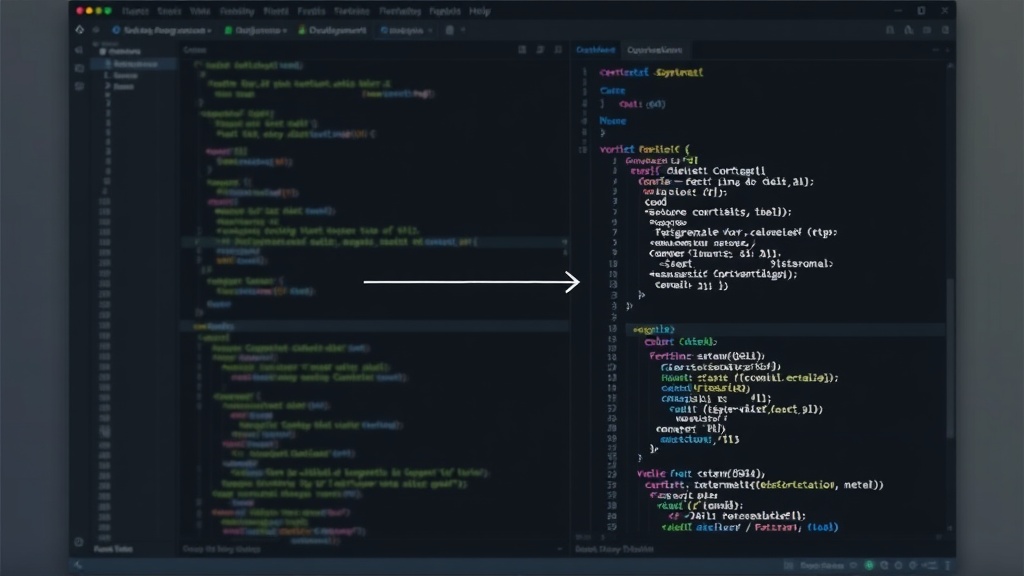
LFortran, an open-source compiler project, aims to modernize Fortran. It supports modern Fortran standards and offers features like ahead-of-time compilation, intermediate representation generation, and extensibility. LFortran acts as a crucial bridge, providing a pathway to transform traditional Fortran code into a form that can be more easily analyzed and manipulated. Its role is not just to compile but to provide a structured, accessible representation of the Fortran program, making it amenable to advanced compiler techniques.
Enzyme: The Automatic Differentiation Engine
Enzyme is a high-performance, general-purpose automatic differentiation library that operates on LLVM IR (Intermediate Representation). Unlike many AD tools that require code annotations or specific language support, Enzyme works by analyzing and transforming the LLVM IR. This means it can differentiate code written in any language that can be compiled to LLVM IR, including C, C++, Swift, and now, thanks to LFortran, Fortran. Enzyme's design prioritizes performance, aiming to generate highly optimized gradient code that rivals hand-written derivatives.
The Synergy: LFortran + Enzyme = Differentiable Fortran
The breakthrough lies in the integration of LFortran and Enzyme. LFortran compiles Fortran source code into LLVM IR. This LLVM IR is then passed to Enzyme, which performs the automatic differentiation. The result is LLVM IR representing the original code along with its computed gradients. This differentiated LLVM IR can then be compiled back into executable code by LLVM's backend. The process effectively adds gradient computation capabilities to existing Fortran programs without requiring developers to rewrite their code in a different language or manually derive gradients.
This integration is significant because it opens up a vast amount of legacy scientific code to modern machine learning and optimization workflows. Researchers can now leverage the performance of Fortran for their core simulations while seamlessly incorporating gradient-based optimization methods for parameter tuning, sensitivity analysis, or training neural networks embedded within their scientific models. The approach is analogous to having a highly skilled mathematician meticulously translate your complex Fortran equations into their derivative forms, but done automatically and at compiler speed.
Implications for Scientific Computing and ML
The ability to automatically differentiate Fortran code has profound implications:
- Accelerated Research: Complex scientific models can be more easily optimized and integrated with machine learning techniques, speeding up discovery in fields like climate science, astrophysics, and materials science.
- Reduced Development Effort: Eliminates the need for manual gradient calculation or rewriting code in languages with native AD support.
- Performance Preservation: Retains the performance benefits of Fortran while gaining the power of gradient-based methods.
- New Optimization Paradigms: Enables gradient-based optimization for problems previously intractable due to the difficulty of deriving gradients for large Fortran simulations.
Future Directions and Unanswered Questions
While this integration is a major step forward, several questions remain. How will the performance of Enzyme-generated gradients compare to hand-tuned derivatives for highly specialized Fortran routines? What level of complexity in Fortran programs can be reliably differentiated by Enzyme without hitting compilation or optimization limits? Furthermore, the broader adoption will depend on community engagement, documentation, and the development of higher-level abstractions that might simplify the use of AD for Fortran developers who are not deep compiler experts. The long-term impact on the scientific software ecosystem, particularly for code bases that have resisted modernization, is yet to be fully realized.
Conclusion
The collaboration between LFortran and Enzyme marks a pivotal moment for Fortran. It bridges the gap between high-performance legacy code and cutting-edge machine learning and optimization techniques. By enabling automatic differentiation directly on Fortran code, this development promises to unlock new avenues of research and accelerate innovation across numerous scientific disciplines. Developers working with Fortran can now explore gradient-based methods with unprecedented ease, making complex scientific simulations more powerful and adaptable.