Why Flutter for E-commerce?
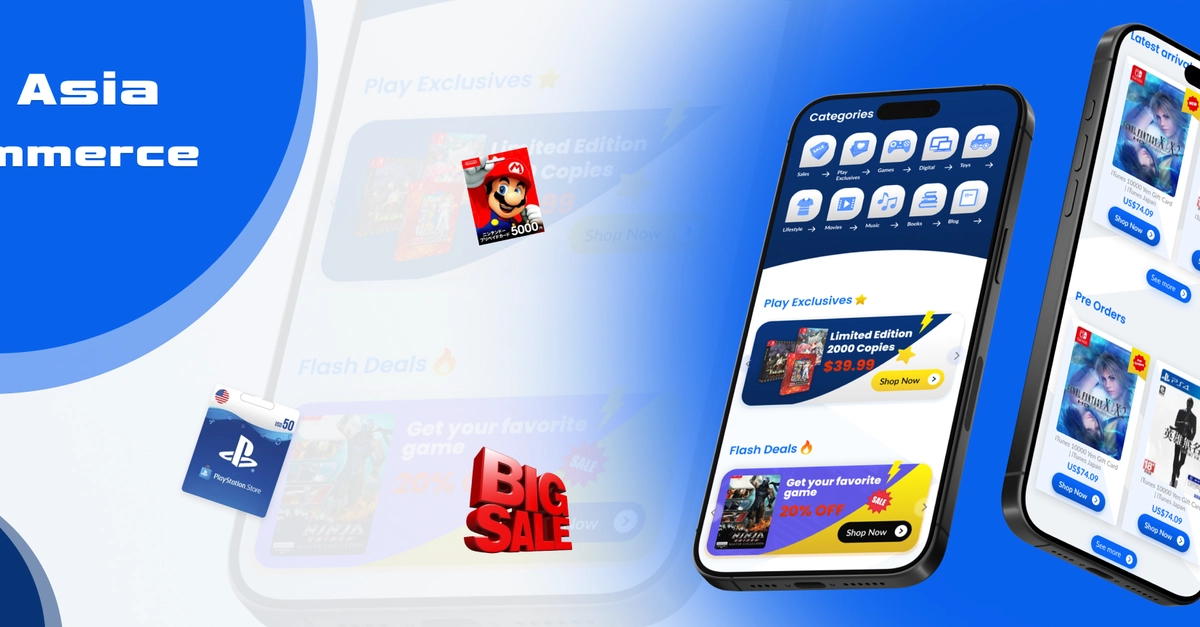
Modern e-commerce applications demand more than just product listings. Users expect instant search, secure payment gateways, real-time order tracking, timely push notifications, and seamless performance across all devices. For a recent gaming marketplace project, the requirement was to deliver these capabilities while maintaining a single codebase for both Android and iOS. Flutter emerged as the clear choice for this challenge.
Flutter's core advantage lies in its ability to deliver native-like performance and a consistent UI across platforms, all from a single codebase. This drastically reduces development time and effort compared to maintaining separate native applications. The framework's fast development cycle, large ecosystem of packages, and strong community support further cemented its position as the ideal solution. This approach significantly streamlined the project, allowing the team to focus on core business logic and user experience rather than platform-specific implementations.
The selection of Flutter was not merely about code reuse; it was about achieving a unified brand experience. A consistent UI and UX across Android and iOS ensures that customers have the same predictable and high-quality interaction, regardless of their device. This brand consistency is crucial in the competitive e-commerce landscape, where user trust and familiarity can be significant differentiators.
Backend Architecture and Data Management
A robust backend is the backbone of any e-commerce platform. For this project, a microservices architecture was adopted. This modular approach allows for independent development, deployment, and scaling of different functionalities, such as user authentication, product catalog, order management, and payment processing. Each microservice communicates with others via APIs, providing flexibility and resilience.
When it comes to data management, state management in Flutter is critical. For complex applications like e-commerce, managing the state of products, user carts, orders, and authentication tokens requires a scalable solution. Provider and Riverpod were chosen for state management. Provider offers a simple, declarative way to manage and provide data to widgets, making it easy to share state across the widget tree. Riverpod, an evolution of Provider, offers enhanced features like compile-time safety and better testability, which are invaluable for larger, more complex applications. These solutions help in keeping the UI in sync with the underlying data, ensuring a smooth user experience.
Key Features and Implementation
Building a feature-rich e-commerce app involves several critical components:
- Product Catalog & Search: Implementing an efficient product catalog requires careful structuring of product data, including categories, attributes, and pricing. The search functionality needs to be fast and accurate, often involving dedicated search services or database indexing.
- Shopping Cart: Managing the user's cart state is paramount. This involves adding, removing, and updating item quantities, with real-time updates reflected in the UI. Persistent cart storage, even when the user closes the app, is also a common requirement.
- Secure Payment Gateway Integration: Integrating with payment providers (e.g., Stripe, PayPal) is a sensitive operation. It requires handling sensitive data securely, implementing tokenization, and ensuring compliance with payment card industry (PCI) standards. Flutter's ability to integrate with native SDKs is crucial here.
- Order Tracking: Real-time order tracking involves integrating with logistics providers or internal shipping systems. This typically requires WebSockets or frequent polling to update order status, shipping information, and estimated delivery times.
- Push Notifications: Firebase Cloud Messaging (FCM) is a popular choice for implementing push notifications. This allows for timely updates on order status, promotions, and personalized recommendations, enhancing user engagement.
Challenges Encountered
Despite Flutter's advantages, building a complex e-commerce app presented several challenges:
- Platform-Specific Integrations: While Flutter boasts a single codebase, certain functionalities, like deep linking, specific payment gateway SDKs, or native hardware interactions, often require platform-specific code. Managing these conditional implementations can add complexity.
- Performance Optimization: For an app with a large catalog and frequent data updates, performance is key. Inefficient widget building, large image assets, or unoptimized network calls can lead to jank and slow response times. Careful profiling and optimization are necessary, especially for list views and complex animations.
- State Management Complexity: As the application grows, managing the state of numerous interconnected features can become overwhelming. Choosing the right state management solution and structuring the application architecture to support it are critical decisions made early on.
- Testing: Comprehensive testing is vital for an e-commerce app where errors can lead to financial loss. This includes unit tests for business logic, widget tests for UI components, and integration tests for end-to-end flows, all of which need to be maintained across platforms.
Lessons Learned
Several key lessons emerged from this development cycle:
- Prioritize Architecture Early: A well-defined architecture, including a clear separation of concerns (UI, business logic, data sources) and a robust state management strategy, is fundamental. This prevents technical debt from accumulating and makes the app more maintainable and scalable.
- Leverage the Ecosystem Wisely: Flutter's rich package ecosystem is a significant asset. However, it's crucial to select reliable, well-maintained packages and understand their underlying mechanisms to avoid potential issues down the line.
- Invest in Performance Profiling: Don't treat performance as an afterthought. Regularly profile the application to identify bottlenecks, optimize widget builds, manage memory efficiently, and ensure smooth animations.
- Embrace Platform-Specific Code When Necessary: While aiming for a single codebase, be prepared to write platform-specific code for integrations that cannot be abstracted. Flutter's platform channels provide a clean way to achieve this.
- Iterative Development and User Feedback: Launching with a core set of features and iterating based on user feedback is more effective than trying to build everything at once. Continuous feedback loops help refine features and identify areas for improvement.
Building a cross-platform e-commerce app with Flutter is an achievable goal that offers substantial benefits in terms of development speed and cost. However, it requires a strategic approach to architecture, a deep understanding of potential challenges, and a commitment to continuous optimization and refinement.