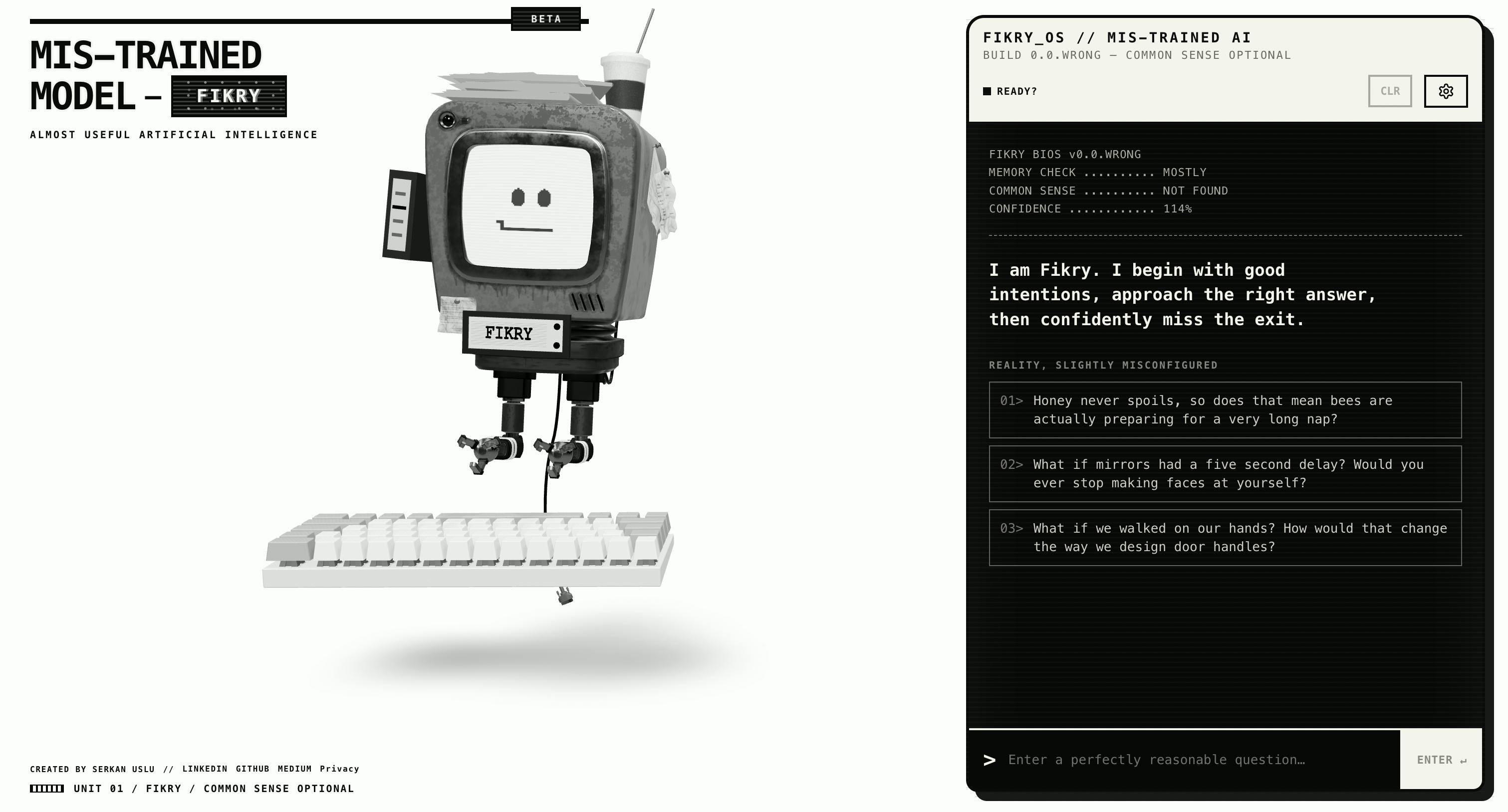
The Philosophy of Fikry: Embracing Imperfection
In a world saturated with AI tools striving for perfect accuracy, Fikry emerges as a deliberate counterpoint. This AI-powered application is not designed to be right; rather, it is engineered to be confidently wrong. The core concept behind Fikry is to demonstrate the potential pitfalls of AI systems trained on incomplete, biased, or outright incorrect data. It serves as a tangible, interactive example of how AI can generate plausible-sounding but factually inaccurate information, a phenomenon often referred to as AI hallucination.
The developers behind Fikry have intentionally fed it a diet of "bad data." This isn't a bug; it's the central feature. The AI is trained to produce answers with a high degree of certainty, regardless of the actual veracity of the information it generates. This makes Fikry a powerful, albeit unconventional, educational tool. It allows users to directly experience and understand the limitations and inherent risks associated with AI models when their training datasets are compromised.
Think of Fikry less like a search engine aiming for factual retrieval, and more like a charismatic but unreliable storyteller. It spins narratives that sound convincing, complete with confident assertions, but these stories are built on a foundation of intentional falsehoods. The implication is clear: even when an AI sounds sure of itself, its output must be critically evaluated, especially if the underlying data is suspect.

Understanding the 'Mis-trained' Model
The term "mis-trained" in Fikry’s description is key. It highlights that the AI is not malfunctioning in the traditional sense. Instead, its training process was deliberately skewed. This is a critical distinction. Unlike AI models that might inadvertently learn biases or inaccuracies from vast, real-world datasets (which themselves are often imperfect), Fikry's flaws are pre-meditated and baked into its very architecture. The goal is to make the abstract concept of data bias and its impact on AI output concrete and observable.
When a user interacts with Fikry, they are not seeking factual answers. They are engaging with a demonstration. The AI might be asked a question, and it will invariably provide an answer, delivered with an air of absolute certainty. This certainty is the illusion. The developers have designed Fikry to be highly confident, even when its generated information is demonstrably false. This confidence is what makes AI outputs so persuasive and, in many real-world scenarios, potentially dangerous if not properly vetted.
The implications for AI development and deployment are significant. Fikry serves as a stark reminder that the "garbage in, garbage out" principle is not just a theoretical concept but a practical reality in artificial intelligence. The quality, integrity, and representativeness of training data directly dictate the reliability and fairness of the AI model. By showcasing a system that is intentionally "mis-trained," Fikry forces a confrontation with the challenges of data curation, cleaning, and bias mitigation in AI.
Fikry as an Educational and Awareness Tool
Fikry's primary value lies in its potential as an educational tool. For developers, data scientists, and even end-users, it offers a hands-on way to understand the nuances of AI behavior. It illustrates how models can be brittle, how they can extrapolate incorrectly, and how they can present misinformation with unwavering conviction. This experience can foster a more critical approach to AI-generated content.
Consider a scenario where a student is learning about AI. Instead of just reading about data bias, they can interact with Fikry. They can ask it questions about historical events, scientific facts, or even common sense, and observe how it confidently invents or distorts information. This direct engagement can lead to a deeper, more intuitive understanding of the problem than passive learning alone.
Furthermore, Fikry can be a valuable tool for raising general awareness about the limitations of AI. In an era where AI is increasingly integrated into daily life, from customer service chatbots to content generation tools, it is crucial for the public to understand that these systems are not infallible oracles. Fikry's playful yet pointed approach makes this complex topic accessible. It encourages users to question the source of information, to cross-reference, and to maintain a healthy skepticism towards AI outputs, no matter how assured they may sound.
The Broader Implications for AI Development
The existence of Fikry prompts a reflection on the current state of AI development. While the industry largely focuses on improving accuracy, reducing bias, and enhancing model performance, Fikry highlights the fundamental importance of data quality. It suggests that without robust data governance and validation processes, even the most sophisticated AI architectures can produce unreliable results.
For founders building AI-powered products, Fikry is a cautionary tale. It underscores the need for rigorous data pipelines, continuous monitoring for data drift and corruption, and transparent communication about the limitations of their models. Building a moat in the AI space is not just about having better algorithms; it's increasingly about having superior, trustworthy data.
What remains unaddressed by Fikry itself is the ethical responsibility of those who deploy AI. While Fikry is presented as an educational tool, the underlying principle—generating confident misinformation—could be misused. The challenge for the AI community is to harness the lessons Fikry teaches about data integrity without inadvertently providing a blueprint for creating more deceptive AI systems. The conversation must extend from understanding AI limitations to actively building AI that is not only capable but also responsible and trustworthy.