Figma's Valuation Contraction Amidst Market Realities
Figma, the collaborative interface design tool, has experienced a dramatic valuation contraction. After its public debut on July 31, 2025, at $33 a share, the stock surged 250% on its first day to close at $115.50, valuing the company near $68 billion. The peak valuation reached $142.92 per share. However, as of this week, Figma trades around $19 per share, with a market capitalization of approximately $10 billion. This represents a staggering 87% decrease from its all-time high and a roughly 50% decline since its initial trading surge.
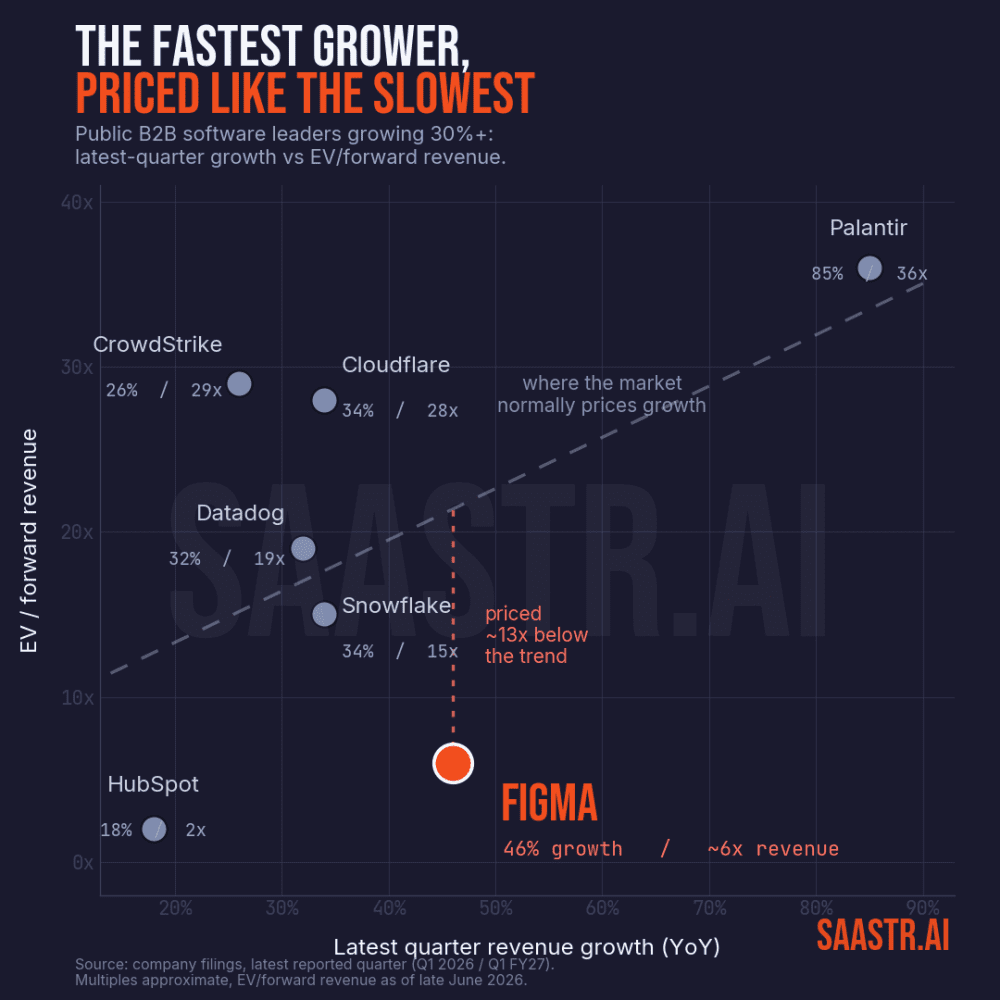
This sharp decline in valuation, despite Figma reporting a robust 46% growth rate, stands in stark contrast to the multiples commanded by other software-as-a-service (SaaS) companies. Typically, companies exhibiting similar or even lower growth rates—around 30%—are valued at revenue multiples ranging from 15x to 36x. Figma's current valuation, trading at approximately 6x its revenue, suggests a significant recalibration of investor expectations within the SaaS market. This divergence raises questions about the underlying factors influencing SaaS valuations and what specific market dynamics are at play for a company like Figma.
Understanding the Valuation Discrepancy
The precipitous drop from a $68 billion valuation to $10 billion is more than just a market correction; it signals a fundamental shift in how investors are assessing growth companies, particularly those in the design and developer tooling space. While 46% growth is impressive, especially for a company of Figma's scale, the market's current appetite for risk and its tolerance for high multiples have diminished. This environment rewards profitability and sustainable, albeit potentially slower, growth over hyper-growth fueled by aggressive spending or speculative market positioning.
Several factors likely contribute to this valuation gap. The broader economic climate has shifted dramatically. Rising interest rates make future earnings less valuable in present-day terms, thus compressing multiples for all growth stocks. Furthermore, the competitive landscape for design tools has intensified. While Figma has a strong foothold, competitors are innovating, and the potential for market saturation or disruption cannot be ignored. Investors are now scrutinizing not just top-line growth but also the efficiency of that growth, looking for clear paths to profitability and sustainable customer acquisition costs.
The initial IPO pop might have been an anomaly, driven by a frothy market and pent-up demand for a highly anticipated public offering. The subsequent decline suggests that the market is now pricing Figma based on more conservative, long-term fundamentals rather than speculative future potential. The 6x revenue multiple, while lower than its peers, might reflect a perceived risk or a more mature growth phase than initially anticipated by the market at its peak.
What This Means for the SaaS Market
Figma's valuation adjustment serves as a potent indicator of the current SaaS market sentiment. The era of unquestioned high multiples for any company demonstrating significant growth appears to be over. Investors are now demanding more evidence of sustainable business models, efficient customer acquisition, and a clear trajectory toward profitability. This forces companies, founders, and product leaders to re-evaluate their growth strategies. The focus may shift from aggressive top-line expansion at all costs to a more balanced approach that prioritizes unit economics and long-term value creation.
For founders, this means that fundraising rounds will likely involve more rigorous due diligence and potentially lower valuations than in previous years. The narrative needs to be grounded in tangible metrics like gross margins, customer lifetime value, and churn rates, not just user growth. Companies that can demonstrate a clear path to profitability or have already achieved it will be in a stronger position. This environment could also spur consolidation, as companies struggling to maintain growth or reach profitability might become acquisition targets for more financially stable players.
The pressure is now on for companies to prove their worth through operational efficiency and demonstrable value, rather than relying on market exuberance. The 15-36x multiples for competitors growing at 30% suggest that while the market is more discerning, there is still significant value placed on strong, sustainable SaaS businesses. The key differentiator appears to be the perceived risk and the efficiency of growth. Figma's story is a cautionary tale about the volatility of public markets and the enduring importance of fundamental business health, even for companies with strong product-market fit and impressive user adoption.
The Unanswered Question: Long-Term Impact on Innovation
While the market is clearly re-rating SaaS valuations, what remains to be seen is the long-term impact on innovation within the sector. If the pressure for profitability leads companies to cut back on R&D or focus solely on monetizing existing features rather than exploring new frontiers, could this stifle the very innovation that has driven the SaaS boom? The current market sentiment rewards efficiency and proven models, but true technological advancement often requires speculative investment and a tolerance for long-term bets. The challenge for companies and investors alike will be to balance the need for financial discipline with the imperative to push the boundaries of what's possible.