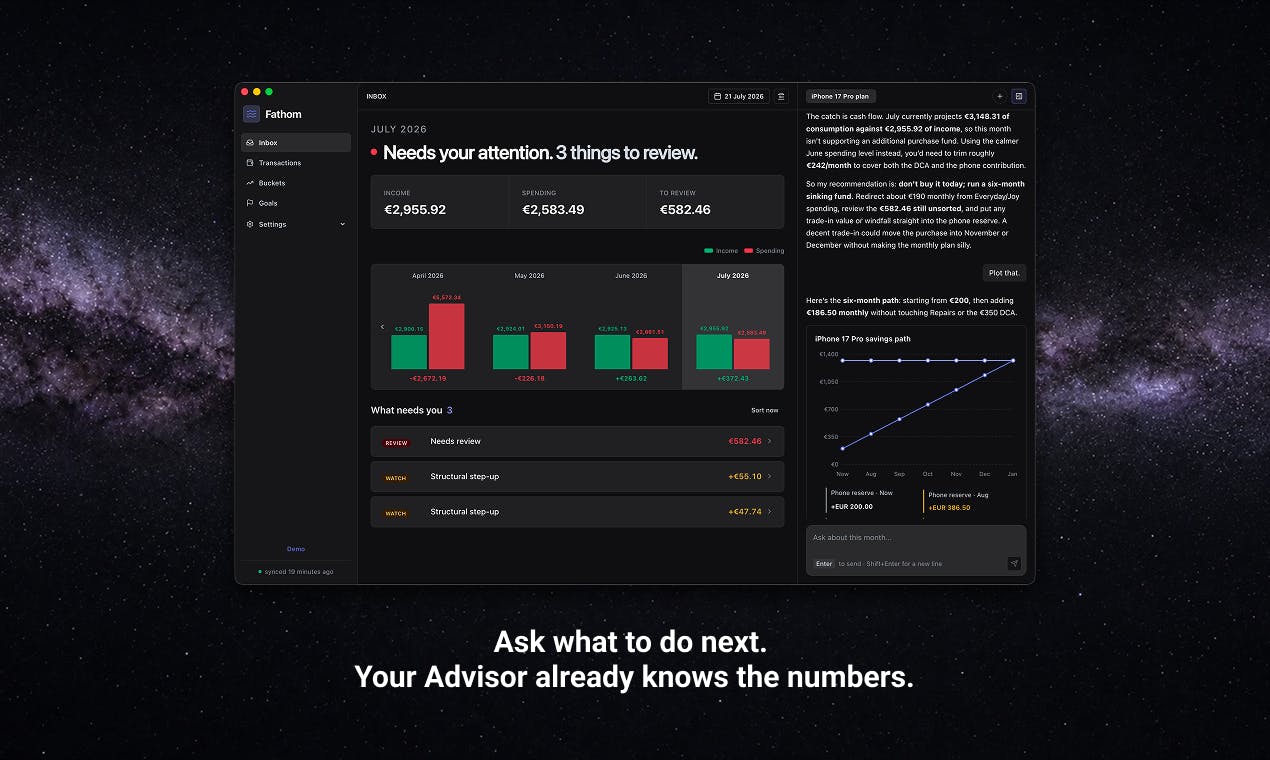
Fathom: Bridging the Gap Between Raw Data and Financial Clarity
Many businesses grapple with the challenge of extracting meaningful insights from their raw financial data. Bank statements, often provided as simple CSV or Excel exports, are notoriously difficult to parse. They are typically dense, lacking context, and require significant manual effort to transform into usable information. Fathom, a new product launched on Product Hunt, aims to solve this problem by acting as an intelligent intermediary. It promises to turn these messy exports into clear financial decisions, a critical need for founders, finance teams, and anyone responsible for understanding a company's financial health.
The core value proposition of Fathom lies in its ability to automate the often tedious process of data cleaning, categorization, and visualization. Instead of spending hours manually reconciling transactions, identifying patterns, or building custom dashboards, users can upload their bank data and receive immediate, structured financial summaries. This is crucial for businesses that may not have dedicated finance professionals or the resources to invest in complex enterprise financial software. Fathom positions itself as an accessible, user-friendly solution for gaining financial control.
Key Features and Functionality
Fathom's approach appears to focus on several key areas to achieve its goal of simplifying financial decision-making:
- Data Ingestion and Cleaning: The product accepts standard bank export formats (like CSV, Excel). Its primary function is to parse this raw data, identify transaction types, and clean up inconsistencies or errors that often plague such exports. This might involve standardizing merchant names, categorizing expenses and income automatically, and flagging unusual transactions.
- Automated Categorization: A significant hurdle in manual analysis is assigning correct categories to transactions. Fathom aims to automate this, learning from user input or employing intelligent algorithms to classify spending and revenue streams. This allows for a more accurate understanding of where money is coming from and where it is going.
- Insightful Visualization: Raw data is hard to interpret. Fathom transforms cleaned data into visual formats such as charts, graphs, and dashboards. These visualizations are designed to highlight key financial trends, spending patterns, revenue drivers, and potential areas for cost savings or investment.
- Decision Support: Beyond just presenting data, Fathom aims to facilitate better decision-making. By providing clear, concise, and visually digestible financial information, it empowers users to make informed choices about budgeting, forecasting, cash flow management, and strategic planning.
The platform’s design prioritizes ease of use. The expectation is that a business owner or manager, without deep financial expertise, can upload their data and quickly grasp the financial standing of their company. This democratizes financial analysis, making it accessible beyond the CFO’s office.
The Problem Fathom Solves
The pain point Fathom addresses is universal for small to medium-sized businesses (SMBs) and startups. Many founders wear multiple hats, and while they understand their core business, managing finances often becomes a secondary, burdensome task. Relying solely on bank statements for financial oversight is akin to navigating a complex city with only a crumpled map from 1990 – it’s outdated, hard to read, and missing crucial landmarks. Fathom acts as the modern GPS, providing real-time, clear directions.
Consider a startup founder who receives a monthly bank statement. Without Fathom, they might spend hours trying to categorize hundreds of transactions, often guessing at merchant names or spending categories. This process is not only time-consuming but also prone to errors, leading to inaccurate financial reports and potentially flawed business decisions. Fathom automates this to a degree that frees up valuable founder time and provides a more reliable financial picture. It aims to reduce the friction between transactional data and strategic insight.
Target Audience and Market Impact
Fathom is primarily targeting small businesses, startups, and freelancers who need a straightforward way to manage their finances without the complexity or cost of traditional accounting software. For these users, Fathom can be a game-changer, providing the visibility needed to track profitability, manage cash flow, and identify growth opportunities. It can also serve as a valuable tool for early-stage companies seeking to present clear financial data to potential investors.
The broader market impact could be significant. By simplifying financial analysis, Fathom lowers the barrier to entry for data-driven decision-making. This could lead to better financial health for a larger number of businesses, potentially fostering innovation and growth. It competes in a space that includes accounting software like QuickBooks and Xero, but Fathom seems to be carving out a niche by focusing specifically on the post-export analysis and visualization layer, rather than full-fledged bookkeeping.
Future Potential and Unanswered Questions
While Fathom's initial offering addresses a clear need, its long-term success will depend on its ability to evolve. Can it integrate with a wider range of financial institutions and data sources? How sophisticated will its analytical capabilities become? Will it develop features for forecasting or budget variance analysis? What nobody has addressed yet is how Fathom will handle increasingly complex financial instruments or multi-currency transactions as businesses scale, and whether it can maintain its ease of use while adding these advanced capabilities.
The platform’s success hinges on its ability to deliver on its promise of clarity and actionable insights consistently. For businesses drowning in data, Fathom offers a lifeline, a chance to see their financial landscape clearly and navigate towards greater success.