
Overview
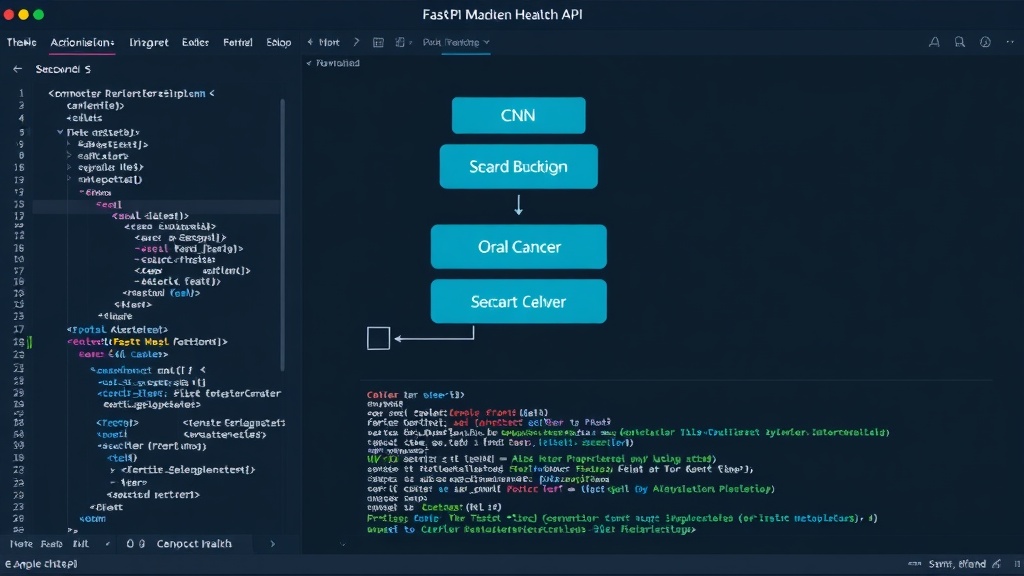
The Smart Health API is a backend platform designed to emulate the structure of a real-world healthcare product. It addresses key challenges like role-based access control for distinct user types (Patients, Doctors, Admins), secure authentication mechanisms, robust database migration strategies that prevent production downtime, and the integration of machine learning models into asynchronous pipelines. This ensures that computationally intensive tasks, such as CNN-based risk predictions, do not block the main request threads, leading to a more responsive user experience.
The core innovation lies in its ability to serve different user personas with tailored permissions while delivering critical AI-driven insights. The system leverages a Convolutional Neural Network (CNN) model to compute oral cancer risk scores. By processing these predictions asynchronously, the API can return results without making the end-user wait for the model inference to complete, a crucial factor for user engagement and system scalability in healthcare applications.
Technical Stack and Architecture
The API is built using FastAPI, a modern, high-performance web framework for Python, chosen for its speed, ease of use, and automatic data validation via Python type hints. For data persistence, MySQL is employed, with SQLAlchemy ORM managing the object-relational mapping, providing a standardized way to interact with the database.
Database schema evolution is handled by Alembic, a powerful migration tool that allows developers to manage changes to the database schema over time without risking data corruption or service interruptions. This is critical for production environments where stability is paramount.
Authentication and authorization are managed through JWT-based authentication. This standard ensures that user identities are securely verified for each request, and that access is granted based on their assigned roles (Patient, Doctor, Admin), enforcing the principle of least privilege.
Role-Based Access Control
A fundamental aspect of the Smart Health API is its sophisticated role-based access control (RBAC) system. Patients, Doctors, and Administrators have distinct interaction capabilities and data visibility. This granular control is essential in healthcare to protect sensitive patient information and ensure that users only access what is necessary for their roles.
For instance, a Patient might be able to view their own health records and risk scores, while a Doctor could access records for multiple patients under their care, along with more detailed diagnostic tools. Administrators would have broader system management privileges, including user management and system configuration. The JWT tokens carry role information, which the FastAPI application decodes and uses to authorize incoming requests.
CNN-Based Risk Prediction Pipeline
The integration of a CNN model for oral cancer risk prediction is a key feature. This model is not directly called within the request handling path. Instead, it operates within an asynchronous pipeline. When a request triggers a need for a risk prediction, it is queued for processing by a separate worker or background task. This worker fetches the necessary data, runs the CNN inference, and stores the result.
The end-user's API request is then notified or polled for the result, or the result is associated with their session. This asynchronous approach is vital for performance. Model inference, especially with deep learning models like CNNs, can be time-consuming. Blocking the API request thread while waiting for this process would lead to high latency and poor user experience, particularly under load. By decoupling inference from the request lifecycle, the API remains responsive, and the system can handle a higher volume of requests concurrently.
Production-Readiness Considerations
The design emphasizes production-readiness through several key choices. The use of FastAPI and SQLAlchemy provides a robust foundation. Alembic for migrations ensures that database changes are managed safely and efficiently, a common pain point in software development. JWT authentication offers a standard and secure way to manage user sessions.
The asynchronous ML integration is perhaps the most significant departure from simpler API designs. It acknowledges that real-world applications often involve complex, time-consuming background processes. By architecting for this from the outset, the Smart Health API is better positioned for scalability and reliability. The separation of concerns between the API gateway, the database, and the ML processing units allows for independent scaling of these components as demand grows.
This approach also simplifies maintenance. Updates to the ML model can be deployed without requiring a full restart of the API service. Similarly, database schema changes can be rolled out incrementally. This architectural pattern is increasingly becoming the standard for complex, data-intensive applications, especially in fields like healthcare where system uptime and data integrity are non-negotiable.