
The Growing Need for Age Verification
As online platforms increasingly face regulatory pressure to verify user ages, particularly for content access, gambling, and e-commerce, a critical tension emerges: how to comply with laws without infringing on user privacy. Traditional methods often involve uploading government IDs, a process that raises significant concerns about data storage, potential breaches, and the misuse of sensitive personal information. This is where on-device age estimation technology, championed by companies like Incode, offers a promising path forward. The core principle is simple yet powerful: verify age using biometric data without ever transmitting or storing the raw facial images off the user's device.
This approach addresses the fundamental privacy paradox. Users want to access age-restricted services, and regulators demand proof of age. Yet, no one wants their face, a unique and indelible biometric identifier, to be stored in a company's database, vulnerable to hacks or future misuse. The current landscape of age verification is a patchwork of often intrusive methods. Many platforms resort to asking users to upload a photo of their ID, which then needs to be stored, processed, and secured. This creates a honeypot for attackers and a significant compliance burden for businesses. Others rely on self-declaration, which is easily circumvented. The challenge, therefore, is to build a system that is both robust enough to satisfy legal requirements and respectful enough of user privacy to build trust.
How On-Device Age Estimation Works
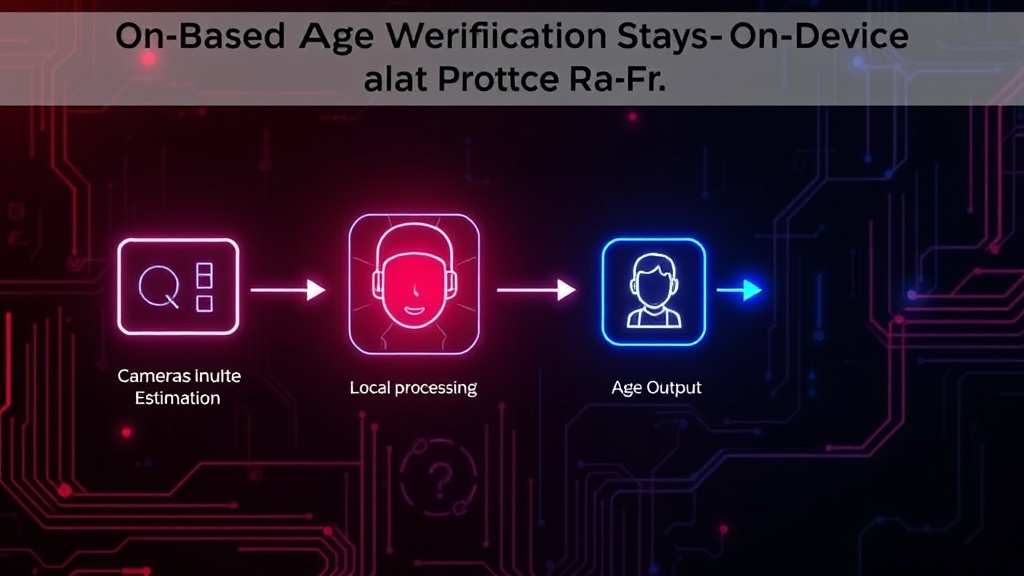
Incode's solution exemplifies this new paradigm. Instead of sending a user's photograph to a server for analysis, the entire age estimation process occurs locally on the user's smartphone or computer. When a user needs to verify their age, the application prompts them to look at their device's camera. The device's processing power then analyzes the captured facial features – such as the distance between facial landmarks, skin texture, and other subtle cues indicative of age – to estimate the user's age. This estimation is a complex machine learning task, trained on vast datasets of anonymized facial data, but the critical distinction is that the original image, or any identifying biometric template derived from it, never leaves the user's control.
The technology leverages advanced AI and machine learning algorithms. These models are trained to identify age-related patterns in facial geometry and appearance. Think of it less like a facial recognition system that tries to identify *who* you are, and more like a sophisticated system that analyzes the *characteristics* of your face to infer a specific attribute: your age. The output is a confidence score for a particular age range, not a definitive identity match. This on-device processing is crucial. It means that even if the device is compromised, the sensitive raw facial data is not exposed. The data processed and potentially stored is the *result* of the estimation (an age range or confirmation), not the source image itself.
Privacy and Security Benefits
The primary advantage of this on-device approach is a dramatic reduction in privacy risks. By eliminating the need to transmit or store facial images, companies significantly shrink their attack surface. There's no central database of facial scans to breach. This not only protects users from potential identity theft or misuse of their biometric data but also alleviates the immense responsibility and cost associated with securing such sensitive information. For businesses, this translates to lower compliance burdens under regulations like GDPR, CCPA, and emerging biometric privacy laws.
This technology acts as a privacy shield. Users can satisfy age verification requirements without having to surrender their most personal digital identifier. The implications for user trust are substantial. When users know their biometric data is being processed locally and never uploaded, they are more likely to engage with services that require age checks. This is particularly important for platforms targeting younger demographics who are increasingly aware of and concerned about digital privacy. The absence of data transmission also means faster verification times, as there's no network latency involved in sending data to a server and waiting for a response.
Regulatory Compliance and Future Outlook
As governments worldwide implement stricter age verification mandates, technologies like Incode's become essential tools for compliance. The European Union's Digital Services Act (DSA), for instance, requires platforms to implement robust age verification for certain services. Similarly, many US states are enacting laws requiring age verification for access to adult content or online gambling. The on-device, privacy-preserving model offers a way to meet these legal obligations without creating new privacy liabilities.
The future of age verification is clearly moving towards solutions that balance regulatory needs with user privacy. While challenges remain, such as ensuring the accuracy and fairness of AI models across diverse demographics and preventing sophisticated spoofing attempts, the on-device approach represents a significant leap forward. It transforms age verification from a potential privacy threat into a seamless, secure, and user-friendly experience. This shift is not just about technology; it's about building a more trustworthy digital environment where users can engage freely and safely, knowing their personal data is protected by design.