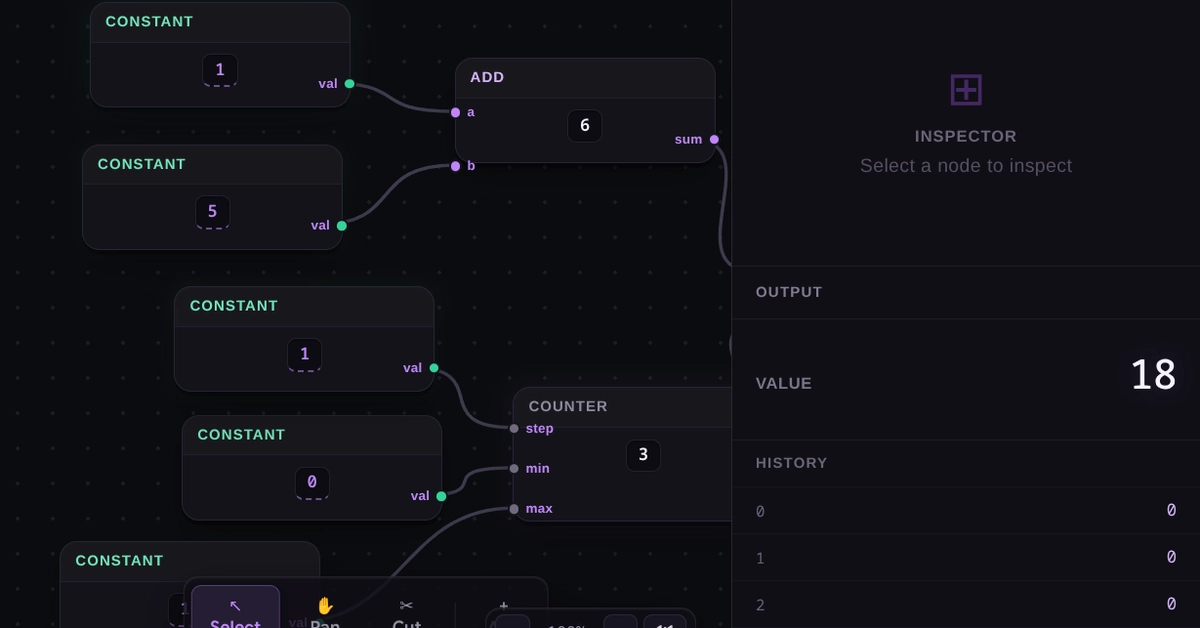
The Computational World Concept
What if altering a single parameter in a complex system instantly revealed its ripple effect across the entire architecture? This is the core question driving the development of Computational World (CW), also known as Simwire. This experimental, browser-based environment reimagines computation by treating the program itself as a dynamic graph. Unlike traditional programming paradigms where code is sequential and state changes are often managed explicitly, CW focuses on the flow of data through a network of nodes, where the structure of the graph dictates the computation.
The fundamental idea is to create a low-level dataflow environment that allows for deep experimentation with computational processes. The author, a developer named Mac, is building this system to explore how changes propagate and how systems behave under varying conditions. The emphasis is on immediate feedback, allowing users to visualize and understand the consequences of modifications in real-time. This approach is particularly valuable for understanding complex systems where emergent behaviors can be difficult to predict using conventional tools.
CW operates on a topological dataflow model. In this paradigm, computation is represented as a directed acyclic graph (DAG), where nodes represent operations or data sources, and edges represent the flow of data between them. The execution order is determined by the dependencies between nodes, rather than a predetermined sequence in a script. This naturally lends itself to parallel execution and makes it easier to reason about data dependencies and system state.
How Simwire Works: Nodes, Edges, and Propagation
At its heart, Simwire is built around the concept of nodes and edges. Each node in the graph performs a specific function, such as receiving input, performing a calculation, or outputting a result. Edges connect these nodes, carrying data from one node to another. When a value changes at a particular node, that change propagates through the connected edges to downstream nodes, triggering their execution or updating their state. This immediate propagation is the key differentiator.
Consider a simple analogy: imagine a Rube Goldberg machine. Each component (a lever, a ball, a ramp) is a node. The way they are connected dictates the sequence of actions. In Simwire, if you were to change the weight of the initial ball, you would immediately see how that affects the trajectory of subsequent balls, the tension on springs, and the final outcome. The graph is not just a representation of the program; it is the program. The structure and state of the graph define the computation.
The browser-based nature of CW makes it highly accessible. Developers can experiment with building and modifying these computational graphs directly in their web browser, without complex installation procedures. This lowers the barrier to entry for exploring advanced computational models. The environment is designed to be low-level, meaning it provides fine-grained control over the dataflow and computation, which is crucial for deep experimentation and understanding the fundamental mechanics of data propagation.
Applications and Future Potential
The potential applications for a system like Simwire are broad, particularly in domains that involve complex simulations, real-time data processing, and emergent system behavior. Fields like scientific computing, financial modeling, game development (for AI or physics simulations), and even intricate control systems could benefit from this direct, graph-centric approach to computation.
One of the most compelling aspects is its utility for debugging and understanding complex, distributed, or asynchronous systems. By visualizing the dataflow and the immediate impact of changes, developers can more easily identify bottlenecks, race conditions, or unexpected interactions between components. This is a significant advantage over traditional debugging methods that often require stepping through sequential code, which can obscure the root cause of issues in data-driven systems.
Furthermore, this model could fundamentally change how we think about programming for certain types of problems. Instead of writing imperative code, developers might focus on designing and composing computational graphs. This declarative approach, where the focus is on what needs to be computed rather than how, can lead to more robust and maintainable systems, especially as complexity scales.
The author's current work on Simwire is an ongoing experiment. The goal is to build a foundational environment that proves the viability of this graph-as-program paradigm. Future developments could include more sophisticated node types, advanced visualization tools, and potentially integration with other programming languages or hardware accelerators. The immediate feedback loop offered by Simwire is its strongest feature, promising a more intuitive way to explore and engineer complex computational processes.
The Unanswered Question: Scalability and Complexity Management
While the concept of a dataflow engine where the graph is the program is powerful for understanding immediate propagation, what remains to be seen is how effectively this model scales to truly massive, complex systems. When a graph contains thousands or millions of nodes and edges, managing that complexity and maintaining real-time visualization and interaction becomes a significant engineering challenge. How will Simwire handle the combinatorial explosion of potential states and interactions in large-scale applications? This question is critical for its adoption beyond experimental use cases and into production environments handling substantial computational loads.