The Inevitability of Event Schema Change
No event schema is static. As businesses mature, regulations shift, products introduce new features, and processes become more intricate, the data exchanged between services must evolve. This isn't an optional upgrade; it's the natural state of a system adapting to changing requirements. The initial assumption that an event can be simply updated as needed often crumbles in real-world scenarios. What starts as a single producer and single consumer relationship quickly blossoms into a complex web with multiple consumers, each operating on its own release schedule and possessing unique responsibilities.
Consider a common e-commerce scenario. An OrderConfirmed event might initially contain only the order ID and customer email. As the system grows, new requirements emerge:
- Shipping needs to track package dimensions and weight.
- Billing requires the customer's full address and payment method details.
- Marketing wants to include product recommendations and customer segmentation data.
Each of these additions necessitates changes to the OrderConfirmed event schema. Without a strategy for managing these changes, the system risks breaking.
Strategies for Event Schema Evolution
The core challenge lies in decoupling producers and consumers. Producers must be able to update their events without immediately breaking all downstream consumers. Conversely, consumers should be able to adopt new event versions at their own pace. This requires a robust versioning strategy.
1. Semantic Versioning for Events
Applying semantic versioning (SemVer) principles to events is a powerful approach. Each event type can be versioned, typically using a major.minor.patch scheme. A change in the major version signifies a breaking change – something that is not backward compatible. A change in the minor version indicates new, backward-compatible functionality. A patch version update suggests a backward-compatible bug fix.
For example:
OrderConfirmed_v1.0.0OrderConfirmed_v1.1.0(added a new optional field, backward compatible)OrderConfirmed_v2.0.0(removed a field, breaking change)
Producers can publish new event versions, and consumers can choose which versions they subscribe to and process. This allows for controlled upgrades. Consumers can continue processing older versions while gradually migrating to newer ones.
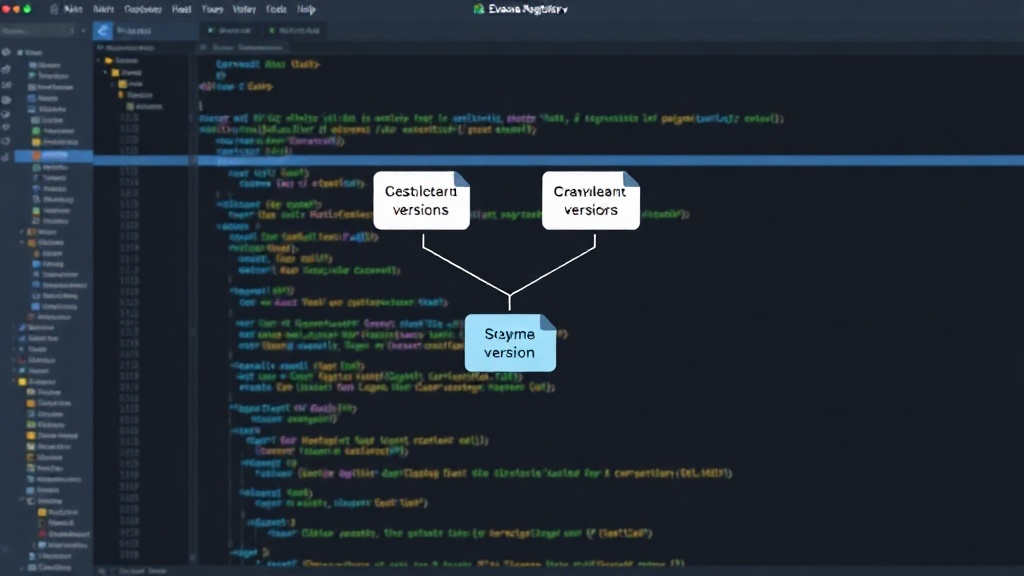
2. Schema Registries
A schema registry acts as a central repository for all event schemas. It stores schema definitions, tracks versions, and often provides validation capabilities. When a producer publishes an event, it registers its schema (or a new version of an existing schema) with the registry. Consumers can then query the registry to retrieve the schema definition they expect for a particular event version.
Tools like Confluent Schema Registry (for Kafka) or AWS Glue Schema Registry facilitate this. They ensure that all participants in the event stream are using compatible schema definitions. This prevents runtime errors caused by mismatched data structures.
3. Contract Testing
While schema registries enforce the *structure* of events, contract testing ensures that producers and consumers agree on the *meaning* and *behavior* associated with those structures. This is particularly vital for ensuring compatibility across different versions.
Contract testing involves defining contracts that specify how a producer will generate events and how a consumer expects to receive them. These contracts are then tested independently. For a producer, the test verifies that it can produce events conforming to the agreed-upon schema and version. For a consumer, the test verifies that it can correctly parse and process events from a specific producer version.
Pact is a popular tool for consumer-driven contract testing. In an event-driven context, this means:
- The consumer defines its expectations (the contract).
- The producer uses this contract to verify it's meeting the consumer's needs.
This process is repeated for each consumer, ensuring that the producer's output aligns with the requirements of all its subscribers, across different schema versions. This proactive testing catches integration issues early, before they manifest in production.
Events vs. Commands: A Clarification
It's crucial to distinguish between events and commands, as they serve different purposes in system design, especially in distributed systems.
- Events: Represent something that has happened in the past. They are facts. They are immutable and can be consumed by multiple interested parties. Example:
OrderShipped. - Commands: Represent an intent to perform an action in the future. They are requests to a specific service to do something. Commands are typically directed at a single recipient and are not immutable in the same way events are; they are acted upon and then potentially result in an event. Example:
ShipOrder.
In a well-designed system, a command is issued to a service, and upon successful execution, that service publishes an event. For instance, the ShipOrder command might be sent to the shipping service. If successful, the shipping service publishes an OrderShipped event. This clear separation of intent (command) and outcome (event) is fundamental to building reliable, observable systems.
Mixing these concepts leads to confusion. If a service receives a message that it interprets as both a command and an event, its behavior can become unpredictable. Commands imply a direct instruction and state change, while events are notifications of state changes that have already occurred.
The evolution of event schemas, coupled with rigorous versioning and contract testing, forms the bedrock of reliable event-driven architectures. By understanding and implementing these practices, teams can build systems that are not only adaptable but also resilient to the inevitable changes that come with growth.