
The Unseen Failure Mode
Every system that relies on asynchronous event processing faces a critical failure mode: a unit of work is accepted, a success is reported, but the work itself never executes. Standard logs, by their very nature, are incapable of reporting this specific failure. This isn't a matter of being difficult to find; it's a structural limitation. The system acknowledges the message and confirms its receipt, but whether the intended operation actually completed remains an unanswered question by the transport layer. The run history is truthful about the message delivery and server response, but silent on the actual execution status of the payload.
Measuring the Undetectable
This problem is particularly acute in no-code automation platforms. Developers and users are often more concerned with the accuracy of metrics than the results themselves. When measuring the frequency of such undetectable failures, the immediate question becomes 'how are you counting that?' This highlights the need for a robust, transparent methodology for defining and computing success metrics in event-driven systems.
Defining Computable Metrics
To address this, a clear specification is required. This specification must define precisely what constitutes a 'successful' run, what conditions must be excluded from the measurement, and the data contract necessary to make such computations possible. Without this, any reported success rate is suspect. The conditions a published number must meet before it holds any real meaning need to be rigorously established. This involves defining discrete states and ensuring that the system provides verifiable signals for each state, extending beyond mere message acknowledgment.
The Specification Framework
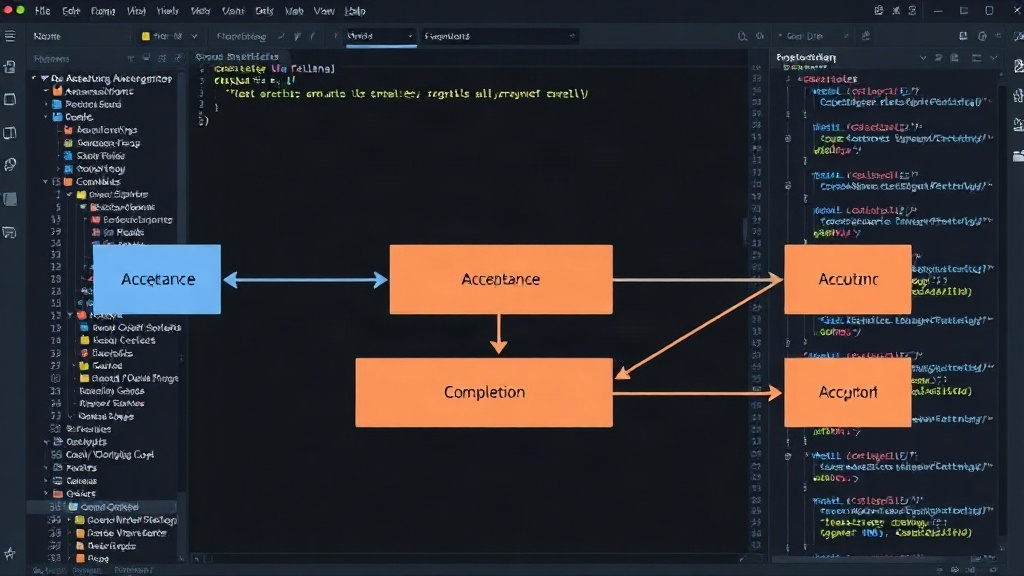
The core of the solution lies in establishing a data contract that ensures all relevant states of a work unit are observable. This contract would typically involve:
- Work Initiation Signal: A clear indication that a unit of work has been accepted for processing.
- Processing Signal: An event or log entry indicating that the system is actively working on the unit of work. This is distinct from mere acceptance.
- Completion Signal: A definitive signal that the work has been fully executed. This could be a success state or a failure state, both indicating that the operation was attempted and concluded.
- Failure-to-Execute Signal: A specific, observable event that occurs when the system accepts work but fails to initiate processing. This is the signal that current logging often misses.
The challenge is that many event-driven systems are designed to only report the first two signals, or implicitly assume that acknowledgment of acceptance implies eventual execution. Think of it less like a meticulously kept diary of every task undertaken, and more like a postal service that only confirms a letter was mailed, not that it was read or acted upon by the recipient. If the recipient's mail is lost before it reaches them, the postal service's record remains technically accurate but entirely misleading about the ultimate outcome.
Beyond Acknowledgment: The Need for Verifiable Outcomes
The implication for developers and system architects is profound. Relying solely on message queues and acknowledgment logs creates a blind spot. For systems where the actual execution of a task is critical—such as financial transactions, state changes in critical infrastructure, or user-impacting workflow completions—this blind spot can lead to severe operational failures that go undetected. The system might report 100% success for message delivery, while the actual business logic fails to run 5% of the time. This discrepancy erodes trust and leads to silent data corruption or missed operations.
The solution requires building mechanisms that provide end-to-end visibility. This could involve:
- Idempotent Operations with Verification: Ensuring operations can be retried safely and implementing checks that confirm completion, not just attempted processing.
- Distributed Tracing: Implementing comprehensive tracing that follows a request from its origin through all asynchronous services, capturing explicit state transitions.
- Dedicated Monitoring Services: Employing external services or dedicated internal agents that monitor the actual state of the work being performed, independent of the processing system's internal logs.
- Data Integrity Checks: Regularly auditing the state of the system to detect anomalies that would only arise from unexecuted work.
The effort to create a specification for computable metrics is not merely an academic exercise. It is a practical necessity for building reliable event-driven systems. Without it, we are operating with a false sense of security, unaware of the failures hidden within the very mechanisms designed to ensure reliability.
The Specification as a Contract
The author has published this methodology as a free, CC BY 4.0 licensed specification. This framework details what constitutes a verifiable metric, outlines exclusions for accuracy, defines the data contract for computability, and sets conditions for published numbers to be meaningful. This allows teams to move beyond vague assurances of success and towards measurable, verifiable outcomes. If you are building or operating event-driven systems where task completion is paramount, understanding and implementing such a specification is not optional—it's fundamental to operational integrity.