Ex-Apple Team Secures $150M for Privacy-First Smart Glasses
Even Realities, a startup founded by former Apple engineers, has secured a significant $150 million in Series B funding. The round values the company at $1 billion and was co-led by Chinese tech giants Meituan and Tencent. This substantial investment signals strong confidence in Even Realities' vision for the future of smart glasses, particularly their commitment to privacy by design.
The company's core differentiation lies in its decision to build smart glasses without cameras. This approach directly addresses growing public and regulatory concerns around data privacy and surveillance inherent in many current wearable and smart home devices. By omitting cameras, Even Realities aims to create a more socially acceptable and less intrusive augmented reality experience, focusing on information display and interaction rather than constant environmental recording.
The founding team's pedigree is a key factor in the company's rapid ascent. Comprising veterans from Apple's secretive AR/VR initiatives, they bring a deep understanding of hardware development, miniaturization, and user experience design at a scale few startups can match. This expertise is crucial for tackling the complex engineering challenges of creating sophisticated smart glasses that are both powerful and aesthetically unobtrusive.
Focus on Information, Not Surveillance
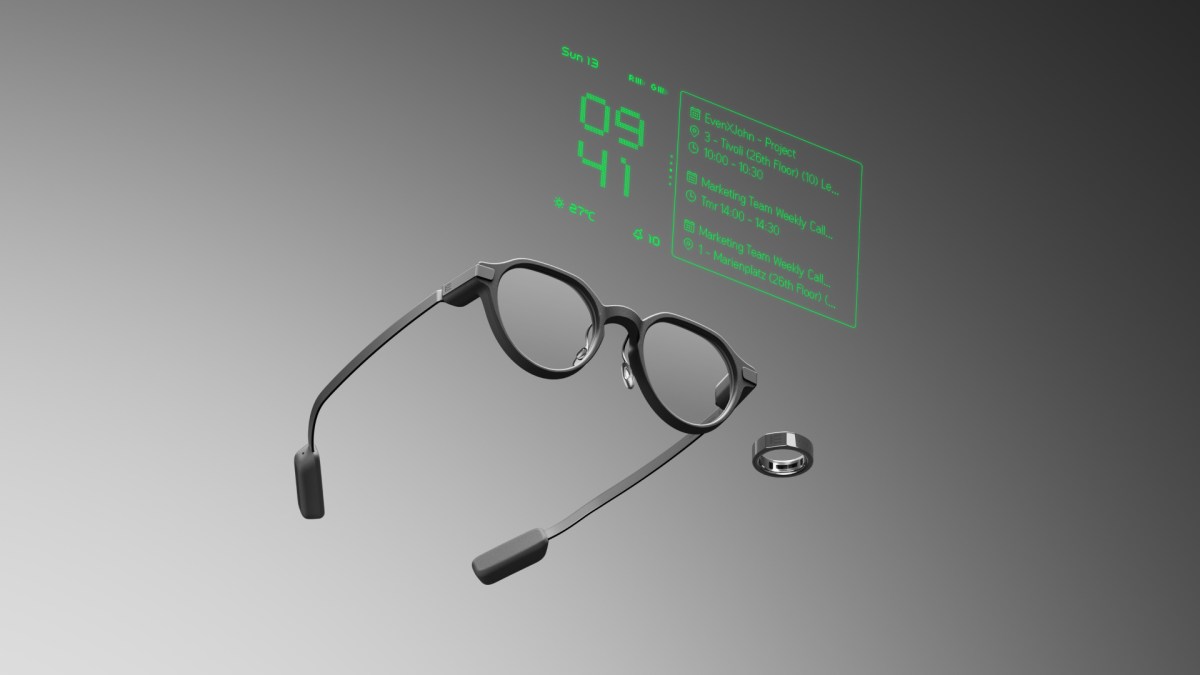
Even Realities' product philosophy centers on delivering contextual information and seamless interaction without the need for visual data capture. Imagine a heads-up display that provides navigation prompts, calendar alerts, message notifications, or real-time translation without requiring the device to 'see' the world around you. This camera-free design is not merely a feature; it's the foundational principle that shapes the entire product architecture and user experience.
The implications for user adoption are profound. Many consumers have shied away from smart glasses due to fears of being constantly recorded or the devices themselves being used for surveillance. Even Realities' approach directly counters these anxieties, positioning their product as a personal assistant and information conduit rather than a potential privacy invasion. This strategic choice could unlock a broader market segment that has been hesitant to embrace existing smart glass technologies.
The $150 million funding will be instrumental in scaling production, further R&D, and expanding the company's engineering and design teams. While specific product details remain under wraps, the company has hinted at a sleek, lightweight form factor that prioritizes long-term wearability. The focus will likely be on delivering a stable, intuitive operating system and a robust ecosystem of applications that leverage the unique capabilities of camera-free AR.

Strategic Backing from Tech Giants
The co-leadership of the funding round by Meituan and Tencent is a strategic coup for Even Realities. Meituan, a dominant Chinese on-demand service platform, and Tencent, a social media and gaming behemoth, bring not only capital but also invaluable market access and strategic partnerships within the vast Chinese consumer electronics and digital services landscape. Their investment suggests a belief that Even Realities' privacy-centric approach can capture significant market share, potentially integrating with their existing ecosystems.
This backing is particularly interesting given the competitive landscape. While many companies, including Meta and Google, have invested heavily in AR glasses, their approaches often involve cameras and sophisticated environmental mapping. Even Realities is carving out a distinct niche by prioritizing a user-friendly, privacy-conscious experience. The success of this strategy hinges on demonstrating that substantial AR functionality can be achieved without visual data capture, a challenge that few have seriously pursued.
What remains to be seen is how Even Realities will translate its privacy-first ethos into compelling, everyday use cases that go beyond simple notifications. Can they deliver a truly immersive or significantly enhancing augmented reality experience using only sensors like accelerometers, gyroscopes, and microphones, without the rich environmental context cameras provide? The engineering and software challenges are considerable, but the potential reward—a widely adopted, privacy-respecting smart glass—is immense.
The company's valuation at $1 billion, achieved relatively early in its lifecycle, underscores the market's appetite for innovative wearable technology that prioritizes user trust. As Even Realities moves towards product launch, all eyes will be on their ability to execute on this ambitious vision and prove that cutting-edge AR doesn't require compromising on privacy.