
The Challenge of LLM Evaluation
As large language models (LLMs) become increasingly sophisticated, so too does the need to reliably evaluate their outputs. Traditional metrics often fall short when dealing with nuanced, creative, or context-dependent responses. This has led to the emergence of using LLMs themselves as judges to assess the quality of other LLMs. However, a critical question arises: how do we judge the judge? This is the core problem addressed by a new open-source project aiming to provide a systematic framework for evaluating LLM-based evaluators.
The core idea is straightforward: if an LLM is to act as an arbiter of quality for other LLMs, its own judgment must be sound, consistent, and unbiased. Simply trusting an LLM to be an objective judge is a leap of faith that the current landscape of AI development cannot afford. Developers and researchers need concrete methods to verify the reliability of these AI evaluators before deploying them in critical applications.
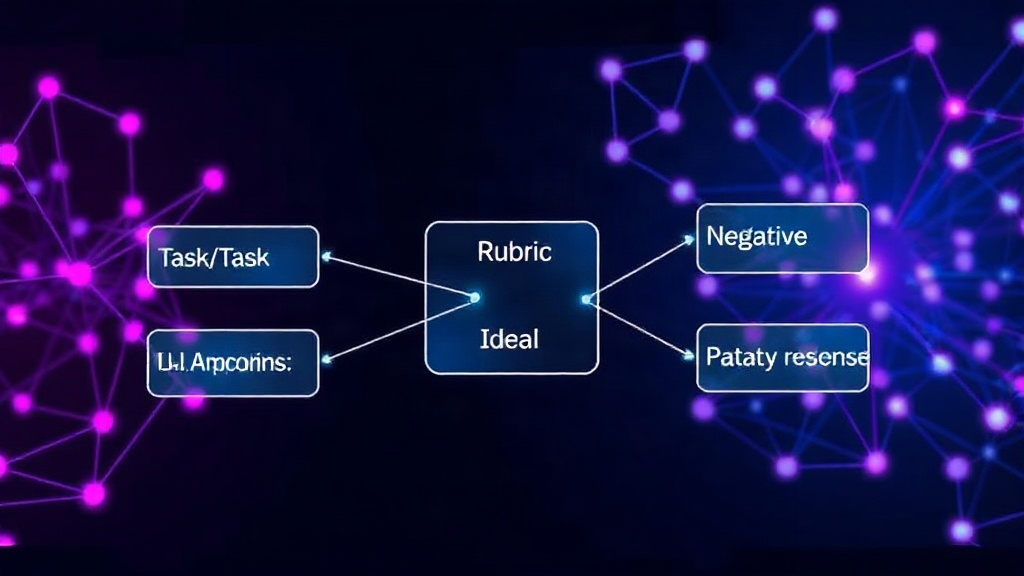
The process begins with defining a robust dataset. This dataset is not merely a collection of prompts and responses. Instead, it requires a structured approach that includes:
- Task: The specific objective or prompt given to the LLM being evaluated.
- Rubric: A clear set of criteria against which the responses will be judged. This is crucial for providing objective guidelines.
- Ideal Response: A pre-defined high-quality response that exemplifies adherence to the rubric.
- Negative Response: A response that, while not necessarily incorrect, is demonstrably less preferred according to the rubric. This helps test the judge's ability to differentiate subtle quality differences.
This structured dataset serves as the ground truth for testing the LLM judge. By presenting the judge with pairs of responses (or even single responses to be rated on an absolute scale) and comparing its judgment against the pre-defined ideal and negative examples, one can begin to quantify its performance.
Testing the Judge's Metacognitive Abilities
Beyond simple accuracy, a good LLM judge must exhibit several key characteristics. The evaluation framework aims to test for these by probing different aspects of the judge's behavior:
- Repeated-Run Consistency: Does the judge provide the same evaluation if presented with the same prompt and responses multiple times? Inconsistency suggests randomness or instability in the judge LLM's internal state or processing.
- Position Bias: LLM judges might exhibit a bias towards preferring the first or second response presented, irrespective of actual quality. Testing this involves systematically swapping the order of responses to see if the judgment changes.
- Sensitivity to Verbosity: How does the judge handle responses that are excessively long or unnecessarily brief, even if they contain the correct information? A good judge should penalize verbosity that detracts from clarity or conciseness, and recognize when brevity is optimal.
- Accuracy / Ability to Prefer the Better Response: This is the fundamental test. Does the judge consistently identify the 'ideal response' as superior to the 'negative response' when presented with both, aligned with the defined rubric?
The concept of a 'negative response' is particularly important. It doesn't always mean factually incorrect. It could be a response that is grammatically flawed, lacks necessary detail, is poorly formatted, or simply fails to meet the nuanced requirements outlined in the rubric. The judge's ability to discern these qualitative differences is a critical measure of its utility.
The project, currently an initial version with approximately 200 lines of code, is available on GitHub under the repository `judgeDjudge`. This demonstrates a pragmatic, developer-centric approach to tackling a complex AI problem. The focus is on building a functional, albeit simple, tool that can be iterated upon and improved.
Implications for LLM Development
The development of reliable LLM judges is not merely an academic exercise; it has direct, practical implications for the entire LLM ecosystem. For developers building applications powered by LLMs, a trustworthy evaluation framework means they can more confidently select, fine-tune, and deploy models. It provides a pathway to ensure that the LLM components integrated into their products meet desired quality standards.
Founders and product managers can leverage such tools to benchmark different LLM providers or custom-trained models, making informed decisions about which technology best suits their product roadmap and user experience goals. In a market where LLM capabilities are rapidly evolving, objective and reproducible evaluation is key to maintaining a competitive edge.
For the broader AI research community, this work contributes to the ongoing effort to develop more robust and interpretable AI systems. Understanding the limitations and biases of LLM judges is as important as understanding the limitations of the LLMs they are evaluating. This self-referential evaluation loop is essential for building more trustworthy AI.
The availability of open-source tools like `judgeDjudge` democratizes access to sophisticated evaluation techniques. It empowers individual developers and smaller teams to conduct rigorous testing without requiring massive computational resources or proprietary benchmarking suites. This fosters a more collaborative and transparent approach to AI development, accelerating progress and improving the overall quality of LLM applications.
What remains to be seen is how these evaluation frameworks will scale to handle the ever-increasing complexity and multi-modal nature of future LLMs. As models move beyond text to incorporate images, audio, and video, the rubrics and testing methodologies will need to evolve significantly. The current focus on textual consistency and bias is a vital first step, but the journey towards truly comprehensive LLM evaluation is far from over.