The Rejection and the Revelation
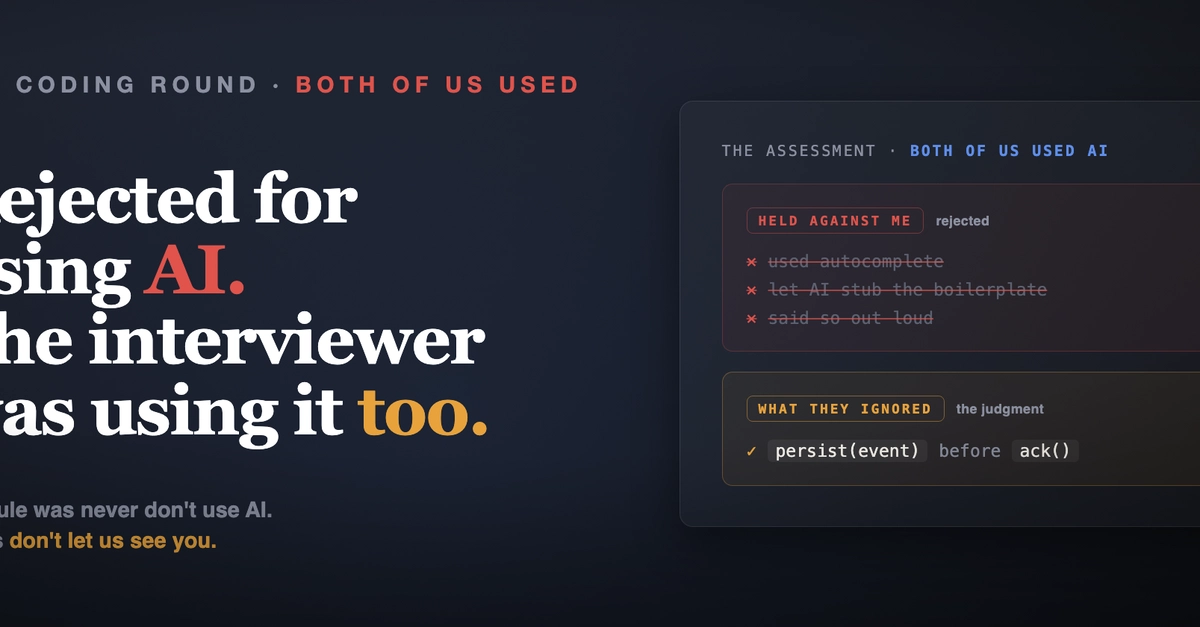
The email arrived on a Tuesday. Rejection is a familiar sting for most job seekers, but this one felt different. The feedback was polite, yet pointed: "While your technical skills are strong, we felt your reliance on AI tools during the assessment didn't reflect the independent problem-solving we're looking for." Rejected. For using AI. The irony was immediate and profound, because less than an hour prior, during the very same video call, the interviewer had demonstrably used an AI assistant himself.
The live-coding round was standard fare. A shared screen, cameras on, and a moderately complex problem: parsing unstructured data, transforming it into a structured format. It was the kind of task I tackle daily in my actual job. My approach was to break the problem into manageable parts, write the core logic myself, and then leverage an AI assistant to handle the boilerplate code. This allowed me to focus my cognitive energy on the critical edge cases and the nuances of the data transformation. I explicitly stated my process to the interviewer, explaining that I was using the AI to accelerate the more mundane aspects of the task, freeing me to concentrate on the higher-level problem-solving. I believed this was an honest and efficient way to demonstrate my capabilities.
The problem itself involved taking a log file with inconsistent formatting and extracting specific pieces of information into a JSON object. For instance, extracting user IDs, timestamps, and event types from lines that might read like "INFO: User 123 performed action 'login' at 2023-10-27T10:30:00Z" or "[WARN] User 456 triggered 'logout' event @ 2023-10-27 10:31:15". The goal was to create a clean array of JSON objects, each representing a distinct event with standardized keys.
As I worked, I encountered a particularly tricky edge case: timestamps that were sometimes in UTC and sometimes in a local timezone without an explicit offset. My thought process was to first implement the standard parsing for well-formed entries. Then, I would address the ambiguous timestamps. I described this plan aloud, and then I invoked my AI coding assistant to generate a function that could handle the initial, common timestamp format. The assistant provided a clean snippet of Python code that correctly parsed ISO 8601 strings. I reviewed it, made a minor tweak for a specific date format variation I anticipated, and integrated it.
It was at this point, while I was explaining how I would approach the more complex, ambiguous timestamp scenario, that I noticed the interviewer’s screen activity. He had a separate browser tab open, and on it, a familiar interface: a chatbot window. He wasn't just browsing; he was typing queries into it. His cursor moved from his IDE to the chatbot, he typed something, waited for a response, and then copied and pasted a block of code directly into his own editor, which was visible on his shared screen as he prepared to demonstrate a related concept.
The code he pasted looked suspiciously like boilerplate for handling date parsing – the very problem we were discussing. It was too coincidental. He quickly switched tabs, but not before I saw the distinctive blue-and-white chat bubble icon in his browser’s tab bar. It was the same AI assistant I was using, or a very similar one. He hadn't written it; he had generated it.
The Double Standard in AI-Assisted Development
The immediate disconnect between his actions and the company’s stated expectations was jarring. He was implicitly penalizing me for a practice he himself was employing, albeit perhaps more discreetly. This isn't just about fairness; it's about a fundamental misunderstanding, or perhaps a deliberate obfuscation, of how modern software development is evolving. AI coding assistants are no longer fringe tools; they are becoming integral to the developer workflow. They excel at generating repetitive code, suggesting optimizations, and even helping to debug complex issues. To reject a candidate for leveraging these tools is to reject a candidate who is working efficiently and effectively in a manner increasingly common in the industry.
The interviewer’s behavior suggests a company that wants the *benefits* of AI-assisted development – faster coding, fewer errors in boilerplate – but wants to maintain the *illusion* of purely human, unassisted problem-solving. This creates an impossible standard for candidates. If the expectation is that developers should not use AI, then companies themselves should not be using AI to evaluate candidates or to speed up their own internal processes. The hypocrisy lies in demanding a purity of method that the company itself is unwilling or unable to uphold.
This situation raises a critical question for the tech industry: What is the actual expectation when it comes to AI tools in the workplace? Are companies looking for developers who can write every line of code from scratch, a skill that is becoming increasingly rare and arguably less valuable than the ability to architect solutions and integrate tools effectively? Or are they looking for developers who can harness the power of AI to deliver results faster and more efficiently, while still understanding the underlying principles and being able to critically evaluate AI-generated output?
The feedback I received implies the former, while the interviewer's actions suggested the latter. This disconnect needs to be addressed. Companies need to be transparent about their expectations regarding AI tools. If AI assistance is acceptable, then candidates should be evaluated on their ability to use these tools effectively and ethically. If it is not acceptable, then the evaluation process itself must be free from any AI assistance, a standard that is proving difficult to maintain.
The broader implication is that many companies are likely adopting a similar stance: embracing AI behind the scenes while publicly maintaining a narrative of traditional, human-centric development. This creates a confusing and potentially unfair landscape for developers navigating the job market. It’s akin to a chef demanding a sous chef only use a knife, while the head chef is using a food processor and a sous-vide machine to prepare their own dishes.
Ultimately, the goal of any interview process should be to accurately assess a candidate's ability to perform the job. If AI tools are part of the modern developer's toolkit, then evaluating a candidate's proficiency with these tools, rather than penalizing their use, seems like a more pragmatic and forward-looking approach. The experience was a harsh lesson in the evolving, and sometimes contradictory, landscape of AI in professional software development.