Introduction
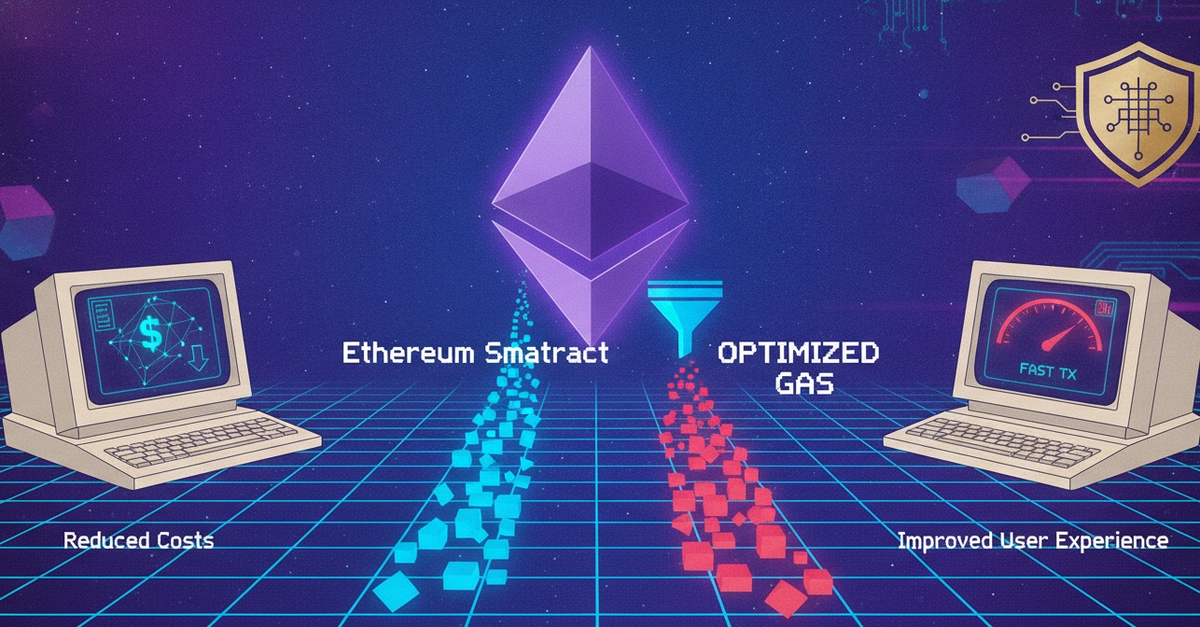
Gas is the fundamental unit of computational effort on the Ethereum blockchain. Every transaction, from a simple ether transfer to a complex smart contract interaction, requires gas. Users pay for this gas in Ether (ETH). Inefficient smart contracts translate directly into higher transaction fees for users, making dApps more expensive to use and less competitive. Optimizing gas usage is not just a technical nicety; it’s a critical factor for user adoption and the overall economic viability of decentralized applications on Ethereum.
This guide details essential gas optimization strategies that developers must implement to build cost-effective and performant smart contracts. By understanding how gas is consumed and applying these techniques, you can significantly reduce operational costs for your users.
Understanding Gas Costs
Each opcode executed within the Ethereum Virtual Machine (EVM) has an associated gas cost. Simple operations like addition or variable assignment have low costs, while more complex operations like storage writes, external calls, or SHA3 computations are significantly more expensive. The total gas cost of a transaction is the sum of the gas costs of all opcodes executed during its processing. Transaction fees are calculated as Gas Used * Gas Price. While users set the gas price they are willing to pay, developers control the Gas Used component through their contract design and implementation.
Understanding which operations are gas-intensive is the first step. Storage operations (SSTORE and SLOAD) are among the most expensive, as they involve writing to and reading from the Ethereum state. External calls, which interact with other contracts, also incur substantial gas costs due to the overhead of context switching and data serialization/deserialization.
Key Gas Optimization Techniques
Minimize Storage Writes
Writing to storage is one of the most expensive operations in Ethereum. Each SSTORE operation can cost upwards of 20,000 gas, depending on whether the storage slot is being written to for the first time (warm vs. cold access). Whenever possible, avoid unnecessary storage writes. Consider using memory variables for temporary calculations or intermediate states that do not need to be persisted on the blockchain.
If you must store data, try to pack related variables into a single storage slot. For example, instead of using separate boolean variables for `isOwner`, `isApproved`, and `isActive`, consider using a single uint8 or uint256 and using bitwise operations to store these flags. This reduces the number of SSTORE operations needed.
Efficient Data Types and Encoding
Use the smallest appropriate data types for your variables. For instance, if a variable will never exceed 255, use uint8 instead of uint256. While Solidity often pads smaller types to uint256 for operations, careful use of packing can still reduce storage and memory usage, and consequently, gas costs.
Be mindful of how data is encoded, especially for function arguments and return values in external calls. ABI encoding can be complex. For internal function calls or when passing data within the same contract, using memory arrays or structs can be more gas-efficient than repeatedly encoding and decoding data.
Optimize Loops and Array Operations
Loops are common sources of gas inefficiency. Iterating over large arrays can quickly consume significant gas. If possible, limit loop iterations or process data in smaller batches. For operations that require iterating over all elements, consider if a more efficient data structure, like a mapping, could be used. Mappings provide O(1) lookup time, which is often more gas-efficient than iterating through an array to find a specific element.
When reading from arrays, be aware of the gas cost difference between cold and warm reads. If you need to access multiple elements from the same array within a function, try to read them within a single loop or sequence of operations to benefit from warm storage access.
Leverage Mappings Over Arrays for Lookups
As mentioned, mappings are generally more gas-efficient than arrays for lookups. If you need to associate unique identifiers with data, a mapping is often the superior choice. For example, mapping addresses to user profiles or token IDs to ownership information. Arrays require iteration to find an element, whereas mappings offer direct access.
Minimize External Calls
External calls to other smart contracts are costly. They involve serializing arguments, sending them across the network, and deserializing them on the receiving end, plus the gas cost of the called function itself. If you find yourself making frequent external calls to the same contract for read operations, consider fetching all necessary data in a single call if the external contract supports it, or even caching frequently accessed data internally (though caching can add its own complexity and gas costs).
For write operations, batching is crucial. If a user action requires multiple state changes in other contracts, design your contract to perform these updates in a single, atomic transaction if possible, or provide a function that orchestrates these calls efficiently.
Use `immutable` and `constant` Keywords
Variables declared with immutable can only be set once during contract deployment and have their values baked into the contract's bytecode. This eliminates the need for storage reads for these variables, saving gas on every read. Similarly, constant variables are compile-time constants whose values are directly substituted into the code wherever they are used, incurring no runtime cost.
Careful Use of Events
Events are crucial for off-chain monitoring and dApp frontends, but they do consume gas. While generally less expensive than storage writes, emitting many events unnecessarily can add up. Ensure you only emit events that are truly needed for off-chain services or user interfaces. Indexed event parameters are more expensive than non-indexed ones because they require more work to store and retrieve from the blockchain.
Code Structure and Solidity Version
Always use the latest stable version of the Solidity compiler. Newer versions often include compiler optimizations that can reduce gas usage automatically. Additionally, structuring your code logically and avoiding redundant computations can naturally lead to more gas-efficient contracts.
The Cost of Inefficiency
Consider a simple scenario: a smart contract that needs to track the balance of thousands of users. If implemented using an array and iterating to find a user’s balance, each read/write operation could cost hundreds of thousands of gas, especially as the array grows. Using a mapping, the same operation might cost only tens of thousands of gas. Over time, for a popular dApp, this difference translates into significant savings for users. A dApp with high gas costs will struggle to compete with more efficient alternatives, potentially leading to user churn and a reduced network effect.
The surprising detail here is not just the cost itself, but how easily it can be overlooked by developers focused solely on functionality. A contract that works perfectly might still fail to gain traction if its operational cost makes it impractical for everyday use.
Conclusion
Gas optimization is an ongoing discipline in smart contract development. By diligently applying these techniques—minimizing storage writes, using efficient data types, optimizing loops, leveraging mappings, reducing external calls, and utilizing compiler features—developers can build more economical and user-friendly decentralized applications. Understanding the EVM's gas mechanics and prioritizing efficiency from the outset is key to creating successful and scalable dApps on Ethereum.