The Problem with Monolithic UI Libraries
For years, the go-to strategy for building React admin dashboards involved installing large, comprehensive UI libraries like Material UI (MUI) or Ant Design. These libraries offer a vast array of pre-built components, enabling rapid prototyping and initial development. However, as projects scale and evolve, developers often encounter significant drawbacks. The primary issues include fighting CSS specificity wars, the laborious task of overriding inline styles to achieve custom designs, and the considerable bloat introduced into the JavaScript bundle size. This complexity can hinder performance and slow down development velocity over time.
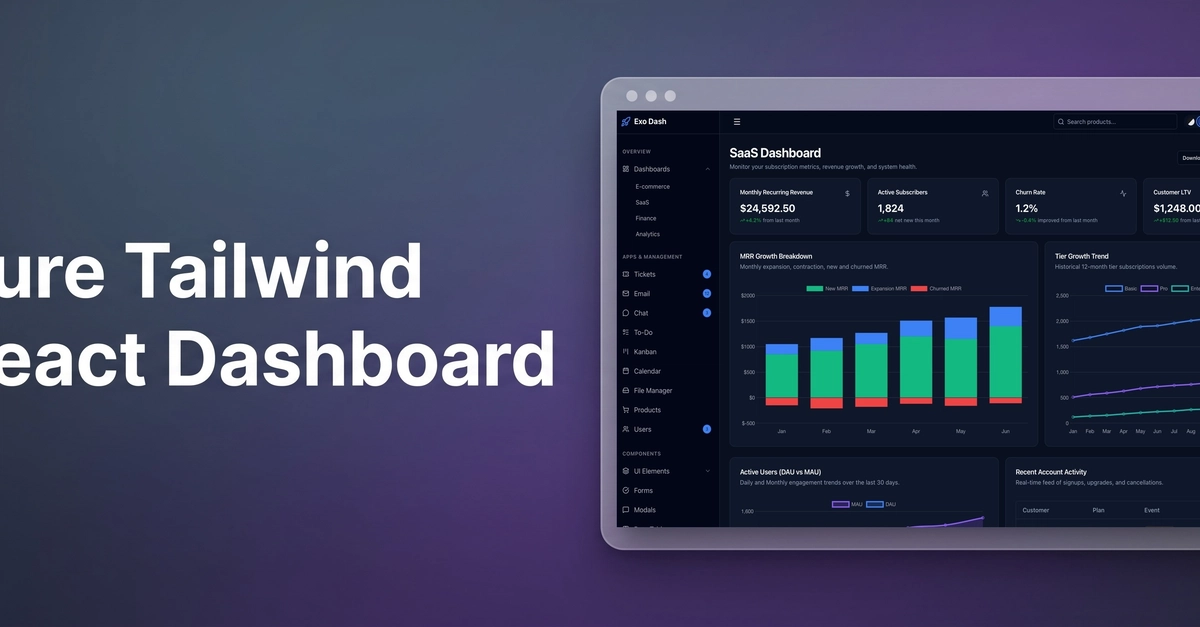
The author, seeking a more streamlined and performant approach, aimed to break away from this conventional workflow. The goal was to establish an architecture that provides complete design autonomy without compromising on application speed or developer experience. This led to the creation and open-sourcing of Exo-Dash, a dashboard boilerplate designed with these principles in mind.
Exo-Dash: A Primitive, Tailwind-Centric Approach
Exo-Dash is built on a foundation that prioritizes a lightweight, primitive UI architecture, drawing inspiration from patterns popularized by libraries like shadcn-ui. This approach fundamentally differs from monolithic libraries by avoiding the inherent CSS conflicts that arise from extensive component overrides. Instead of importing and potentially overriding entire component libraries, Exo-Dash utilizes a system of composable primitives. This grants developers unhindered control over the markup and styling of every element within the dashboard.
The core of this architecture involves leveraging Tailwind CSS, specifically v4, which is known for its utility-first approach and performance optimizations. By using Tailwind, developers can apply styles directly through class names, leading to more predictable and maintainable CSS. This also means that the styling is tightly coupled with the component structure, reducing the need for separate CSS files or complex style management solutions.
The structure is designed to be highly modular. Instead of installing a large dependency that brings hundreds of unused components and styles, developers can selectively import only the UI primitives they need. This granular control over dependencies directly contributes to a smaller JavaScript bundle size, which is crucial for frontend performance, especially in complex applications like dashboards where numerous components might be rendered.
React 19 and Server Components
The choice of React 19 is significant, particularly with its enhanced support for features like Server Components. Server Components allow parts of the UI to be rendered on the server, reducing the amount of JavaScript that needs to be shipped to the client. This can lead to faster initial page loads and improved performance, especially for content-heavy dashboards that might otherwise struggle with client-side rendering bottlenecks.
By building Exo-Dash on React 19, the boilerplate is positioned to take full advantage of these modern React capabilities. This means that developers using Exo-Dash can benefit from server-driven UI rendering, better code splitting, and more efficient data fetching strategies, all contributing to a superior user experience. The primitive UI approach complements this by ensuring that even the client-side rendered components are as lean as possible, minimizing the impact of client-side JavaScript.
The development experience is also enhanced. With Server Components, the separation between server-rendered and client-rendered logic becomes clearer. Developers can decide which parts of the dashboard should be static and server-rendered for maximum performance, and which parts require client-side interactivity. This architectural clarity, combined with the flexibility of Tailwind CSS and the composability of primitive UI elements, creates an environment where complex dashboards can be built efficiently and maintained with less friction.
Variant Management and Design Tokens
A key aspect of managing a consistent design system, even with a primitive architecture, is effective variant management and the use of design tokens. Exo-Dash implements a system where components can have multiple visual variants (e.g., primary, secondary, destructive buttons; outlined or filled cards) that are easily configurable. This is achieved through a combination of Tailwind CSS's utility classes and a well-defined set of design tokens.
Design tokens act as the single source of truth for design decisions like colors, typography, spacing, and border-radius. By abstracting these values into tokens, the entire application's look and feel can be updated by modifying a central set of values. This is far more efficient than manually changing styles across hundreds of components. For example, if the brand’s primary color needs to change, updating the primary color token in Tailwind's configuration (or a dedicated token file) will propagate the change across all components that use that token.
This approach ensures that while developers have complete control over the markup and can create unique component variations, the overall design remains cohesive and adheres to the established design language. It strikes a balance between the flexibility offered by Tailwind and the consistency required for a professional UI.
Developer Experience and Performance Trade-offs
The decision to move away from heavy UI kits and embrace a primitive, Tailwind-centric architecture like Exo-Dash is fundamentally about optimizing for developer experience and application performance. The trade-off is a slightly steeper initial learning curve compared to dropping in a fully-featured library. Developers need to understand Tailwind CSS deeply and how to compose primitive components effectively.
However, the long-term benefits are substantial. Reduced bundle sizes lead to faster load times, which directly impacts user engagement and conversion rates. The elimination of CSS specificity conflicts and the ease of customization mean that developers spend less time fighting the framework and more time building features. Debugging becomes simpler because styles are applied directly via utility classes, and the component structure is more transparent.
For founders and teams looking to build scalable, high-performance web applications, this architectural choice offers a compelling path forward. It empowers developers with the tools to create unique, performant interfaces without being constrained by the limitations of pre-packaged, often rigid, UI component libraries. The open-source nature of Exo-Dash further lowers the barrier to entry, allowing teams to adopt and adapt the boilerplate to their specific needs.