The Hidden Cost of Historical Data Access
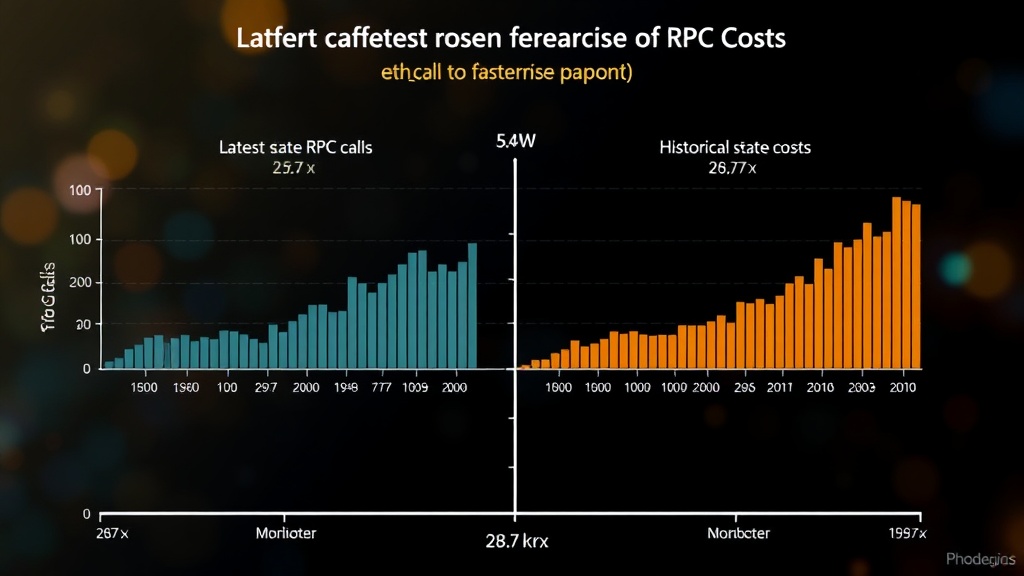
Developers querying historical Ethereum blockchain data via RPC endpoints are facing unexpectedly high costs, often 26.7 times more expensive than current state queries. This significant cost multiplier stems from a subtle but critical behavior: when RPC providers receive a request specifying a historical blockNumber for methods like eth_call, eth_getBalance, or eth_getLogs, these requests are automatically routed to the provider's archive tier. This tier, which stores every historical state of the blockchain, is inherently more resource-intensive and thus more expensive to operate than nodes that only track the latest state.
The issue was identified by the team at OpenChainBench when their RPC cost dashboard projected an overage of over $4,000 for a single billing cycle on one provider, despite their services appearing to perform normal eth_call operations. The culprit wasn't the operation itself, but a common pattern buried within the client code that developers frequently use without realizing its cost implications. This pattern involves querying specific historical states of smart contracts or account balances, a seemingly innocuous operation that, under the hood, forces a deep dive into the blockchain's extensive history.
RPC providers offer different service tiers to manage costs and performance. 'Archive' nodes store the complete history of the Ethereum blockchain, including the state of every account and contract at every block. This is essential for deep historical analysis, debugging, and auditing. In contrast, 'pruned' or 'full' nodes typically store recent states and only a limited history, significantly reducing storage and computational requirements. When a developer specifies a block number far in the past (e.g., block 10,000,000), the RPC provider must access its archive tier to retrieve the requested state. This archival data is far larger and more complex to query than the readily available latest state, leading to increased computational load on the provider's infrastructure. This load is then passed on to the end-user in the form of higher RPC costs.
Understanding the Mechanism
The core of the problem lies in how RPC providers interpret requests. Standard RPC calls to latest or recent block numbers are handled by optimized, often pruned, nodes. However, any request that specifies a historical block number, even if it's only a few hundred blocks in the past, triggers a different processing path. The provider's infrastructure detects the historical block number and reroutes the query to their archive node cluster. This routing is often invisible to the end-user, as it's an internal mechanism of the RPC service.
Consider a simple smart contract interaction, like checking a token balance at a specific past block. The client sends a request to the RPC endpoint with the contract address, the function to call (e.g., balanceOf), and the historical blockNumber. The RPC provider receives this, identifies the historical block, and instead of querying a fast, readily available node, it must traverse its vast archive to reconstruct or retrieve the exact state of the contract at that precise moment. This process is computationally far more demanding. It's akin to asking a librarian for a book that's currently on the shelf versus asking for a book that was checked out, archived, and needs to be retrieved from deep storage – the latter takes significantly more effort and time.
The 'Archive Multiplier' effect is amplified by the sheer volume of historical data. Ethereum's mainnet alone has hundreds of millions of blocks. Accessing and processing the state at any given historical block requires traversing a significant portion of this history, especially if the state has changed frequently. For smart contracts with complex state transitions, the computational cost to accurately determine their state at a specific historical block can be substantial. This is why archive nodes require vastly more disk space and processing power than nodes that only track the latest state.
Measuring Your Own Exposure
To help developers understand and mitigate these costs, OpenChainBench has published specific Prometheus queries. These queries can be integrated into existing monitoring systems to track RPC usage patterns and identify instances where historical block calls are being made. By monitoring these queries, development teams can gain visibility into their own archive RPC consumption, allowing them to optimize their code and reduce unexpected expenses.
One key pattern to watch for is repeated calls to the same historical block, or calls to blocks that are not strictly necessary for the application's current functionality. For instance, if an application only needs to verify a transaction that occurred recently, but it's configured to query a block from months ago, it's unnecessarily incurring archive costs. Developers should critically assess the necessity of historical data for each RPC call. If historical data is indeed required, it's crucial to understand the associated costs and potentially explore alternative solutions, such as running your own archive node (though this is a significant undertaking) or using specialized historical data services that might offer more predictable pricing.
The surprising detail here is not the existence of archive nodes, which are a known necessity for deep blockchain analytics, but how easily and silently standard RPC calls can be rerouted to them, leading to cost surprises. Most developers assume that eth_call is a relatively uniform operation, regardless of the block number. This article reveals that the block number is a critical parameter that dictates not just the data returned, but the entire operational cost and infrastructure path taken by the RPC provider.
Mitigation Strategies
The primary mitigation strategy is to avoid querying historical blocks unless absolutely necessary. For most applications, querying the latest block is sufficient. If historical data is required for auditing, debugging, or specific application logic, developers should:
- Optimize Block Number Specification: Only request historical data for the specific block ranges absolutely needed. Avoid broad or unnecessary historical queries.
- Cache Results: If historical data for a particular block or range is accessed frequently, cache the results client-side or in a dedicated database to avoid repeated RPC calls.
- Consider Data Availability Services: For applications requiring extensive historical data, explore specialized services that aggregate and serve historical blockchain data, as they may offer more predictable pricing models than general-purpose RPC providers.
- Run Your Own Node: For high-volume or mission-critical historical data needs, running a self-hosted archive node can provide cost control and data sovereignty, though it requires significant infrastructure investment and maintenance.
The OpenChainBench benchmarks provide a valuable resource for understanding the performance and cost characteristics of various RPC providers. By leveraging this data and implementing proper monitoring, developers can navigate the complexities of blockchain data access and avoid the hidden costs associated with historical queries.