
Etched's Bold Claim: AI Inference Without GPUs
In a market saturated with AI hardware vying for supremacy, Etched has emerged with a bold proposition: to accelerate AI model inference without requiring the ubiquitous Graphics Processing Units (GPUs) that currently dominate the landscape. The startup, founded by three Harvard dropouts, announced a staggering $10.3 billion valuation following a funding round that saw participation from significant, though unnamed, big-name investors. This valuation, especially in the current economic climate, signals strong confidence in Etched's novel approach to AI acceleration.
At the heart of Etched's technology are custom-designed chips and integrated memory components. The company claims these innovations enable AI models to perform inference tasks at speeds that rival or surpass GPU-based solutions, while crucially consuming less power and operating with greater efficiency. This is particularly significant for inference, the process of deploying a trained AI model to make predictions on new data, which is becoming increasingly critical as AI applications proliferate across industries. Traditional inference often relies on powerful, energy-intensive GPUs, creating bottlenecks for deployment in edge devices, data centers, and even personal computing environments.
The Technical Edge: Memory-Centric Inference
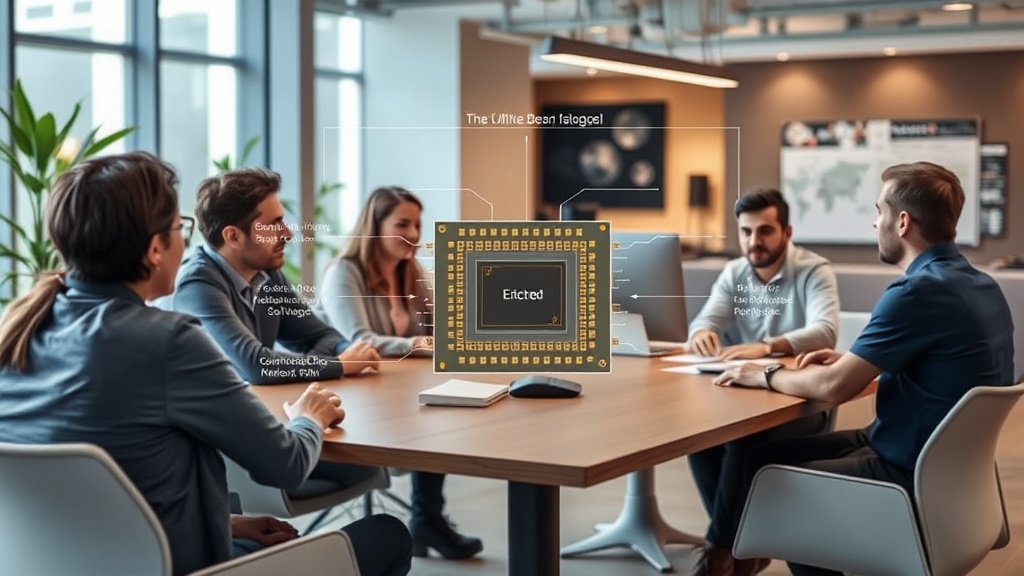
Etched's differentiation lies in its memory-centric design. Instead of relying on off-chip memory access patterns that are typical for GPUs, Etched's architecture integrates high-bandwidth, low-latency memory directly with its processing units. This architectural shift is designed to drastically reduce the time and energy spent moving data between memory and compute cores – a major performance limiter in conventional AI hardware. By keeping data closer to the processing elements, Etched aims to achieve near-instantaneous access, which is paramount for real-time AI applications such as natural language processing, computer vision, and recommendation systems.
The company's proprietary chips are engineered to handle the specific computational demands of deep learning inference. While GPUs are highly parallel and excel at training massive models, their architecture can be less optimized for the often sequential and varied workloads of inference. Etched claims its architecture is more flexible, capable of efficiently running a wide array of AI models, from large language models (LLMs) to smaller, specialized neural networks, without the need for extensive re-optimization that often accompanies shifts between hardware platforms.
Defying Skepticism in a Crowded Market
The AI hardware market is intensely competitive, with established giants like NVIDIA, Intel, and AMD, alongside numerous well-funded startups, all vying for market share. Many of these players are also investing heavily in GPU technology and specialized AI accelerators. Etched's ability to achieve such a high valuation suggests that its technological claims have resonated strongly with investors, potentially offering a solution to a critical pain point: the cost and power inefficiency of GPU-dependent AI inference.
The skepticism Etched reportedly faces likely stems from the immense technical challenges in developing new semiconductor architectures and the entrenched dominance of existing players. Building a new chip from the ground up is an extraordinarily capital-intensive and time-consuming endeavor, fraught with manufacturing complexities and the need for extensive software ecosystem support. However, the company's founders, having dropped out of Harvard to pursue this venture, appear to have navigated these hurdles with remarkable speed and success, at least from a funding perspective.
What This Means for the AI Ecosystem
If Etched's technology delivers on its promises, it could significantly alter the landscape of AI deployment. For developers, it means potentially greater flexibility in where and how they deploy AI models, unburdened by the need for specific, high-power GPU hardware. This could democratize AI by making sophisticated inference capabilities more accessible and affordable for a broader range of applications, including mobile devices, IoT sensors, and even embedded systems where power and thermal constraints are severe.
For businesses, the implications are equally profound. Reduced reliance on expensive GPUs for inference could lead to substantial cost savings in data center operations and a faster return on investment for AI initiatives. Furthermore, the promise of lower power consumption aligns with growing environmental concerns and the increasing demand for sustainable computing solutions. This could also open new avenues for AI applications that were previously impractical due to hardware limitations.
The Road Ahead: Scaling and Adoption
The $10.3 billion valuation is a strong signal of investor belief, but the true test for Etched will be in market adoption and the ability to scale production. The company must now prove that its chips can be manufactured reliably at scale, that its software stack is robust and developer-friendly, and that its performance claims hold up under real-world, diverse workloads. The absence of GPUs for inference is a significant departure, and convincing developers and enterprises to shift their established workflows will require not only superior technology but also a compelling ecosystem of tools and support.
The success of Etched could also spur further innovation in specialized AI hardware, pushing the boundaries of what's possible in terms of efficiency and performance. As AI continues its relentless march into every facet of technology and business, the demand for optimized hardware solutions will only grow. Etched's ambitious trajectory suggests it aims to be at the forefront of this evolution, offering a distinct alternative to the GPU-centric paradigm.