Behavioral Detection Engine at the Core
ET Ducky, a new Remote Monitoring and Management (RMM) tool, is set to launch on Product Hunt on Tuesday, September 29. Its core innovation lies in its behavioral rule engine, designed for real-time ransomware detection across both Windows and Linux environments. The system operates by reading kernel event streams from each endpoint. On Windows, this is achieved through Event Tracing for Windows (ETW), while on Linux, it utilizes eBPF (extended Berkeley Packet Filter) tracepoints. A key design choice is the funneling of these OS-specific events into a single, unified event format. This allows each of the thirteen built-in detection rules to function identically, with a single configurable definition applicable to either operating system.
The engine's architecture prioritizes speed and responsiveness. Rules execute on the same thread responsible for delivering kernel events. This mandates that no rule can ever block or introduce significant latency, as doing so would impede the event stream. To manage potential noise and ensure actionable alerts, the engine is intentionally tuned to favor a higher rate of false positives over missed threats (false negatives). This approach ensures that suspicious activity is flagged, even if occasional legitimate actions trigger an alert. To mitigate alert fatigue from repeated detections of the same pattern, per-process cooldown periods are implemented. Furthermore, the dashboard aggregates and deduplicates identical alert firings, presenting a cleaner overview to the operator.
Key Behavioral Detection Rules Explained
ET Ducky employs several specific behavioral rules to identify common ransomware tactics. Two prominent examples illustrate its detection methodology:
Mass File Rename Detection
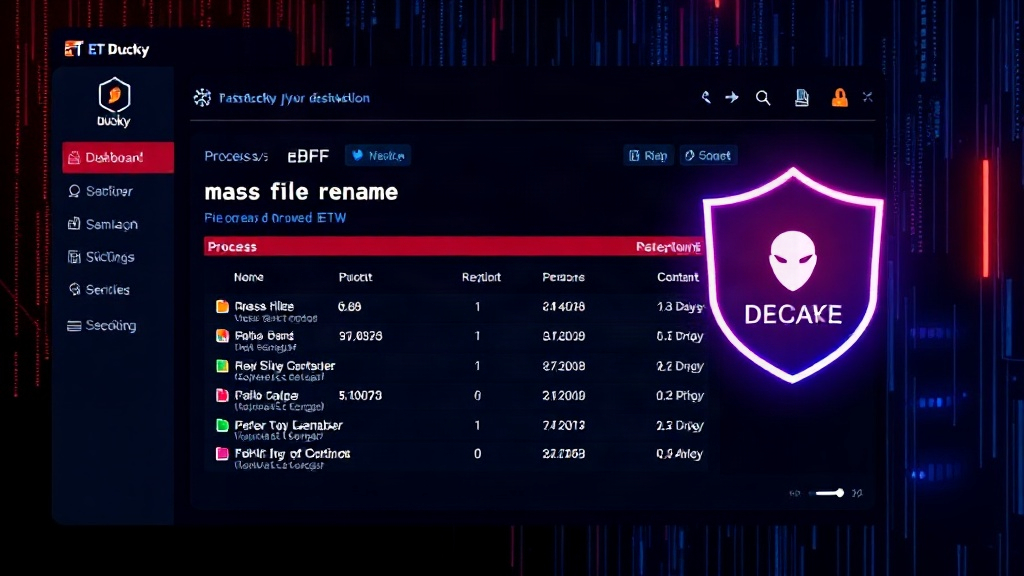
The mass-file-rename rule triggers when a single process attempts to rename 25 or more files within a 60-second window. This pattern is characteristic of ransomware that appends new extensions to encrypted files (e.g., changing `document.txt` to `document.txt.locked` or `document.txt.xyz`). By monitoring the frequency and volume of file rename operations associated with a specific process, ET Ducky can identify this aggressive file modification behavior. The threshold of 25 files and the 60-second window are configurable parameters, allowing administrators to tune the sensitivity based on their environment's typical file operation patterns.
File Encryption Sweep Detection
The file-encryption-sweep rule is designed to detect the rapid encryption of files. It fires when a process performs 20 or more file modifications (specifically, writes that change the file's content) with the same destination extension within a 30-second period. This rule targets the core action of ransomware: encrypting user data and often marking it with a specific, unique extension. The destination extension parameter is crucial here. If multiple files are being written with a consistent, new extension within a short timeframe, it strongly suggests an automated encryption process at work. Like the rename rule, the specific counts (20 files) and time window (30 seconds) are adjustable via policy settings, enabling adaptation to different operational needs and risk appetites.
Cross-Platform Unified Eventing
The unification of ETW and eBPF event streams is a significant engineering feat. ETW provides a robust, built-in tracing infrastructure on Windows, offering detailed insights into system and application activity. eBPF, on the other hand, offers unparalleled flexibility and performance for kernel-level instrumentation on Linux. By abstracting these distinct mechanisms into a common event format, ET Ducky achieves true cross-platform parity in its detection capabilities. This means a security team managing a mixed Windows and Linux fleet can deploy and manage a single set of detection policies without needing OS-specific rule sets. The developer, who is the source of this information, emphasizes this unified approach as a cornerstone of ET Ducky's design, aiming to simplify security operations for heterogeneous environments.
Operational Considerations and Future Development
The engine's design philosophy, favoring false positives over false negatives, implies a need for effective alert triage. Administrators using ET Ducky will need established procedures to quickly investigate and dismiss legitimate alerts. The per-process cooldown and dashboard deduplication are critical components in making this manageable. While the current rules focus on file modification patterns, the underlying architecture of consuming kernel event streams is extensible. Future rules could potentially target other ransomware behaviors, such as suspicious process injection, unusual network connections, or attempts to disable security software, all derived from the rich telemetry provided by ETW and eBPF.
The choice to launch on Product Hunt suggests a focus on early adopters and community feedback. This approach can be invaluable for refining the behavioral rules and improving the accuracy of the detection engine based on real-world usage. The success of ET Ducky will depend not only on the technical merits of its cross-platform detection but also on its usability and the effectiveness of its alert management features in a live security operations center (SOC) environment.