
The Challenge of Verified Embedded Code
Developing reliable embedded systems, especially those deployed on microcontrollers like those common in the Arduino ecosystem, presents a significant challenge. Traditional testing methods often fall short of guaranteeing the absence of critical bugs, particularly those that manifest under specific, hard-to-reproduce conditions. This is where formal verification methods promise a higher degree of assurance, mathematically proving program properties. However, the complexity and steep learning curve associated with these methods have historically confined them to high-assurance domains like aerospace and critical infrastructure, far removed from the hobbyist and rapid prototyping world of Arduino.
The core issue is the deployment gap: a chasm separating the theoretical power of formal verification from its practical application in widely used, resource-constrained development environments. Tools that exist for formal verification are often designed for full-fledged operating systems or high-performance computing, requiring extensive setup, specialized knowledge, and significant computational resources. Adapting these powerful techniques to the constraints and typical workflows of microcontroller development, particularly for platforms as ubiquitous as Arduino, has been a persistent hurdle.
Introducing ESBMC-Arduino
The ESBMC-Arduino toolchain directly addresses this deployment gap. It integrates the Extended Static Model Checker for C (ESBMC) with the Arduino development environment. ESBMC is a sophisticated tool that employs symbolic execution to automatically check for software defects. By porting and adapting ESBMC to the specific architecture and toolchains used by Arduino, developers can now leverage these advanced verification capabilities without leaving their familiar development paradigm.
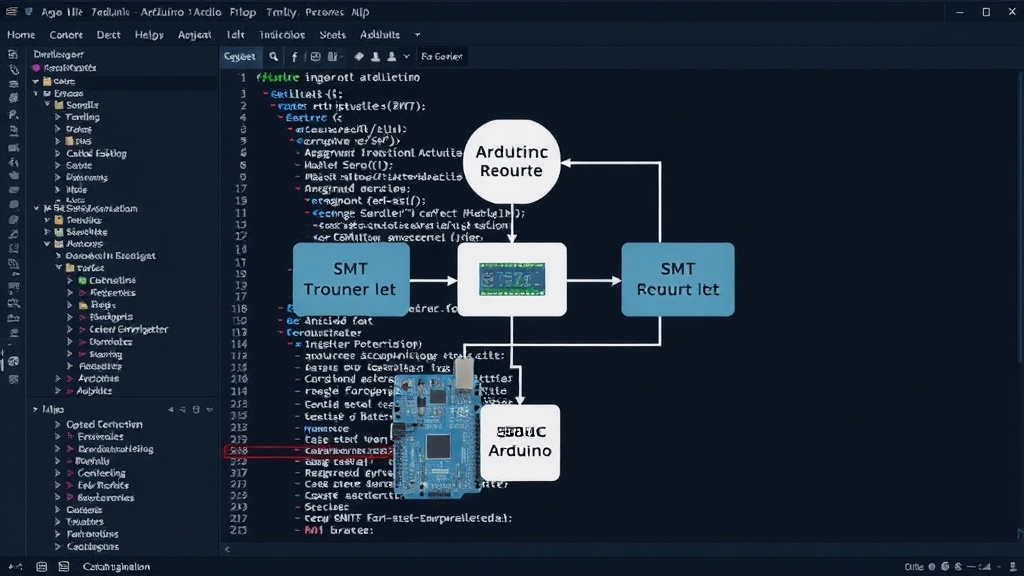
This integration means that developers can write their Arduino sketches and then, with minimal additional effort, employ ESBMC to analyze them. The tool can automatically discover a wide range of bugs, including buffer overflows, division by zero, and other runtime errors, by exploring all possible execution paths of the code. This is achieved by translating the C/C++ code of an Arduino sketch into a format that ESBMC can analyze, often involving the generation of verification conditions that are then passed to an SMT (Satisfiability Modulo Theories) solver.
How ESBMC-Arduino Works
The process begins with the standard Arduino development environment, where a developer writes their code in C/C++ and uses the Arduino IDE. Once the code is ready for verification, ESBMC-Arduino takes over. It preprocesses the sketch, handling Arduino-specific libraries and hardware abstractions. This preprocessed code is then fed into ESBMC, which performs symbolic execution. During symbolic execution, program variables are treated as symbolic values, allowing the checker to explore all possible branches of computation.
The tool aims to find violations of properties, which can be explicitly stated by the user or implicitly checked by ESBMC itself (e.g., absence of runtime errors like null pointer dereferences or integer overflows). If ESBMC finds a bug, it generates a counterexample – a concrete execution trace that demonstrates the bug. This trace is invaluable for developers, as it pinpoints the exact location and conditions under which the error occurs, significantly speeding up the debugging process. If no bugs are found after exploring all reachable states (or a specified bound), the tool can provide a high degree of confidence in the code's correctness with respect to the checked properties.
Closing the Deployment Gap
The true innovation of ESBMC-Arduino lies in its accessibility. It doesn't require developers to become formal verification experts or to master intricate, unfamiliar toolchains. Instead, it plugs directly into the existing, widely adopted Arduino workflow. This dramatically lowers the barrier to entry for formal methods, making them a practical option for a much broader audience.
Consider the analogy of learning a new language. Previously, using formal verification was like needing to learn ancient Greek to read a specific philosophical text. ESBMC-Arduino, on the other hand, is like having a fluent interpreter who can translate that text into your everyday language, allowing you to understand its wisdom without the years of linguistic study. This democratization of advanced verification techniques is crucial for improving the safety and reliability of the billions of embedded devices that are becoming integral to our daily lives.
The impact extends beyond hobbyists. Professional engineers developing IoT devices, industrial control systems, or automotive components using Arduino-compatible microcontrollers can now integrate a stronger verification step into their development cycles. This can lead to more robust products, reduced development costs associated with bug fixing late in the cycle, and ultimately, enhanced user safety and trust.
What This Means for Embedded Development
The ESBMC-Arduino toolchain signals a shift towards more rigorous software development practices in the embedded space, particularly for microcontroller-based systems. It democratizes access to powerful bug-finding capabilities, moving formal verification from the realm of academic research and specialized industries into the hands of everyday developers.
For developers, this means an opportunity to build more reliable code with greater confidence. The ability to automatically uncover subtle bugs that evade traditional testing is a significant advantage. It encourages a proactive approach to quality assurance, where verification is an integral part of the development loop, not an afterthought.
The broader implication is a potential increase in the overall quality and security of embedded systems. As more devices become connected and interact with critical infrastructure, ensuring their correctness and robustness is paramount. Tools like ESBMC-Arduino are essential in meeting this growing demand for dependable embedded software.