The Fragmentation Problem in Financial Data APIs
Building sophisticated AI financial agents typically involves stitching together data from multiple sources. Developers often find themselves manually integrating four or five separate APIs: one for real-time or historical price data, another for fundamental company information, a third for news sentiment, and a fourth for key dates like earnings announcements. This fragmentation isn't due to a lack of available data, but rather the complex and time-consuming process of harmonizing disparate endpoints, data formats, and authentication methods. This overhead significantly slows down development for critical applications such as research copilot tools for equities, automated pre-earnings screening systems, or agents designed to reason holistically across price movements, financial health, and market sentiment.
The traditional approach using plain REST APIs for financial data presents several challenges. Developers must write custom functions for each data type, leading to repetitive code and increased maintenance. Orchestrating these calls—determining the correct sequence, handling rate limits, managing authentication for each service, and merging diverse responses into a coherent dataset—becomes a substantial engineering effort. For instance, fetching a stock's current price, its latest quarterly earnings report, recent news articles, and the next earnings date would require separate API calls, each with its own request structure and response schema. The agent then needs logic to parse and combine this information, a process that is prone to errors and difficult to scale.
This manual integration means that a significant portion of development time is spent on data plumbing rather than on building the core intelligence of the AI agent. For developers focused on creating agents that can provide nuanced insights or automate complex financial tasks, this data acquisition bottleneck is a major impediment. It forces a trade-off between the depth of analysis and the speed of development, often leading to agents that are either less capable or take an unacceptably long time to build and deploy.
Introducing EODHD's MCP Server as a Unified Solution
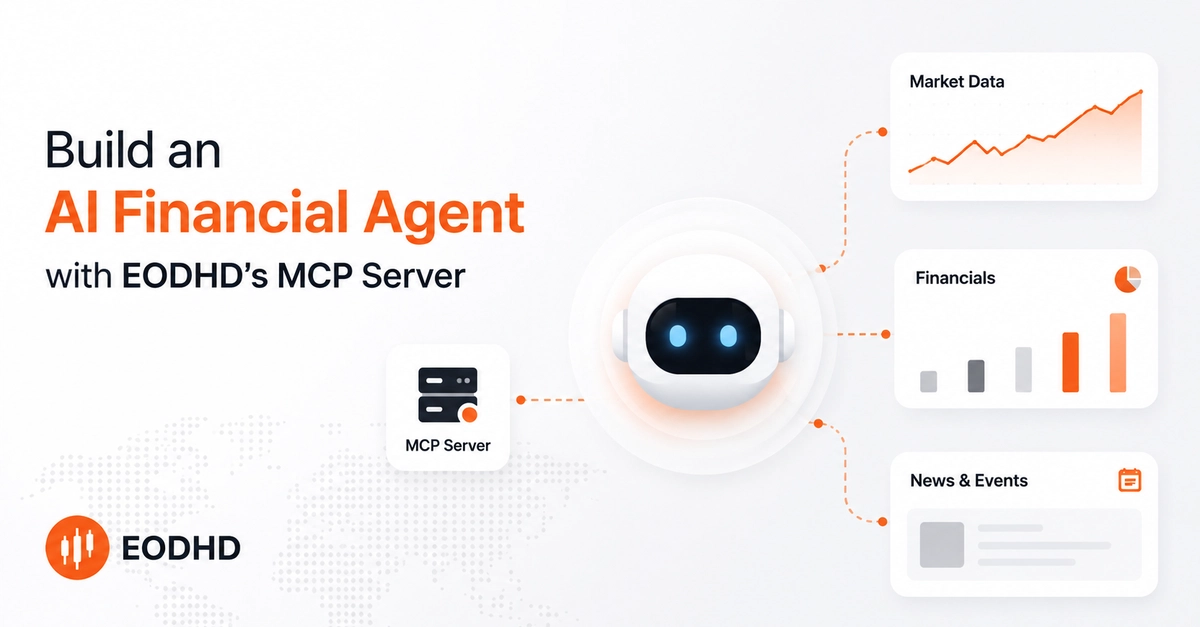
EODHD aims to solve this fragmentation problem with its new Market Data Connect Protocol (MCP) Server. This server acts as a central hub, aggregating various financial data streams into a single, unified interface. Instead of interacting with multiple individual APIs, developers can connect to the MCP Server, which then handles the underlying complexity of fetching and correlating data from different sources.
The MCP Server is designed to provide a consolidated view of critical financial information. This includes real-time and historical price data, comprehensive fundamental analysis metrics, sentiment-driving news feeds, and essential corporate event dates like earnings releases. By offering these diverse data types through a single protocol and server, EODHD significantly simplifies the data acquisition pipeline for AI agents.
This unified approach means developers can spend less time on data integration and more time on building sophisticated AI models and agent logic. The server's architecture is built to handle the complexities of real-time data processing, historical data retrieval, and the normalization of data formats. This allows AI agents to access a rich, multi-faceted dataset without needing to manage numerous API keys, rate limits, and data parsing routines for each individual data provider.
How MCP Server Simplifies AI Agent Development
The core benefit of EODHD's MCP Server lies in its ability to abstract away the complexities of traditional financial data APIs. Consider an AI agent tasked with evaluating a stock. Traditionally, this might involve:
- Calling a price API for current and historical stock prices.
- Querying a fundamentals API for P/E ratios, revenue growth, and debt-to-equity.
- Accessing a news API to gauge market sentiment and recent company announcements.
- Checking an events API for the upcoming earnings date and past performance.
Each of these steps requires separate API calls, error handling, and data transformation. The MCP Server collapses these into a single connection point. Developers can configure the server to fetch the specific data points they need, and the server delivers them in a consistent, structured format. This is akin to having a single, highly organized assistant who knows exactly where to find all the information you need, rather than having to call five different people who each only know a piece of the puzzle.
Referenced Sources
- verified