The Limitations of Local Configuration
Traditional application development often relies on configuration files, typically stored in predictable locations like ~/.config/myapp.yaml or /etc/myapp/config.json. This approach works well for individual developers running applications on their personal machines. The application can be built with an assumption of a user with a home directory and a writable filesystem, allowing it to locate and read its settings before execution. This is the default for many tools, offering a straightforward way to manage application behavior. However, this model breaks down rapidly when applications are deployed in more dynamic or ephemeral environments.
Consider a containerized application. A container image is built once, intended to be immutable and portable. Its configuration should not be baked into the image itself, as this defeats the purpose of a single, reusable artifact. Instead, settings must be provided at runtime. Similarly, Continuous Integration (CI) jobs often receive their configuration from the orchestrator or the job definition itself, not from a pre-existing file within the build environment. Systemd units, a common way to manage services on Linux, use Environment= directives to pass settings, again bypassing traditional file-based configuration.
The common thread across these scenarios—containers, CI, systemd services—is the reliance on environment variables as the primary, and often only, channel for delivering configuration. This is because environment variables are a fundamental mechanism that every running process has access to, regardless of its execution context. They represent the universal interface for injecting runtime parameters into an application.

The Environment Variable Fallback
When an application must accommodate these varied deployment environments, its configuration logic must adapt. The typical response involves a series of os.environ.get() calls (or their equivalents in other languages) near the application's entry point. Developers write code to read specific environment variable names, often providing sensible defaults if a variable is not found. This creates an internal configuration system that maps external environment variables to the application's internal settings.
For example, a web application might look for PORT to determine which network port to listen on, defaulting to 8080 if not specified. Database connection details, API keys, and feature flags are commonly managed this way. This pattern is so pervasive that many frameworks and libraries have emerged to simplify this process, abstracting away the raw os.environ.get() calls and offering more sophisticated ways to load, validate, and manage environment-based configuration.
This approach is robust because it decouples the application's configuration from its build process and its deployment environment. The application binary remains static, while its behavior is dictated by the environment in which it's run. This is a critical principle for modern software deployment, enabling greater flexibility and operational efficiency.
Beyond Simple Key-Value Pairs
While basic environment variables are often simple strings, many applications require more complex configuration structures, such as lists, nested objects, or even binary data. Simply passing these as single strings in environment variables can be cumbersome and error-prone. For instance, a list of allowed IP addresses might be passed as ALLOWED_IPS=192.168.1.1,10.0.0.5, requiring the application to parse this string into a list. Similarly, a JSON configuration object might be passed as a single, long environment variable, which can be difficult to manage and read.
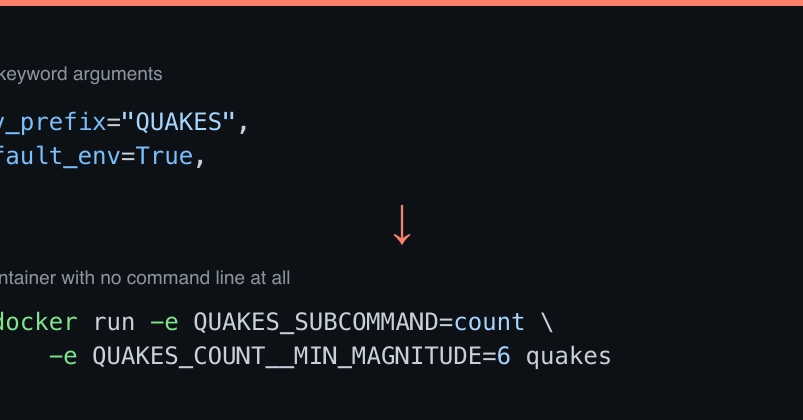
To address this, developers often employ conventions. For example, a common pattern is to use a prefix for all configuration-related environment variables, such as APP_DATABASE_URL, APP_PORT, APP_FEATURE_FLAG_NEW_UI. This helps namespace configuration and prevents conflicts with environment variables set by the operating system or other applications.
More advanced techniques involve serializing complex data structures into environment variables. A common approach is to use JSON. For example, a complex setting might be passed as APP_SERVICE_CONFIG='{