The Enterprise AI Imperative: Beyond Proof-of-Concept
The generative AI landscape is rapidly evolving from experimental playgrounds to mission-critical enterprise solutions. For organizations sitting on vast repositories of institutional knowledge—from intricate regulatory documents to complex internal policies—the promise of AI lies not in its ability to generate novel content, but in its capacity to reliably retrieve and synthesize existing information. The current paradigm, however, presents a significant bottleneck: employees often struggle to navigate fragmented, disconnected data silos, leading to decreased productivity. As companies pivot to Generative AI to address this, they hit a fundamental hurdle: trust and governance. Public, off-the-shelf Large Language Models (LLMs) lack the specific corporate context necessary for reliable enterprise use, and are notoriously prone to hallucination. An incorrect or fabricated answer from an AI system in an enterprise setting carries unacceptable operational, brand, and regulatory risks. The core challenge, therefore, is shifting the engineering focus from merely demonstrating what AI can do to building systems that enterprises can unequivocally trust.
This transition demands a robust architectural approach, particularly when leveraging cloud platforms like Amazon Web Services (AWS). Simply feeding an LLM a document and expecting accurate, contextually relevant answers is insufficient. An enterprise-grade RAG platform must be meticulously designed to ensure data security, accuracy, and compliance. This involves a multi-layered strategy that addresses data ingestion, vectorization, retrieval, and response generation, all within a secure and manageable framework.
Foundations of a Trustworthy RAG Architecture on AWS
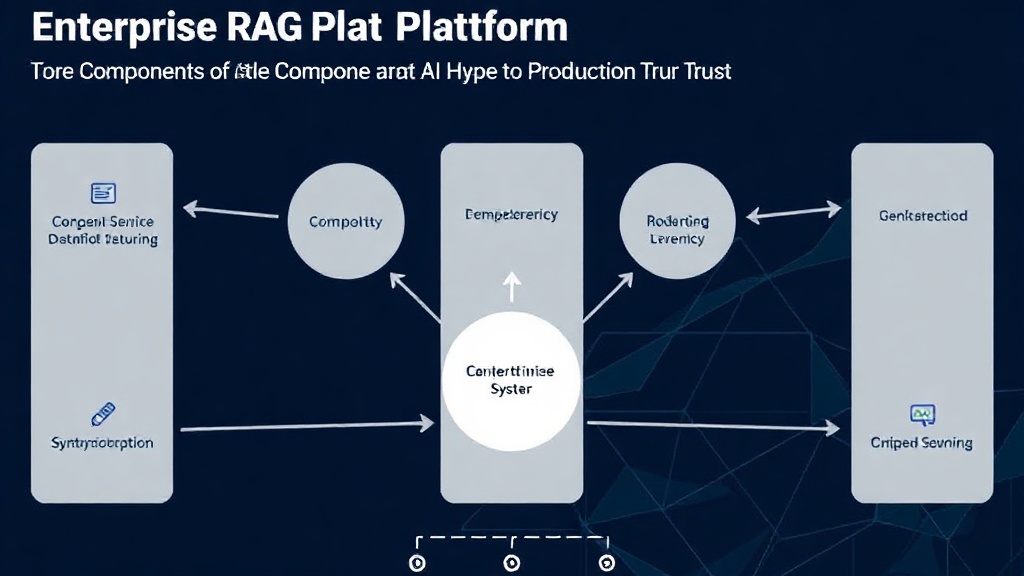
Building a production-ready RAG system on AWS involves several key components, each requiring careful consideration for enterprise needs. The journey begins with data ingestion and preparation. Enterprises possess diverse data sources, including structured databases, unstructured documents (PDFs, Word docs, emails), and rich media. A robust ingestion pipeline must handle this variety, ensuring data is cleaned, pre-processed, and appropriately chunked for effective embedding. Services like AWS Glue or custom Lambda functions can orchestrate this process, integrating with various data stores.
Following ingestion, data is transformed into vector embeddings. This process, crucial for semantic search, requires selecting the right embedding models. The choice of model impacts not only the quality of semantic understanding but also the computational resources and cost. AWS services like Amazon SageMaker provide managed environments for training and deploying embedding models, while third-party APIs offer pre-trained options. The vectorized data is then stored in a vector database. Amazon OpenSearch Service with k-NN, or dedicated vector database solutions available on the AWS Marketplace, are prime candidates. The selection depends on factors like scalability, query latency requirements, and existing AWS infrastructure.
The Retrieval and Generation Stack: Ensuring Accuracy and Context
The heart of a RAG system is its ability to retrieve relevant information and use it to ground the LLM's response. This retrieval process is far from a simple keyword search. It involves sophisticated querying of the vector database to find embeddings semantically similar to the user's query. Advanced techniques such as hybrid search (combining vector search with traditional keyword search), re-ranking of retrieved documents, and context window management are essential for optimizing relevance. AWS services can facilitate these operations, with Lambda functions orchestrating the retrieval logic and interacting with the chosen vector database.
Once relevant documents are retrieved, they are passed to the LLM along with the original user query. The LLM's task is to synthesize this information into a coherent, accurate, and contextually appropriate answer. This is where the challenge of hallucination is directly confronted. By providing the LLM with specific, retrieved context, the likelihood of it generating fabricated information is significantly reduced. However, further measures are needed. Prompt engineering plays a critical role in guiding the LLM to adhere strictly to the provided context and to indicate when it cannot find an answer. Techniques like few-shot prompting and specific instructions to cite sources are vital. The choice of LLM itself is also a critical decision, balancing performance, cost, and the ability to be fine-tuned or deployed within a secure VPC for enhanced data privacy.
Productionizing RAG: Governance, Security, and Monitoring
Moving RAG systems to production requires a rigorous focus on governance, security, and ongoing monitoring – areas where enterprises demand a higher standard than typical AI demos. Security is paramount. Data must be protected both at rest and in transit, adhering to corporate security policies and regulatory compliance standards. This often means deploying LLMs and vector databases within a Virtual Private Cloud (VPC) on AWS, utilizing IAM roles for granular access control, and implementing encryption at every layer. Compliance considerations, such as GDPR, HIPAA, or industry-specific regulations, must be baked into the architecture from the outset, dictating data residency, access controls, and audit trails.
Governance extends to managing the RAG system's performance and reliability. This includes establishing clear metrics for accuracy, latency, and user satisfaction. Continuous monitoring of these metrics is crucial, using tools like Amazon CloudWatch and custom logging solutions. Alerting mechanisms should be in place to notify teams of performance degradation or unexpected behavior. Furthermore, a feedback loop mechanism is essential. Allowing users to rate answers or provide corrections creates a valuable dataset for iterative improvement, enabling the system to learn and adapt over time. This iterative process, informed by real-world usage and feedback, is how AI hype transforms into production trust.
The Future of Enterprise RAG: Beyond Basic Retrieval
The evolution of enterprise RAG platforms will undoubtedly involve more sophisticated capabilities. We can anticipate advancements in agentic RAG, where the system can not only retrieve information but also take actions based on it. This could involve automating workflows, initiating requests, or interacting with other enterprise systems. Furthermore, multi-modal RAG, capable of processing and generating responses involving text, images, and other data types, will become increasingly important as enterprises leverage diverse data formats. The underlying AWS infrastructure will continue to evolve, offering more specialized services for AI/ML workloads, improved vector database capabilities, and enhanced security features. The key takeaway for any organization architecting an enterprise RAG platform is that the journey from hype to trust is paved with meticulous engineering, a deep understanding of enterprise requirements, and a relentless commitment to security and governance on a robust cloud foundation like AWS.