
The Emacs Service Model: A Paradigm Shift
Emacs, the extensible, customizable, self-documenting real-time display editor, has long been a bedrock for developers who value deep control and a rich ecosystem. Now, a significant architectural shift is underway, treating nearly every internal operation and external interaction as a distinct service. This isn't merely an API update; it's a re-conceptualization of how the editor functions, moving towards a more modular, composable, and robust model. This evolution aims to make Emacs even more adaptable and easier to integrate with modern development workflows.
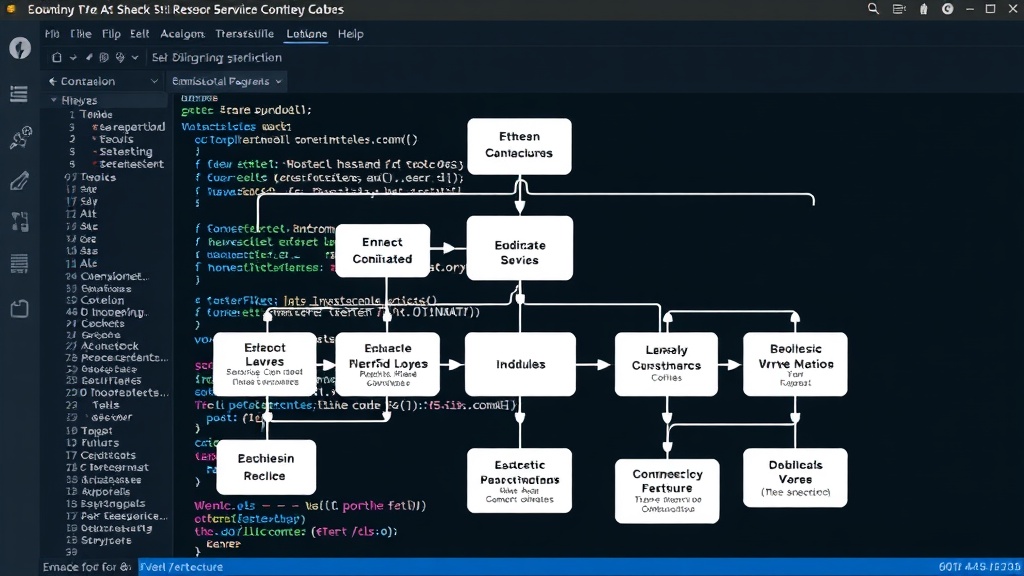
Historically, Emacs's extensibility has relied on Lisp code directly manipulating the editor's core structures. While powerful, this approach can lead to tight coupling and complex dependencies, making it challenging to reason about and maintain large configurations. The new service-oriented approach breaks down these monolithic structures into smaller, independent units. Each unit, or service, performs a specific task—like managing buffers, handling text properties, interacting with external processes, or rendering UI elements—and communicates with other parts of the system through well-defined interfaces. This is akin to how microservices operate in a distributed system, but contained within the Emacs process. The benefit is increased isolation: a failure or bug in one service is less likely to cascade and bring down the entire editor.
Key Components and Their Service Abstractions
The transformation touches virtually every corner of Emacs. Consider buffer management. Instead of direct manipulation of buffer objects, operations like creating, deleting, or modifying buffer content are now exposed as services. This allows for cleaner separation of concerns. For instance, a service responsible for file I/O can operate independently from a service handling syntax highlighting for a specific language, both interacting with a central buffer-management service.
Text properties, the mechanism Emacs uses to attach metadata (like font styles, colors, or semantic information) to ranges of text, are also being refactored into services. This means that operations like adding, removing, or querying text properties are no longer low-level Lisp calls but requests to a dedicated text-property service. This abstraction simplifies the development of features that rely heavily on rich text annotations, such as code completion, semantic highlighting, or integrated debugging tools. Developers can interact with these properties through a consistent interface, regardless of the underlying implementation details.
Interactions with external processes, a core Emacs capability for tasks like running compilers, linters, or version control commands, are also being re-envisioned. Rather than directly spawning and managing subprocesses, Emacs now offers services for process communication. This includes services for sending input to a process, receiving its output, and managing its lifecycle. This modularity makes it easier to build sophisticated tools that integrate seamlessly with external command-line utilities, abstracting away the complexities of inter-process communication.
Implications for Emacs Development and Usage
For Emacs users, this architectural change promises greater stability and predictability. When a feature relies on a specific service, its behavior is more contained. This means that when a new package or configuration is introduced, the risk of unintended side effects across the entire editor is reduced. Debugging also becomes more targeted; instead of sifting through vast amounts of Lisp code, developers can focus on the specific service that is misbehaving.
The impact on package developers is perhaps the most profound. They can now build and distribute Emacs functionality as self-contained services or as clients that consume existing services. This encourages a more modular and composable approach to package development, akin to building with Lego bricks. It lowers the barrier to entry for creating complex extensions, as developers don't need to deeply understand the intricate internals of Emacs to interact with its core functionalities. They can simply call the relevant service. This also opens doors for new types of extensions that might not have been feasible with the older, more monolithic architecture. For example, imagine a service that intercepts all UI rendering requests to apply custom animations or themes dynamically, without needing to patch core rendering functions.
The surprising detail here is not the complexity of the internal refactoring, but the speed and consensus with which this shift is being adopted. What began as internal discussions has rapidly coalesced into a guiding principle for ongoing development, indicating a strong community drive towards modernization. This isn't just about making Emacs 'better'; it's about ensuring its relevance and power in an era dominated by distributed systems and microservice architectures.
The Future: A More Composable Emacs
This service-oriented transformation positions Emacs to integrate more smoothly with external tools and services. Imagine Emacs acting as a central control plane for a developer's entire toolchain, orchestrating tasks across various applications and environments through its service interfaces. The editor becomes less of a standalone environment and more of a highly customizable, intelligent front-end for a developer's entire workflow.
What nobody has addressed yet is the long-term impact on the Lisp ecosystem specifically within Emacs. Will this service abstraction lead to a decline in direct Lisp manipulation, or will it foster a new wave of Lisp-based service development? The potential for a more robust, modular, and developer-friendly Emacs is immense. This architectural evolution is not just about maintaining a legacy tool; it's about future-proofing it for decades to come.