
The Quest for Smarter LoRA Adapters
The landscape of large language model (LLM) adaptation is rapidly evolving. While full fine-tuning offers maximum performance, it comes with prohibitive computational costs and significant storage requirements. Techniques like Low-Rank Adaptation (LoRA) have emerged as a more efficient alternative, enabling model customization with drastically fewer trainable parameters. However, the quest for even more efficient and effective adaptation methods continues. A nascent area of interest is the application of Exponential Moving Average (EMA) to LoRA adapters, specifically for self-teaching purposes.
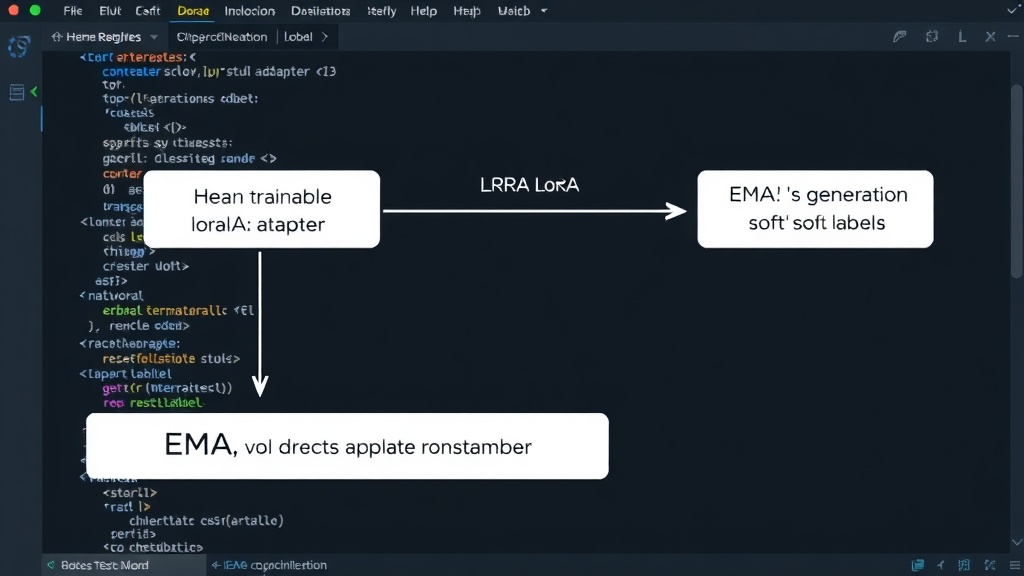
The core idea, as explored in online technical communities, is to leverage an EMA of the LoRA adapter weights to act as a stable, less volatile 'teacher' model. This teacher could then generate soft labels for the currently trainable adapter, guiding its learning process. This is conceptually similar to self-distillation techniques where a model learns from its own improved past versions. The critical question is whether this approach yields empirical benefits when applied to the compact LoRA framework, especially on pre-trained models.
Understanding EMA in Model Adaptation
Exponential Moving Average is a well-established technique in time-series analysis and has found applications in deep learning optimization. In essence, EMA assigns exponentially decreasing weights to older observations. For model training, this means the EMA of model parameters is a weighted average of the current parameters and the previous EMA, with a small learning rate (often denoted as $\tau$) controlling the decay. The formula is typically:
$$EMA_{t+1} = \tau \cdot EMA_t + (1 - \tau) \cdot \theta_t$$
Where $\theta_t$ represents the model parameters at step $t$. The benefit of EMA is that it smooths out parameter fluctuations, leading to a more stable model, particularly beneficial during fine-tuning. Models using EMA often exhibit better generalization and performance stability.
In the context of LoRA, the EMA would be applied to the low-rank matrices (A and B) that constitute the LoRA adapter. The primary, actively trained LoRA adapter would undergo standard backpropagation. Simultaneously, its parameters would be used to update a separate EMA version of the adapter. This EMA adapter, being a smoothed representation, could then serve as a teacher.
The Self-Teaching Hypothesis for LoRA
The proposed self-teaching mechanism for EMA-on-LoRA centers on generating pseudo-labels. The actively trained LoRA adapter, being more volatile and prone to rapid changes, might not be the best source of consistent training signals. The EMA adapter, however, represents a more stable, averaged behavior of the model over time. The hypothesis is that this stable EMA adapter can provide higher-quality, more consistent soft labels for the training data than the current, potentially noisy, output of the actively trained adapter.
Consider a scenario where the active LoRA adapter is fine-tuning for a specific task. It might fluctuate between correct and incorrect predictions as it explores the parameter space. The EMA adapter, by averaging these states, would offer a more robust prediction. This prediction, when converted into soft labels (e.g., probability distributions over tokens), could then be used to train the active LoRA adapter further. This creates a closed loop: the adapter trains, its EMA smooths, the EMA generates labels, and these labels refine the adapter.
Current Research Landscape and Challenges
The concept of EMA for self-distillation is not entirely new. Papers like "On-policy self-distillation" (though the provided arXiv ID seems to point to a future date, suggesting it might be a placeholder or an internal reference) explore similar ideas. However, these approaches often involve full model fine-tuning, which is computationally intensive. The novelty and appeal of applying EMA to LoRA lie in its potential to achieve similar self-distillation benefits with the efficiency of parameter-efficient fine-tuning (PEFT).
The primary challenge is the lack of publicly available empirical results specifically demonstrating the success of EMA on LoRA adapters for this self-teaching paradigm. While the theoretical underpinnings are sound – EMA provides stability, and self-distillation can enhance performance – bridging this to practical, demonstrable gains in LoRA models is key. Researchers and practitioners are actively seeking papers or experimental evidence that validates this approach.
Several factors contribute to this research gap:
- Emergent Technique: Applying EMA specifically to the low-rank matrices of LoRA for self-teaching is a relatively new idea. It may not have been widely explored or published yet.
- Implementation Complexity: While LoRA is parameter-efficient, managing two sets of adapter weights (active and EMA) and orchestrating the self-labeling process adds implementation complexity compared to standard LoRA fine-tuning.
- Hyperparameter Sensitivity: The effectiveness of EMA is highly dependent on the decay rate ($\tau$), and the self-distillation process introduces further hyperparameters (e.g., how soft labels are generated and used). Finding optimal configurations can be challenging.
- Empirical Validation Needed: Theoretical benefits must be proven through rigorous experimentation. This includes comparing EMA-LoRA against standard LoRA and potentially other PEFT methods on various benchmarks and tasks.
Potential Benefits and Future Directions
If successful, EMA on LoRA adapters could offer several advantages:
- Improved Performance: By providing a more stable teacher signal, self-distillation could lead to better generalization and accuracy for the fine-tuned adapter.
- Enhanced Stability: The EMA component can act as a regularizer, preventing catastrophic forgetting and ensuring smoother convergence during fine-tuning.
- Efficiency: Crucially, it aims to achieve these benefits within the parameter-efficient framework of LoRA, avoiding the costs of full fine-tuning.
The community is actively seeking concrete results. Developers asking about this are looking for empirical evidence: performance metrics, qualitative examples, or even code repositories demonstrating successful implementations. The next steps in this research area will likely involve:
- Publishing benchmark results comparing EMA-LoRA with standard LoRA.
- Investigating different methods for generating soft labels from the EMA adapter.
- Exploring the optimal decay rates and integration strategies for EMA within the LoRA training loop.
- Analyzing the impact on downstream tasks and model robustness.
What nobody has addressed yet is how the choice of the base pre-trained model and the complexity of the downstream task influence the efficacy of EMA-driven self-distillation on LoRA adapters.