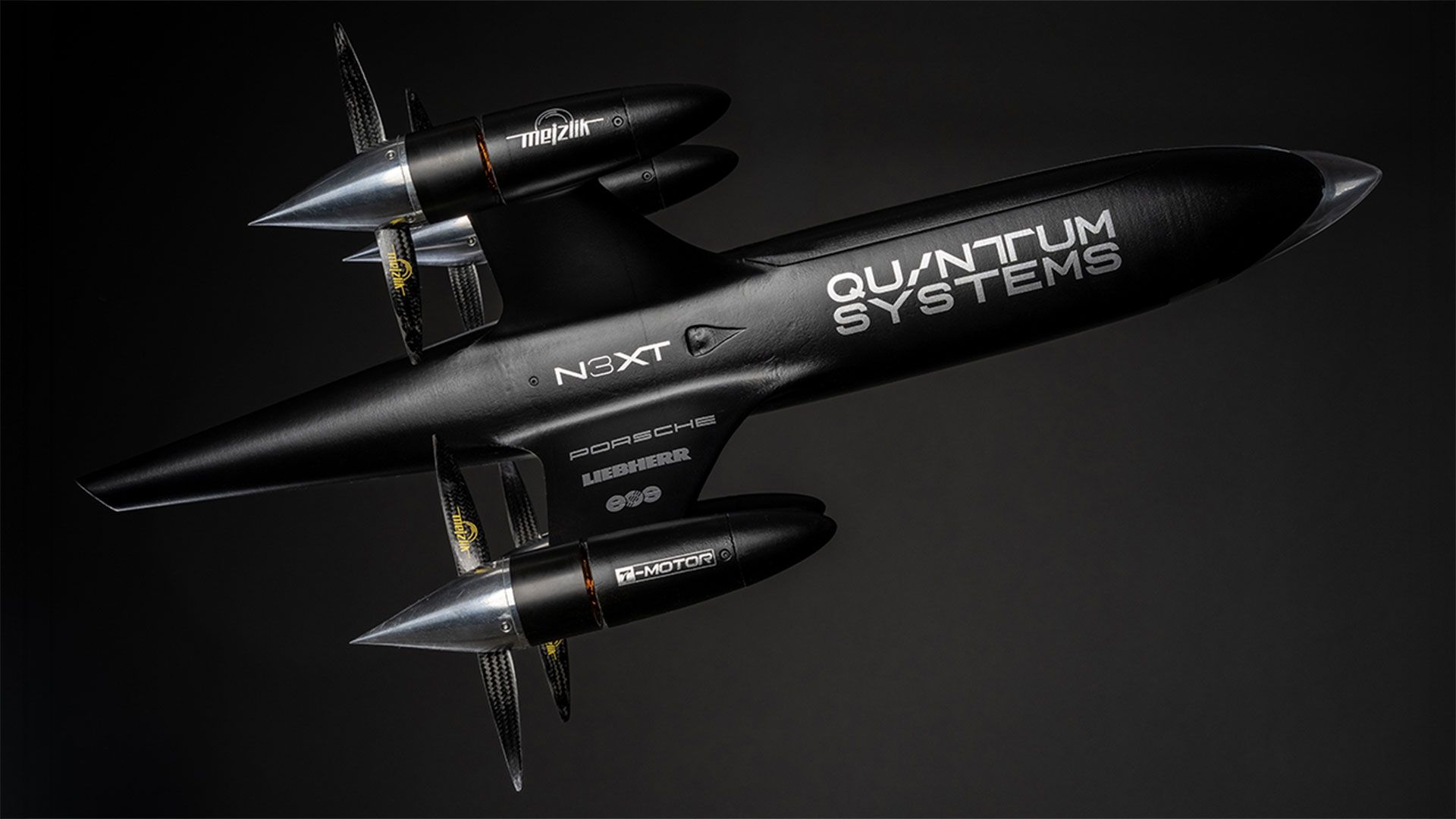
New Speed Benchmark for Electric Drones Established
Munich-based Quantum Systems Group has announced a significant achievement in unmanned aerial vehicle technology. During recent internal testing, their electric drone, dubbed the Apex Recordhunter, reached a staggering top speed of 434 mph (approximately 698 km/h) in straight and level flight. This performance handily surpasses the existing official Guinness World Record for electric drones, which stands at 409 mph (658 km/h). The company is reportedly seeking official validation from Guinness World Records to formalize this new benchmark.
The Apex Recordhunter's remarkable speed is a testament to advanced aerodynamic design and powerful electric propulsion systems. While specific details about the drone's powertrain and design are proprietary, the achievement suggests a sophisticated integration of high-efficiency motors, advanced battery technology, and a low-drag airframe. This new speed record is not merely an academic exercise; it underscores the rapidly evolving capabilities of electric-powered unmanned systems and points towards their potential in demanding operational roles.
Designed for High-Speed Interception
Beyond setting speed records, the Apex Recordhunter is engineered with a specific, high-stakes application in mind: serving as an anti-aircraft interceptor. This design intent fundamentally differentiates it from many other high-speed drone projects, which often focus on reconnaissance, delivery, or even racing. The need for a drone capable of rapidly closing distances and engaging targets at high altitudes and speeds is becoming increasingly critical in modern defense strategies. Such a capability could be used for various purposes, including simulating enemy aircraft for training exercises, or potentially for actual defensive roles against airborne threats.
The implications of a fast, electric drone for defense are substantial. Traditional manned interceptors are expensive, complex, and carry significant risks. Drones offer a more cost-effective and potentially less risky alternative for certain missions. An electric platform, in particular, offers advantages such as quieter operation compared to internal combustion engines, and potentially quicker response times due to the instant torque of electric motors. The ability to reach speeds approaching that of some manned fighter jets, while remaining a fraction of the cost and complexity, makes this technology a compelling prospect for military organizations worldwide.

Technical Considerations and Future Prospects
Achieving 434 mph with an electric drone presents considerable engineering challenges. At such speeds, aerodynamic drag increases exponentially, requiring immense power to overcome. This necessitates highly efficient motors, advanced battery management systems to deliver sustained high power output, and an airframe optimized for high-speed flight, likely featuring a slender profile and minimal surface irregularities. The drone's stability and control at these velocities are also critical factors, requiring sophisticated flight control software and robust actuators.
The company’s focus on an anti-aircraft interceptor role suggests that the drone is not only fast but also likely possesses advanced sensor and communication capabilities. To effectively intercept targets, it would need to track them, receive guidance, and potentially carry a payload. The fact that Quantum Systems is pursuing this dual-track approach—record-breaking performance and a specific military application—indicates a mature development program. This is not merely a science project; it is a product designed for operational deployment. The drone's success in testing suggests that Quantum Systems is on the cusp of delivering a capability that could significantly alter the landscape of aerial defense and unmanned system applications.
The speed record itself serves as a powerful validation of the company's technological prowess. It generates publicity, attracts potential investors and customers, and establishes the company as a leader in high-performance drone technology. For military procurement agencies, seeing such a speed record achieved by a drone designed for interceptor roles provides tangible evidence of its potential effectiveness. The journey from record-breaking test flights to operational deployment is often long and complex, involving further testing, integration with existing systems, and regulatory approvals. However, the 434 mph milestone is a significant step, demonstrating that the fundamental performance requirements for such advanced applications are within reach for electric drone technology.
Broader Implications for the Drone Industry
This achievement by Quantum Systems Group has broader implications for the entire drone industry. It pushes the boundaries of what is considered possible for electric propulsion in aviation. For years, electric motors were seen as limited in power density compared to internal combustion engines, particularly for sustained high-speed flight. The Apex Recordhunter’s performance challenges this perception, suggesting that electric powertrains are rapidly maturing and can now compete with, and even surpass, traditional systems in certain high-performance niches.
This development could accelerate investment and research into high-power electric propulsion systems for a wide range of aerial vehicles, not just drones. We might see this technology trickle down into electric aircraft, advanced eVTOL designs, and other aerospace applications. The focus on military roles also highlights a growing trend of dual-use technology, where advancements initially developed for defense find applications in civilian sectors, and vice-versa. As drone technology continues to evolve at an unprecedented pace, the capabilities demonstrated by the Apex Recordhunter signal a future where unmanned aerial systems play an increasingly vital and versatile role across numerous domains.