
The Core Problem: Beyond Linear Scans
Searching billions of documents for a specific phrase and receiving ranked results in mere milliseconds appears to defy logic. This speed isn't magic; it's the result of two fundamental concepts working in concert: an index that maps words to documents, rather than scanning documents for words, and a sophisticated method for distributing this index across multiple machines, ensuring each machine handles only a portion of the data. Understanding these two pillars demystifies the power of full-text search.
Traditional databases operate by scanning rows. If tasked with finding every document containing a particular word, a standard database would meticulously read each document and check its contents. This linear scanning process is perfectly adequate for exact key lookups but becomes prohibitively slow and inefficient for free-text searches across vast datasets. The requirement for free-text search necessitates an inversion of this process. Instead of asking, "Given a document, what words does it contain?" the crucial question becomes, "Given a word, which documents contain it?" This fundamental shift in perspective is the essence of the inverted index.
The second major challenge is the sheer scale of the data. A single machine cannot possibly store the comprehensive index required for billions of documents. Furthermore, a single machine would be overwhelmed attempting to serve queries against such a massive index. This is where distributed systems and shard routing become indispensable. By breaking down the index into smaller, manageable pieces called shards, and distributing these shards across a cluster of machines, Elasticsearch can parallelize both storage and query processing. Each node in the cluster becomes responsible for a subset of the data, allowing queries to be executed concurrently across multiple machines, drastically reducing response times.
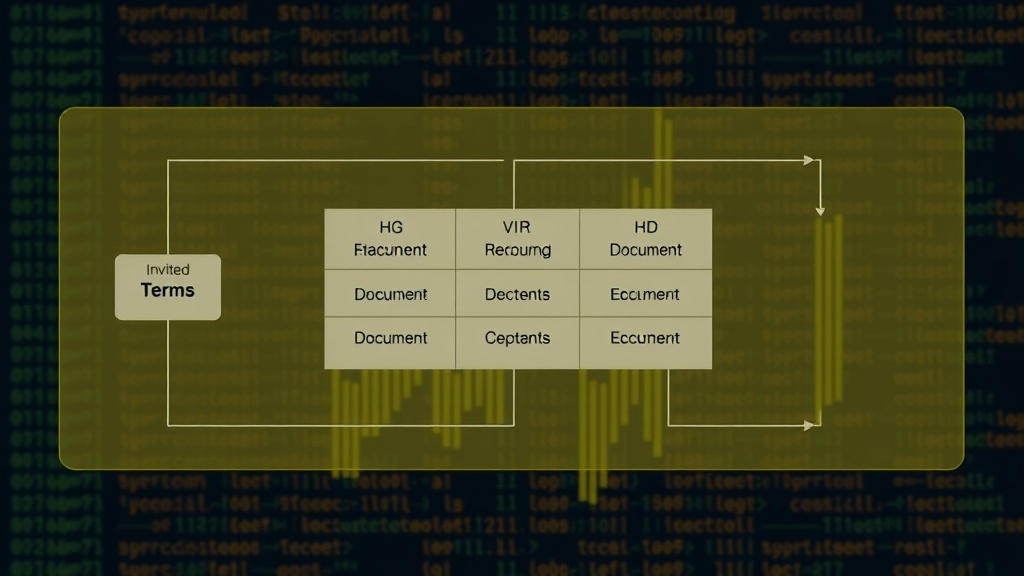
The Inverted Index: A Word's-Eye View
An inverted index is the cornerstone of efficient full-text search. Unlike a traditional database index that maps a primary key to a row, an inverted index maps a term (a word or token) to a list of documents containing that term. Think of it less like a library's traditional catalog that lists books by title, and more like a meticulously cross-referenced index at the back of a textbook. You look up a concept (the term), and it immediately tells you every page number (document ID) where that concept appears. This structure allows search engines to bypass the need to read every single document. When a search query is issued, Elasticsearch consults the inverted index for each search term. It retrieves the lists of documents associated with each term and then performs operations (like intersections or unions, depending on the query logic) to find documents that match all or any of the search terms.
The process of creating an inverted index involves several steps. First, documents are analyzed. This typically includes tokenization (breaking text into individual words or terms), lowercasing, removing stop words (common words like "the," "a," "is" that don't add much meaning), and stemming or lemmatization (reducing words to their root form, e.g., "running," "ran," "runs" all become "run"). Once the terms are extracted and normalized, they are collected, and for each unique term, a list of document IDs where it appears is compiled. This list is often augmented with positional information, which is crucial for phrase searches (e.g., finding documents where "quick" is immediately followed by "brown"). This positional data allows Elasticsearch to determine not just which documents contain the terms, but also their proximity and order within the document.
Shard Routing: Distributing the Load
The sheer volume of data and the computational cost of indexing and searching necessitate a distributed architecture. Elasticsearch achieves this through sharding. An index is divided into multiple pieces, known as shards. Each shard is a self-contained, fully functional Lucene index. These shards are distributed across the nodes in an Elasticsearch cluster. When a document is indexed, Elasticsearch determines which shard it belongs to based on a routing algorithm. When a search query is executed, it's sent to all relevant shards in parallel. The results from each shard are then aggregated and ranked by a coordinating node before being returned to the client.
Shard routing is critical for performance and scalability. It dictates how documents are distributed among shards and how queries are directed to the appropriate shards. By default, Elasticsearch uses a hash-based routing mechanism. When a document is indexed, its ID (or a custom routing value) is hashed, and the resulting hash value determines which shard the document will be stored on. This ensures a relatively even distribution of data across shards. For searches, the same routing logic is applied. If a specific routing value is provided with the query, Elasticsearch can narrow down the search to only the shards that contain documents associated with that routing value, significantly improving query performance for targeted searches. For example, if an application routes all data for a specific customer to a particular shard or set of shards, a query for that customer's data only needs to be sent to those specific shards, rather than the entire cluster.
The number and size of shards are critical tuning parameters. Too many small shards can lead to increased overhead and reduced performance due to inter-node communication and resource management. Conversely, too few large shards can create performance bottlenecks and hinder parallelization. Elasticsearch's ability to dynamically rebalance shards across nodes as the cluster scales up or down is a key feature for maintaining optimal performance and availability.
Putting It All Together: Speed Through Inversion and Distribution
The synergy between the inverted index and shard routing is what enables Elasticsearch's remarkable search speed. The inverted index transforms the search problem from a document-by-document scan into a highly efficient term-lookup operation. Shard routing then takes this efficient lookup and distributes it across a cluster of machines, allowing for massive parallel processing. When you search, your query is broadcast to potentially many shards. Each shard independently uses its local inverted index to find matching documents. The results are then collected, merged, and ranked. This distributed, inverted approach means that the time it takes to search does not grow linearly with the total amount of data, but rather with the amount of data on the shards being queried. For a well-distributed index, this scales exceptionally well, allowing searches across petabytes of data to complete in milliseconds.
This architecture is not unique to Elasticsearch; it's a foundational pattern for most modern search engines and databases designed for complex text analysis. However, Elasticsearch's mature implementation, coupled with its ease of use and integration into the broader Elastic Stack, has made it a dominant force in log analysis, application search, security analytics, and business intelligence. The underlying principles, however, remain the elegant combination of intelligent data structuring (the inverted index) and efficient resource distribution (shard routing).