The Kubernetes Control Plane Illusion
The promise of Kubernetes is universal compatibility. Run the same YAML on Amazon EKS, Azure AKS, or Google GKE, and it will, for the most part, function identically. This is the true power of the open-source standard. However, the day-to-day reality of managing these clusters—the upgrades, the network incidents, the late-night pages—reveals significant divergences between the major cloud providers' managed offerings. This comparison cuts through vendor marketing to what actually matters when your clusters are your production backbone for years.
The core difference lies not in the Kubernetes API itself, but in the surrounding managed services and operational overhead each provider imposes. While the control plane might be managed, the experience of interacting with it, troubleshooting it, and integrating it with the rest of your cloud infrastructure varies dramatically.
Cost: Beyond the Free Tier
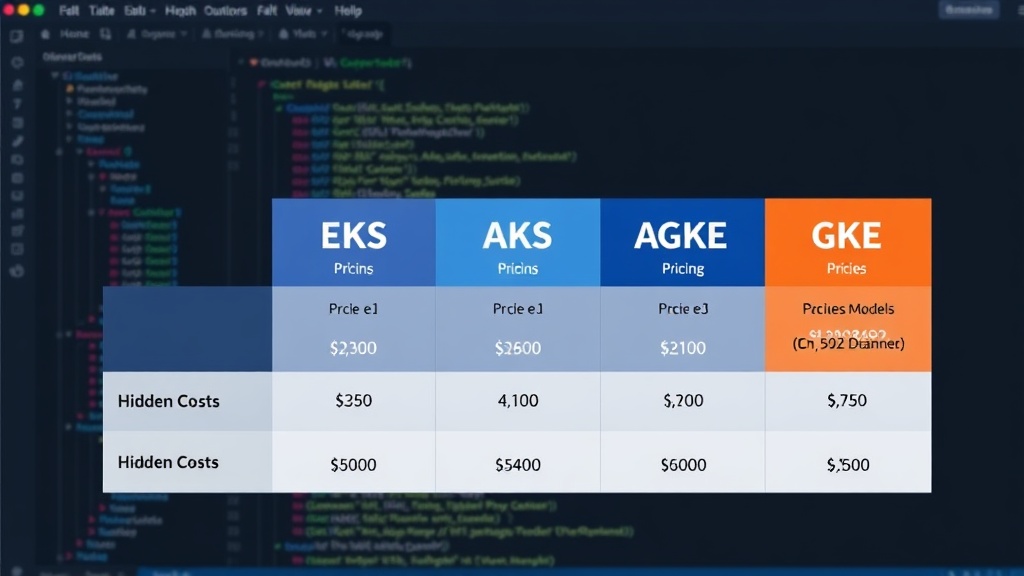
The most immediate differentiator is cost, and it's more nuanced than just the control plane fee. While AKS offers a free control plane, this is often offset by other Azure costs. EKS charges for its control plane, a cost that scales with cluster count and availability zones. GKE's pricing is competitive, but its most advanced features, like Autopilot, come at a premium, abstracting away node management entirely.
When evaluating cost, it's crucial to look beyond the control plane. Node costs, data transfer, load balancers, persistent storage, and the operational burden of managing these components all contribute to the total cost of ownership. GKE's Autopilot, for instance, can appear more expensive per hour, but it eliminates the cost and complexity of managing worker nodes, potentially leading to lower overall operational expenditure and reduced human toil. EKS, by contrast, offers granular control over node types and configurations, allowing for deep cost optimization if you have the expertise to manage it effectively. AKS sits in the middle, with its free control plane being a significant draw, but users must carefully assess the pricing of Azure's integrated services.
Networking: A Labyrinth of Choices
Networking is where managed Kubernetes services often become complex. Each provider has its own CNI (Container Network Interface) plugins and integrations with their native networking services.
EKS integrates tightly with AWS VPC networking. This offers immense flexibility but also introduces complexity. Configuring network policies, ingress controllers, and service meshes requires a deep understanding of AWS networking primitives. Debugging network issues can feel like navigating a labyrinth, tracing traffic through security groups, NACLs, and VPC routing tables. The benefit is unparalleled integration with the vast AWS ecosystem.
AKS leverages Azure's Virtual Network capabilities. Its integration with Azure Active Directory (now Entra ID) for authentication and authorization is a significant advantage for Microsoft-centric enterprises. However, its networking can also be a source of complexity, particularly with advanced configurations like network policies and custom CNI plugins. The free control plane is attractive, but users still pay for the underlying Azure resources, including networking components.
GKE offers several networking modes, including its own GKE Dataplane V2, which is built on eBPF. This often leads to simpler configuration and better performance for common use cases. GKE's networking is generally considered more opinionated and automated, which can reduce operational burden but might limit extreme customization. For cloud-flexible organizations, GKE's straightforward networking often translates to fewer incidents and less 2 AM firefighting.
Day-2 Operations: The Real Cost of Management
The true differentiator for production workloads is the day-2 operational experience. This encompasses upgrades, incident response, monitoring, logging, and overall cluster maintenance.
GKE excels here. Its Autopilot mode is the epitome of managed Kubernetes, handling node upgrades, scaling, and security patching automatically. Even in Standard mode, GKE's automated node upgrades and node auto-provisioning simplify operations significantly. It feels the most polished and automated, requiring the least amount of direct intervention for routine tasks. This is the choice for teams prioritizing reduced toil and cloud flexibility.
EKS offers the least managed experience. While AWS handles the control plane's availability and patching, users are fully responsible for managing worker nodes, including upgrades, patching, and scaling. This grants maximum control and integration with existing AWS tooling but demands significant operational expertise and resources. It is the go-to for deeply entrenched AWS shops that need to leverage the full breadth of the AWS ecosystem and have the teams to manage the underlying infrastructure.
AKS lands in the middle. While it manages the control plane, users still have responsibilities for worker node upgrades and management, though Azure provides tools to assist. Its standout feature is the seamless integration with Entra ID, making it a compelling choice for Microsoft-centric enterprises. The free control plane is a financial advantage, but the overall operational experience is less automated than GKE and requires more active management than one might initially expect.
The Unanswered Question: Vendor Lock-in in Managed K8s
Despite the common YAML layer, the deep integrations with cloud-specific networking, IAM, logging, and monitoring services create subtle but significant forms of vendor lock-in. While you can technically lift and shift YAML, migrating the operational tooling, the CI/CD pipelines, and the expertise built around each platform's unique operational model is a substantial undertaking. What does this mean for organizations that need to maintain multi-cloud strategies or are considering a future exit from a specific cloud provider? The initial choice of managed Kubernetes service has long-term implications that extend far beyond the initial cluster deployment.
Conclusion: Choose Based on Your Ecosystem and Tolerance for Toil
The Kubernetes API is the constant. The managed services are the variables. For teams prioritizing automation and cloud flexibility, GKE is the most polished option. For those deeply committed to AWS and seeking maximum control, EKS is the logical, albeit more operationally intensive, choice. AKS offers a compelling middle ground, especially for Microsoft enterprises, with its Entra ID integration and free control plane. The decision hinges on your existing cloud footprint, your tolerance for operational toil, and your long-term strategic vendor relationships.