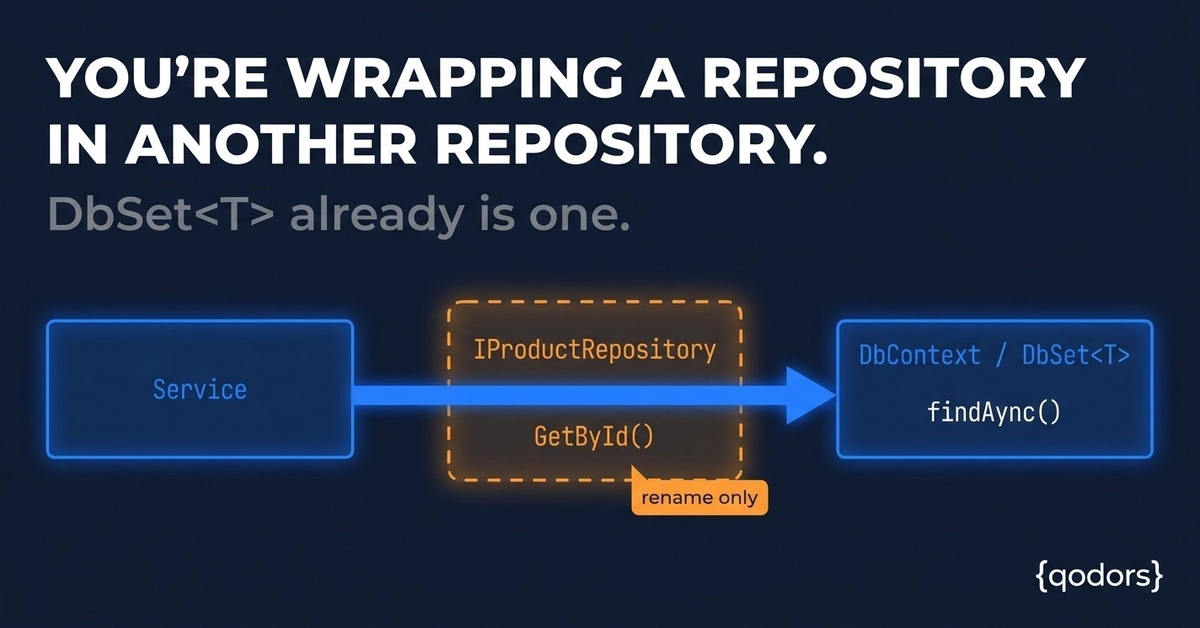
The Redundant Repository Pattern with EF Core
A common sight in .NET projects is the repository pattern layered directly on top of Entity Framework Core (EF Core). Developers implement interfaces like IProductRepository with methods such as GetById, Add, and Save. The reality is that each of these methods often simply delegates to the underlying EF Core DbContext, passing the results back without adding any significant functionality. This wrapper introduces a name and little else.
For the vast majority of applications, the repository pattern is unnecessary when using EF Core. EF Core itself provides the core functionality of a repository. The DbSet<TEntity> class, for instance, already acts as a repository. It handles querying, tracking changes, and persistence, fulfilling the pattern's original purpose.
The persistence of this practice stems from historical teaching. The repository pattern was often introduced alongside EF, leading developers to believe it was a mandatory companion. This is a misconception; you do not need a separate repository layer to effectively use EF Core.
Understanding the Original Purpose of the Repository Pattern
The repository pattern emerged in an era where data access was significantly more cumbersome. Before the advent of sophisticated Object-Relational Mappers (ORMs) like EF Core, developers commonly wrote raw SQL queries using SqlCommand and manually mapped results from a DataReader to application objects. In this context, wrapping data access logic behind an interface was highly valuable. It abstracted away a complex and error-prone implementation, allowing for easier swapping of the underlying data access technology without impacting the rest of the application. This abstraction provided a clean contract, shielding business logic from the nitty-gritty details of database interaction, such as SQL syntax, connection management, and manual data mapping.
The pattern was designed to provide an in-memory collection-like interface to the domain, abstracting the data source. This meant that the domain layer could interact with repositories as if they were simple collections of domain objects, without needing to know if the data was coming from a SQL Server database, a file system, or another persistence mechanism. This separation of concerns was crucial for maintainability and testability in complex systems.
Why EF Core Replaces the Need
Entity Framework Core has evolved to the point where it handles much of the complexity that the repository pattern was designed to hide. EF Core's DbContext is a unit of work and a context for change tracking. Crucially, its DbSet<TEntity> properties expose queryable collections that behave much like repositories themselves. A DbSet<TEntity> allows you to:
- Query entities using LINQ.
- Add new entities.
- Mark entities for deletion.
- Update existing entities (EF Core tracks changes automatically).
When you call DbContext.SaveChanges(), EF Core translates these operations into the appropriate SQL commands and executes them against the database. This is precisely what a custom repository layer, implemented by simply calling DbContext methods, would do, but with added boilerplate code and indirection.
Consider a common scenario: retrieving a user by ID. With EF Core, this is typically done via _context.Users.Find(userId) or _context.Users.FirstOrDefaultAsync(u => u.Id == userId). If you were using a custom repository, you might have an IUserRepository with a GetUserById(int id) method. Inside that method, you would likely write return _context.Users.Find(id);. The extra layer adds no value here. It introduces an extra interface and class for no tangible gain.
When a Custom Repository Might Still Make Sense
While unnecessary for most applications, there are specific scenarios where a custom repository abstraction over EF Core might still be warranted:
Complex Domain Logic or Business Rules
If the retrieval or saving of an entity involves intricate business rules, multiple steps, or interactions with other services, encapsulating this logic within a dedicated repository method can be beneficial. For example, a PlaceOrder method might not just add an order to the database but also trigger inventory updates, send notifications, and perform other domain-specific actions. In such cases, the repository method acts as a facade for a complex operation, rather than just a simple CRUD wrapper.
Abstracting Specific EF Core Features
In larger applications or those with evolving data access needs, you might want to abstract away specific EF Core features or configurations. This could include:
- Global Query Filters: If you consistently apply filters (e.g., for soft deletes or multi-tenancy) to certain entity types, a repository can enforce this consistently without requiring developers to remember to add the
.Where(...)clause every time. - Specific Performance Optimizations: For performance-critical queries, a repository method might encapsulate optimized EF Core queries, perhaps using
AsNoTracking()where appropriate, or specific join strategies. - Data Transformation: If you need to transform data significantly between the EF Core entity model and the domain model, a repository can handle this mapping. However, EF Core's own mapping capabilities and DTO projections often suffice.
Testing Strategies
While EF Core has excellent support for integration testing and in-memory testing, some teams still prefer to mock their data access layer entirely for unit tests. A repository interface allows for easy mocking. However, it's worth noting that EF Core's in-memory provider and test databases have significantly reduced the need for this approach, offering more realistic testing scenarios without the overhead of mocking.
The Danger of Over-Abstraction
The primary risk of blindly applying the repository pattern over EF Core is over-abstraction. This leads to code that is:
- More Complex: An extra layer of interfaces and classes increases the codebase size and cognitive load.
- Harder to Debug: Tracing a query or an issue through an additional abstraction layer can be more difficult.
- Slower to Develop: Writing boilerplate repository code delays actual feature development.
- Potentially Less Performant: While typically negligible, an extra layer can introduce minor overhead.
The surprise here is not that EF Core is capable, but that so many developers continue to build this redundant layer. It's akin to buying a smart refrigerator and then building a separate box to control its temperature settings manually. The tool already does the job.
Moving Forward: Embrace EF Core's Capabilities
If you are working on a .NET project using EF Core, evaluate your current data access strategy. Ask yourself: Does my repository layer add any value beyond what DbContext and DbSet<TEntity> already provide? If the answer is no, consider simplifying your architecture. Embrace EF Core's built-in capabilities for querying, change tracking, and persistence. This will result in cleaner, more maintainable, and more efficient code. Focus your abstraction efforts on genuine complexity, not on reimplementing functionality that is already expertly provided by your ORM.