
EF Core 11: A Major Leap in Split Query Performance
Entity Framework Core 11 is set to dramatically improve the performance of applications relying on split queries. In a move that will be welcomed by developers wrestling with N+1 query problems, EF Core 11 introduces a sophisticated caching strategy specifically designed to accelerate split queries. Benchmarks indicate a potential performance gain of up to 30%, a substantial improvement for data-intensive applications.
Split queries are a powerful feature in EF Core that allow developers to retrieve related data in a single query. Instead of executing multiple individual queries (the classic N+1 problem), a split query generates a single SQL statement that fetches all necessary data. However, historically, the execution of these complex queries could sometimes be less efficient than anticipated, especially when dealing with large object graphs or frequent data access. The overhead associated with parsing and executing these large statements repeatedly could become a bottleneck.
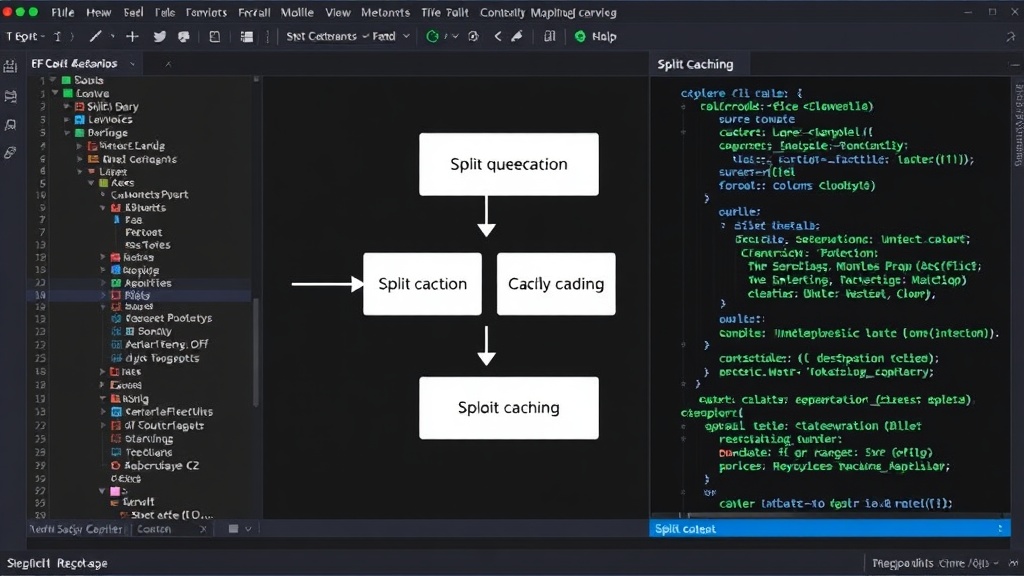
The core of the enhancement in EF Core 11 lies in its new caching mechanism. This isn't a simple query cache; it's a more intelligent system that understands the structure of split queries and the data they retrieve. When a split query is executed for the first time, EF Core analyzes the results and caches them in memory. Subsequent executions of the same or similar split queries can then retrieve data directly from this cache, bypassing the need to hit the database altogether. This significantly reduces latency and database load.
How the New Caching Works
The implementation details are crucial here. EF Core 11's caching solution for split queries is designed to be aware of entity state and relationships. When a split query is executed, EF Core attempts to materialize the entities. If the required data is already present and valid in the cache, it will be used. This cache is designed to be efficient and low-overhead, ensuring that the caching mechanism itself doesn't become a performance impediment. The cache is invalidated intelligently when underlying data changes, preventing stale data from being served.
Consider a scenario where an application lists products and for each product, displays its associated reviews. Without split queries, this would typically result in one query for all products and then N additional queries for each product's reviews. With split queries, EF Core can generate a single SQL query that fetches both product and review data. However, if this list of products and their reviews is viewed frequently, the database still has to process the same large query repeatedly. EF Core 11's cache intercepts this. The first time the query runs, the data is fetched and stored. The second time, if the data hasn't changed, it's served from the cache, meaning the database isn't even touched.
The benefits extend beyond just reduced database load. Faster data retrieval means improved application responsiveness, a better user experience, and the ability to handle more concurrent users without scaling up database resources as aggressively. For developers, this means less time spent optimizing individual queries or implementing custom caching layers, as EF Core now provides a robust, built-in solution.
Implications for Developers and Performance Tuning
This update is particularly impactful for developers who have struggled with the performance implications of complex object graphs or frequently accessed read-heavy data. Previously, developers might have resorted to manual caching strategies, using tools like Redis or memory caches, to mitigate the performance issues associated with split queries. EF Core 11's built-in caching simplifies this greatly. Developers can now leverage the framework's intelligence without adding external dependencies or complex cache invalidation logic.
The surprise here is not that EF Core is improving, but the specific focus and sophistication of the split query caching. It addresses a well-known pain point that often required significant developer effort to overcome. By integrating this at the framework level, Microsoft is providing a standardized and performant solution that benefits all users of EF Core 11. This move signals a maturing of the ORM, moving beyond basic CRUD operations to tackle more complex performance scenarios.
While the exact cache invalidation strategies are not detailed in the initial announcements, the promise of intelligent caching suggests that EF Core will be able to detect changes to entities and invalidate cached split query results accordingly. This is critical for maintaining data consistency. Developers should still be mindful of the cache's memory footprint, as large datasets could lead to significant memory consumption. However, for many read-heavy scenarios, the trade-off is overwhelmingly positive.
What This Means for the Ecosystem
The performance gains from EF Core 11's split query caching are not merely incremental; they represent a fundamental shift in how ORMs can handle complex data retrieval. This will likely encourage more developers to adopt split queries where appropriate, knowing that the performance concerns are being addressed by the framework itself. Competitors in the ORM space will undoubtedly be looking to match or exceed this capability.
For developers building applications with .NET, this is a clear signal to upgrade to EF Core 11 when it becomes available. The potential to see a 30% performance improvement in data retrieval without code changes is a compelling reason. It also provides a strong argument for using EF Core over other data access methods when performance for complex object graphs is a concern.