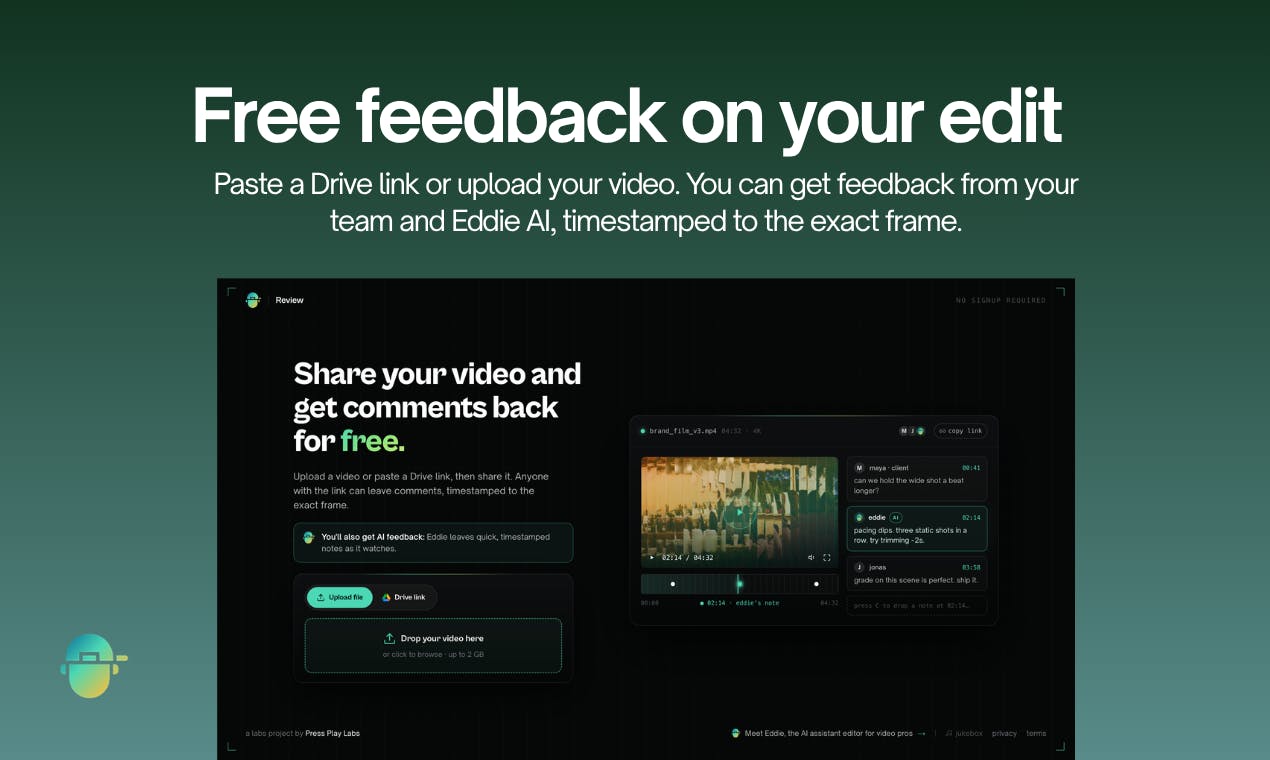
Eddie AI: Precision Feedback for Video Production
The video production and editing process, particularly in collaborative environments, is often bogged down by lengthy feedback loops. Communicating specific edits can be challenging, leading to misinterpretations, multiple rounds of revisions, and significant time loss. Eddie AI emerges as a solution designed to tackle this friction point by integrating artificial intelligence to provide granular, time-stamped feedback on video content. This platform promises to streamline communication between creators, clients, and team members, allowing for more efficient iteration and a faster path to final delivery.
At its core, Eddie AI functions as a centralized hub for video review. Users upload their video content, and the platform allows collaborators to leave comments directly tied to specific moments in the video timeline. This eliminates the ambiguity of general feedback like "make it better" or "speed this up." Instead, comments are precise, indicating exactly where an adjustment is needed and what the proposed change might be. This level of detail is crucial for video editors who need clear direction to implement changes effectively.
The AI component of Eddie is where the platform aims to differentiate itself. While standard video review tools offer time-stamped commenting, Eddie's AI layer is intended to augment this process. This could manifest in several ways, though the exact AI capabilities are still being detailed. Potential applications include AI-generated summaries of feedback, identification of recurring issues across different comments, or even AI-assisted suggestions for how to address the feedback. The goal is to move beyond mere annotation to intelligent analysis that actively aids the editing process.
Streamlining Collaboration and Iteration
The collaborative aspect is central to Eddie AI's value proposition. In creative agencies, marketing teams, or freelance setups, multiple stakeholders often need to review video assets. Managing feedback from various sources can become chaotic. Eddie AI consolidates this feedback into a single, organized stream, ensuring that everyone is working from the same, up-to-date set of comments. This prevents conflicting instructions and ensures that all necessary revisions are captured and addressed.
Consider a marketing team producing a promotional video. The content team might focus on messaging accuracy, the design team on visual aesthetics, and legal on compliance. Each of these groups will have specific, time-sensitive feedback. Without a structured system, these comments might arrive via email, Slack, or even verbally, each with its own timestamp but without the visual context of the video itself. Eddie AI centralizes this, allowing the editor to see a design critique at 0:35, a messaging point at 1:12, and a legal concern at 1:45, all within a single interface. This structured approach dramatically reduces the time spent deciphering and organizing feedback, directly translating to faster project completion.

The platform's emphasis on time-stamped feedback is not just about precision; it's about efficiency. For editors, each comment becomes a direct instruction linked to a specific frame or second. This means less time spent scrubbing through footage to find the exact spot a comment refers to. Instead, an editor can click on a comment and be taken directly to that point in the video, ready to implement the suggested change. This granular control over the editing process minimizes guesswork and maximizes productive work time.
The Role of AI in Video Feedback
While the exact nature of Eddie AI's artificial intelligence is still emerging, its integration suggests a move towards more intelligent content review tools. The potential for AI in this space is vast. Beyond simple annotation, AI could analyze feedback patterns to identify areas where a video consistently draws criticism, even if individual comments don't explicitly state it. It could also be trained to recognize common editing requests, offering templated responses or even suggesting automated fixes for repetitive issues. This could transform video feedback from a purely human-driven, often subjective process, into one that is informed by data and augmented by intelligent automation.
The surprising detail here is not the existence of time-stamped feedback tools, which have been around for years in various forms. Instead, it's the explicit integration of AI to potentially elevate this functionality. Tools like Frame.io and Wipster have long offered robust commenting systems. Eddie AI's bet is that by layering AI onto this familiar workflow, it can offer a more intelligent, efficient, and ultimately more valuable experience for video creators and their collaborators. The question remains how sophisticated this AI will be and what specific tasks it will automate or assist with.
Future Implications and Potential
The success of Eddie AI will likely depend on its ability to deliver tangible time savings and improve the quality of communication. For creative professionals and businesses that rely heavily on video content, reducing the friction in the review and iteration cycle can have a significant impact on project timelines and budgets. If Eddie AI can genuinely streamline these processes through its AI-powered features, it could become an indispensable tool in the video production toolkit.
The platform also opens up possibilities for more advanced features down the line. Imagine AI that can not only flag issues but also suggest alternative visual treatments or audio adjustments based on the feedback provided. Or AI that can automatically generate different versions of a video based on segmented feedback from different stakeholder groups. As AI continues to mature, tools like Eddie AI are poised to redefine how creative content is produced and refined.
The broader implication for the industry is a continued push towards AI-assisted creative workflows. As tools become more intelligent, the focus shifts from manual execution of edits to higher-level creative direction and strategic decision-making. This allows creators to spend more time on the conceptual and artistic aspects of their work, while AI handles some of the more repetitive or time-consuming tasks. Eddie AI appears to be positioning itself at the forefront of this trend for video feedback.