Agentic AI: The Next Frontier in Enterprise Automation
Agentic Artificial Intelligence is moving beyond theoretical discussions and into practical, high-stakes enterprise applications. Unlike traditional AI that performs specific, pre-programmed tasks, agentic AI systems can autonomously plan, reason, and execute complex workflows with minimal human oversight. This capability is particularly impactful in areas demanding high precision, continuous operation, and robust decision-making. The core differentiator lies in the AI's ability to act as an independent agent, breaking down broad objectives into actionable sub-tasks, adapting to unforeseen circumstances, and learning from its own execution. This level of autonomy is critical for automating functions that were previously considered too nuanced or dynamic for scripted or rule-based systems.
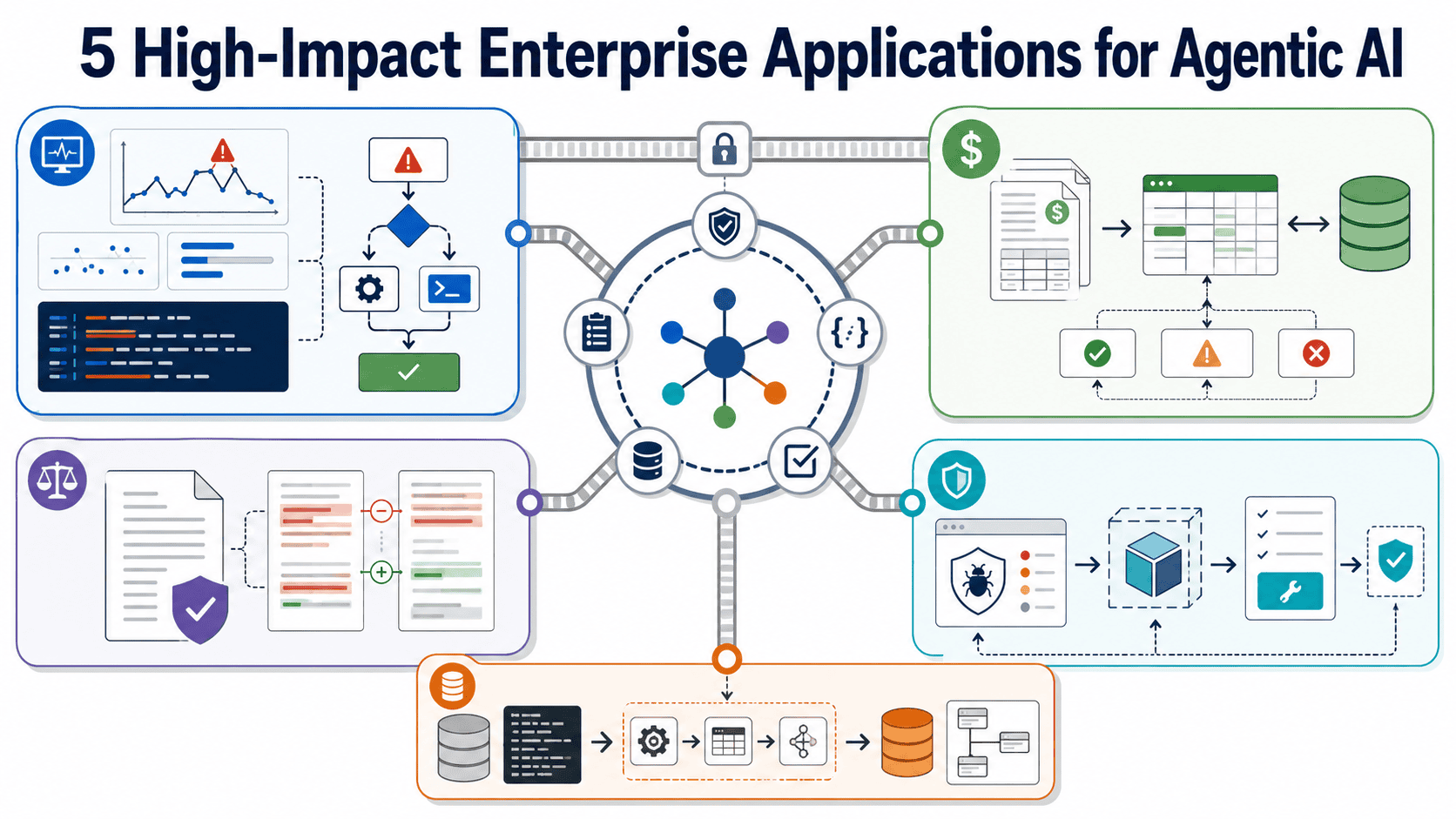
Site Reliability Engineering (SRE) Automation
In Site Reliability Engineering (SRE), agentic AI offers a powerful solution for managing the complexity and scale of modern IT infrastructure. Traditional SRE practices involve a delicate balance of proactive monitoring, incident response, and system optimization. Agentic AI can automate many of these tasks with a level of responsiveness and consistency that human teams struggle to maintain. For instance, an AI agent can continuously monitor system performance, detect anomalies indicative of impending failures, and automatically initiate remediation steps. This could involve scaling resources, rerouting traffic, or even deploying hotfixes. The AI's ability to correlate data from various sources—logs, metrics, traces—allows it to diagnose issues more rapidly and accurately than human operators, reducing Mean Time To Resolution (MTTR). Furthermore, agentic AI can learn from past incidents, refining its diagnostic and remediation strategies over time. This proactive approach prevents outages before they impact users, a key tenet of SRE.
Financial Operations and Compliance
The finance sector, with its stringent regulatory requirements and high volume of transactions, stands to benefit significantly from agentic AI. Automating tasks like invoice processing, expense management, and financial reporting can lead to substantial efficiency gains and error reduction. However, the true power of agentic AI in finance lies in its ability to handle more complex functions such as fraud detection, risk assessment, and compliance monitoring. An AI agent can be tasked with continuously analyzing vast datasets of financial transactions to identify suspicious patterns that might indicate fraud, far faster and more comprehensively than manual review. In compliance, agents can monitor regulatory changes, assess their impact on company policies, and even suggest or implement necessary adjustments to internal systems and procedures. The critical aspect here is the AI's capacity for deterministic safety constraints, ensuring that its automated actions adhere strictly to financial regulations and internal policies, thereby mitigating compliance risks.
Legal Document Analysis and Contract Management
The legal domain presents unique challenges due to its reliance on intricate language, precedent, and the need for absolute accuracy. Agentic AI can transform legal operations by automating time-consuming tasks such as document review, contract analysis, and due diligence. Imagine an AI agent tasked with reviewing thousands of contracts for specific clauses, compliance issues, or potential risks. The agent can understand the context of legal language, identify relevant sections, and flag them for human review, dramatically accelerating processes that would otherwise take teams of lawyers weeks or months. Beyond simple identification, agentic AI can also assist in drafting standard legal documents, ensuring consistency and adherence to established templates and legal requirements. For M&A activities, an AI agent can perform initial rounds of due diligence, sifting through terabytes of corporate documents to identify red flags, saving immense human effort and reducing the risk of overlooking critical information. The deterministic safety constraints are paramount here, ensuring that legal interpretations and actions are always within defined parameters.
Data Migration and Transformation
Migrating large datasets between systems or transforming data formats is a notoriously complex and error-prone process. Agentic AI can bring a new level of intelligence and reliability to these operations. Instead of relying on static scripts that often fail when encountering unexpected data variations, an agentic AI can analyze the source and target schemas, understand data dependencies, and intelligently map and transform data. It can handle data cleansing, de-duplication, and reformatting on the fly, adapting to inconsistencies in the source data without human intervention for every anomaly. This is akin to having an exceptionally skilled data engineer who works tirelessly and learns from every migration. The AI can also proactively identify potential data integrity issues during the migration process and alert administrators or attempt automated resolutions, ensuring data quality is maintained. This makes large-scale data migrations, a common pain point in enterprise IT, significantly more manageable and less risky.
Enhanced Cybersecurity Operations
Cybersecurity is an area where the speed, adaptability, and autonomous decision-making of agentic AI are not just beneficial but essential. Traditional security systems often rely on predefined signatures or rules, which struggle to keep pace with evolving threats. Agentic AI agents can operate as sophisticated security analysts, continuously monitoring networks for anomalous behavior that might indicate a zero-day exploit or an advanced persistent threat. They can correlate events from diverse security tools—SIEMs, EDRs, firewalls—to build a comprehensive picture of a potential attack in real-time. Upon detecting a threat, the AI can autonomously initiate containment and response actions, such as isolating infected endpoints, blocking malicious IP addresses, or triggering further forensic analysis. The key is the AI's ability to learn from new threat intelligence and adapt its detection and response strategies dynamically. Deterministic safety constraints are crucial here to prevent automated responses from inadvertently disrupting critical business operations or causing collateral damage.
The Promise of Deterministic Safety
Across all these applications, the concept of 'deterministic safety constraints' is a recurring theme and a critical enabler. It signifies that while agentic AI operates with a high degree of autonomy, its actions are governed by pre-defined, non-negotiable rules and ethical guidelines. This means that even as the AI learns and adapts, its core operational boundaries remain fixed, ensuring that it will never perform actions that violate critical business policies, regulatory requirements, or ethical standards. This is particularly vital in sensitive domains like finance and legal, where errors can have severe financial and reputational consequences. For SRE and cybersecurity, these constraints ensure that automated responses do not inadvertently cause system outages or security breaches. The ability to deploy these powerful AI agents with such a robust safety net is what makes their adoption in enterprise automation not just feasible, but increasingly inevitable.