EDA Market Demonstrates Strong Double-Digit Growth

The Electronic Design Automation (EDA) market is experiencing a significant upswing, with overall revenue climbing by an impressive 12.7%. This robust growth, reported across most categories within the sector, signals a healthy and expanding landscape for the tools and services that underpin modern chip design. The strength of the market indicates continued investment in semiconductor innovation and an increasing demand for sophisticated design solutions. This performance is not a mere blip but rather a sustained trend that underscores the critical role EDA plays in the entire semiconductor value chain. From conceptualization to verification and physical implementation, EDA tools are indispensable for creating the complex integrated circuits that power everything from smartphones and data centers to automotive systems and artificial intelligence hardware. The double-digit expansion suggests that foundries, fabless companies, and integrated device manufacturers are all actively engaging with the latest design technologies to push the boundaries of performance, power efficiency, and functionality. The resilience and growth of the EDA market can be attributed to several key factors. Firstly, the relentless demand for more powerful and specialized chips across various industries, particularly in AI, 5G, IoT, and high-performance computing, necessitates continuous innovation in chip design. This, in turn, drives the adoption of advanced EDA tools that can handle the increasing complexity of modern designs, such as those involving advanced process nodes, multi-die packaging, and heterogeneous integration. Secondly, the ongoing digital transformation across all sectors of the global economy further fuels the need for semiconductors, creating a virtuous cycle of demand for EDA solutions. The intricate nature of these advanced designs requires highly specialized software that can automate, optimize, and verify billions of transistors, a task that would be impossible without sophisticated EDA platforms.
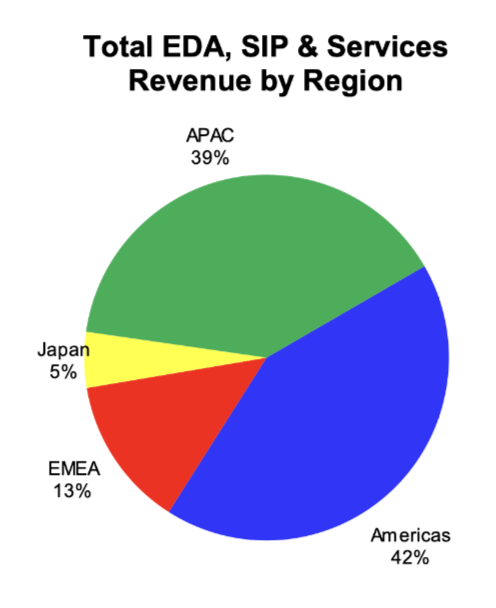
A dashboard displaying global EDA revenue growth percentages by region

Asia-Pacific Region Leads the Charge

Notably, the Asia-Pacific (APAC) region has emerged as a powerhouse, exhibiting particularly strong growth and contributing significantly to the overall market expansion. This resurgence in APAC highlights the region's increasing importance as a hub for semiconductor design and manufacturing. Several factors likely contribute to this impressive performance, including the growing investments in domestic semiconductor capabilities by various nations, the expansion of local design houses, and the continued strength of major electronics manufacturing centers within the region. The robust performance in APAC is a testament to the strategic importance of semiconductors for economic growth and technological sovereignty. As countries in the region continue to invest heavily in R&D, talent development, and manufacturing infrastructure, the demand for cutting-edge EDA tools is expected to remain high. This geographical shift in market strength suggests that EDA vendors will need to continue focusing their resources and strategies on supporting the unique needs and rapid evolution of the APAC market. The region's demand for advanced chip designs, driven by local innovation and global supply chain integration, positions it as a critical growth engine for the EDA industry. This is not just about manufacturing; it's about the increasing sophistication of chip design originating from within APAC itself, a trend that has been accelerating over the past few years. The growth in APAC is also being fueled by a younger, more dynamic workforce entering the design field, coupled with government initiatives aimed at fostering local semiconductor ecosystems. Companies are investing in advanced nodes and complex architectures, which directly translates to a higher demand for the most sophisticated EDA tools available. This surge is critical for global semiconductor supply chain stability and innovation, as APAC increasingly moves beyond being just a manufacturing base to becoming a significant design and R&D center.

Market Strength Across Most Categories

The double-digit growth is not confined to a single segment but is broadly distributed across most EDA categories. This indicates a healthy demand for a comprehensive suite of design tools. While specific details on each category were not elaborated upon in the provided excerpt, this broad-based strength suggests that advancements in areas such as logic synthesis, physical design, simulation, verification, and IP integration are all finding strong market traction. This widespread adoption points to a mature market where continuous technological advancement is a prerequisite for success, and where customers are willing to invest in tools that offer demonstrable improvements in design efficiency, time-to-market, and chip performance. This broad market strength is crucial for the continued innovation in the semiconductor industry. It signifies that companies are not just looking for incremental improvements but are investing in the entire design flow to tackle the increasingly complex challenges of next-generation chip architectures. The demand for tools that can handle advanced packaging, chiplet integration, and power-aware design is likely contributing to this widespread growth. Furthermore, the increasing complexity of verification tasks, which often consume a significant portion of the design cycle, is driving demand for advanced verification methodologies and tools, further bolstering the EDA market. The ability of EDA vendors to provide integrated solutions that span the entire design spectrum is a key factor in this sustained market health.