Understanding DynamoDB Throughput Management
Amazon DynamoDB distributes tables across multiple partitions to scale performance. Ideally, traffic to a table would spread evenly across these partitions. However, real-world applications rarely exhibit such uniform access patterns. Often, a small subset of data, or a specific access pattern, can concentrate traffic on one or a few partitions, creating a 'hot partition.' This uneven distribution can lead to throttling, where requests fail because the hot partition has reached its allocated throughput limit, even if other partitions are largely idle.
DynamoDB employs two primary automatic mechanisms to mitigate the impact of uneven traffic: Burst Capacity and Adaptive Capacity. Burst Capacity acts as a short-term buffer, allowing a table to temporarily exceed its provisioned throughput for up to five minutes. This is useful for absorbing brief, unexpected spikes in traffic. However, for sustained or more significant traffic skew, Adaptive Capacity becomes the critical feature.
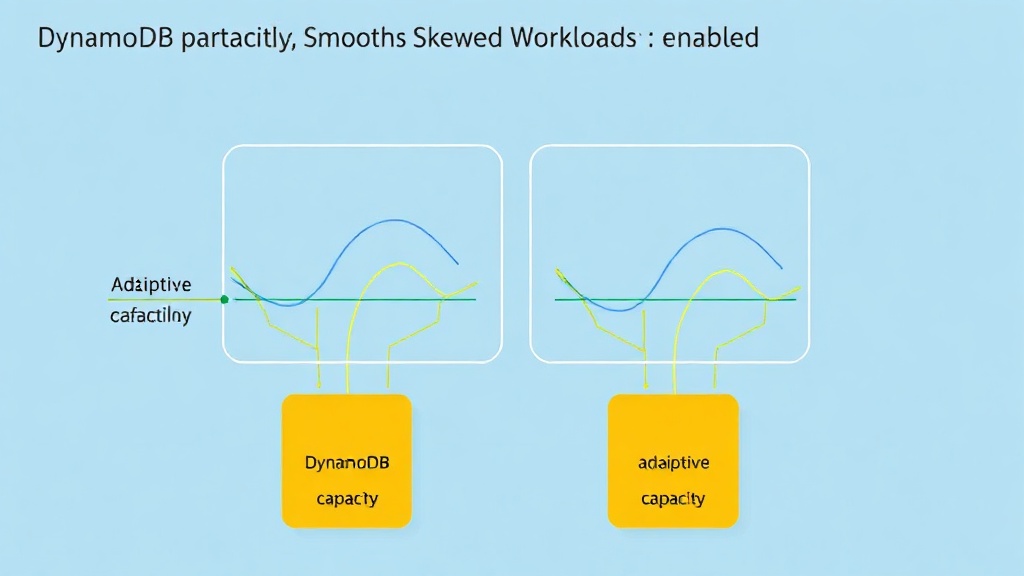
Adaptive Capacity is an intelligent, automatic process designed to reallocate unused throughput from less-utilized partitions to those experiencing higher demand. Think of it less like a rigid, pre-allocated budget for each partition, and more like a dynamic resource pool where unused capacity from one area can be swiftly diverted to another that needs it. This mechanism prevents a single hot partition from becoming a bottleneck, ensuring that the overall table can handle more varied and uneven workloads without manual intervention.
How Adaptive Capacity Works
When DynamoDB detects that a partition is receiving traffic exceeding its allocated throughput, but the table as a whole has available unused capacity, Adaptive Capacity steps in. It identifies partitions that are operating below their provisioned capacity and dynamically shifts some of that unused throughput to the hot partition. This process happens automatically and in near real-time, allowing the hot partition to absorb more traffic than its initially provisioned limit would suggest.
This reallocation is crucial because it allows DynamoDB to serve requests on the hot partition up to the physical limit of the underlying partition hardware, rather than being strictly bound by the provisioned throughput of that specific partition. This effectively raises the ceiling for individual partitions, accommodating traffic patterns that would otherwise lead to throttling. The key benefit is that this enhanced throughput for hot partitions is achieved without requiring customers to over-provision their entire table, which would be an inefficient and costly approach.
It's important to understand that Adaptive Capacity is not a magic bullet. While it can significantly smooth out traffic skew, it cannot push a single partition's throughput indefinitely beyond the physical limits of the hardware it runs on. There is an ultimate ceiling for each partition. If traffic to a single partition consistently exceeds this hard limit, even with Adaptive Capacity working to its maximum, throttling will still occur. However, for a vast majority of skewed workload scenarios, Adaptive Capacity proves highly effective in maintaining performance and availability.
The Role of Burst Capacity
Burst Capacity, often discussed alongside Adaptive Capacity, serves a complementary but distinct purpose. It provides a temporary buffer of excess read and write throughput, up to a maximum of 300 seconds (5 minutes) worth of unused provisioned capacity. This means if your application experiences a short, sharp spike in traffic, Burst Capacity can absorb it without immediate throttling. This is particularly useful for applications with unpredictable, ephemeral traffic surges.
Unlike Adaptive Capacity, which dynamically shifts capacity between partitions for sustained skew, Burst Capacity is more of an 'on-demand' reserve. It doesn't require analysis of other partitions' utilization; it simply allows you to temporarily exceed your provisioned rate, drawing from a pool of 'saved' capacity. Once this burst capacity is exhausted, or after the 5-minute window, the table must operate within its provisioned throughput limits, or rely on Adaptive Capacity if traffic skew is present.
The combination of Burst Capacity and Adaptive Capacity provides a robust, automatic system for handling traffic variability. Burst Capacity handles the short-term spikes, while Adaptive Capacity manages the longer-term, uneven distribution of traffic across partitions. Both are enabled by default and operate without requiring explicit configuration, simplifying operations for developers and architects.
When Adaptive Capacity Might Not Be Enough
While Adaptive Capacity is a powerful feature, it is essential to recognize its limitations. The mechanism relies on the availability of unused throughput from other partitions. If the entire table is consistently operating at or near its provisioned capacity, there will be little to no spare capacity to shift to a hot partition. In such scenarios, the hot partition will eventually hit its physical limit, leading to throttling.
Furthermore, as mentioned, each partition has an inherent physical throughput ceiling. Adaptive Capacity can help a hot partition reach this ceiling by reallocating capacity, but it cannot exceed it. If a single partition's traffic demands consistently surpass this physical limit, throttling is inevitable. This situation might arise in applications with an extremely concentrated access pattern on a very small subset of data, or where a single partition is disproportionately targeted.
For developers and architects, understanding these limits is key. It means that while Adaptive Capacity reduces the need for aggressive over-provisioning, it doesn't eliminate the need for thoughtful data modeling and access pattern design. Monitoring partition-level metrics, even with Adaptive Capacity enabled, remains a best practice to identify potential bottlenecks before they impact users. If persistent throttling occurs despite Adaptive Capacity, it signals a need to re-evaluate the data model, access patterns, or potentially consider larger partition sizes if supported by the use case and AWS recommendations.
Implications for Developers and Architects
The existence of Adaptive Capacity significantly simplifies the operational burden of managing DynamoDB tables. Developers can be more confident that their applications will handle moderate traffic fluctuations and uneven access patterns without immediate performance degradation or the need for constant manual tuning of provisioned throughput. This leads to more predictable performance and potentially lower costs, as over-provisioning to account for worst-case skew becomes less necessary.
However, it's crucial not to become complacent. Architects must still design data models with access patterns in mind. For instance, choosing a partition key that evenly distributes data and access is still the most robust long-term strategy. Relying solely on Adaptive Capacity without considering the underlying data distribution can mask design flaws that might become apparent under extreme load or if the partition ceiling is reached.
Monitoring tools within AWS, such as CloudWatch metrics for DynamoDB, provide insights into consumed versus provisioned throughput at both the table and partition level. Observing these metrics, particularly the `ThrottledRequests` counter and the `ConsumedReadCapacityUnits`/`ConsumedWriteCapacityUnits` relative to `ProvisionedReadCapacityUnits`/`ProvisionedWriteCapacityUnits` for individual partitions, can help identify situations where Adaptive Capacity is working hard, or where it is hitting its limits. Proactive identification of hot partitions, even if they are not currently throttling due to Adaptive Capacity, allows for strategic improvements to the data model or access patterns before performance issues arise.