
The Ubiquitous Dual-Write Problem
Many developers encounter a subtle but critical bug in distributed systems: the dual-write problem. This occurs when an application needs to update two separate data stores atomically, but the system fails between the two writes. Imagine a scenario where you need to save a new product in your primary database and simultaneously publish an event to a message queue notifying other services. If the system crashes after the database write but before the event is published, you have a product without a corresponding notification – a state of inconsistency.
This isn't a rare edge case; it's a fundamental challenge in building reliable distributed applications. The common approach involves writing to the database and then publishing a message. However, the window between these two operations is a potential failure point. If an error occurs during this brief interval, one operation succeeds while the other fails, leaving your system in an inconsistent state. This inconsistency can manifest in various ways, from missed notifications and incorrect inventory counts to failed user transactions. The code snippet below, frequently seen in production environments, illustrates this common pattern:
func (s *ProductService) CreateProduct(ctx context.Context, cmd CreateProduct) error {
    product := entities.NewProduct(cmd.Name, cmd.Description)

    // Write to primary database
    if err := s.productRepo.Save(ctx, product); err != nil {
        return fmt.Errorf("failed to save product: %w", err)
    }

    // Publish event to message queue
    event := ProductCreatedEvent{
        ProductID: product.ID,
        Name: product.Name
    }
    if err := s.eventPublisher.Publish(ctx, "product.created", event); err != nil {
        // PROBLEM: Database write succeeded, but event publish failed.
        return fmt.Errorf("failed to publish product created event: %w", err)
    }

    return nil
}
The Outbox Pattern Solution
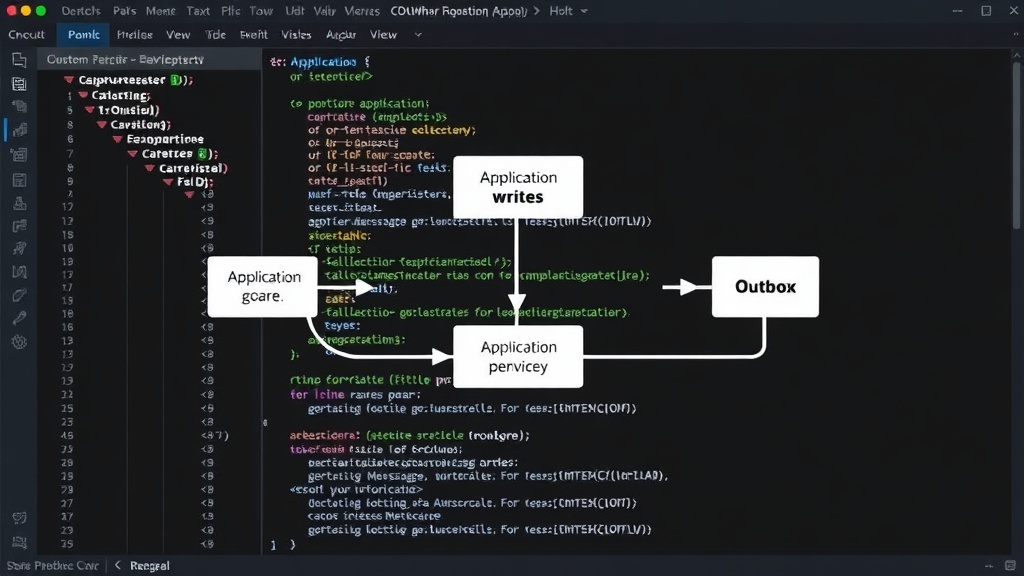
The outbox pattern elegantly solves this by ensuring that the database write and the event publication are effectively atomic. Instead of publishing the event directly to the message queue, the application first writes the event data to a special table within the same database transaction. This 'outbox' table acts as a staging area for events that need to be published.
Once the transaction commits, both the primary data (e.g., the new product) and the event record are safely stored in the database. A separate process, often a dedicated poller or a change data capture (CDC) mechanism, then monitors this outbox table. When it detects new event records, it publishes them to the message queue. Crucially, this process is idempotent and handles failures gracefully. If the poller crashes, it can restart and pick up where it left off, ensuring all committed events are eventually published. This pattern decouples the initial data write from the downstream event propagation, providing much stronger consistency guarantees.
Implementing the Outbox Pattern
Implementing the outbox pattern involves a few key components:
- Outbox Table: A dedicated table in your primary database to store events. Each row represents an event to be published, typically including event type, payload, and metadata like a timestamp or status.
- Transactional Write: The application writes the primary data and the event record to the outbox table within the same database transaction. This ensures that both operations succeed or fail together.
- Event Publisher/Relay: A background process responsible for polling the outbox table for new, unpublished events.
- Idempotent Publishing: The publisher must be able to safely re-process events if it crashes and restarts, avoiding duplicate publications. This often involves marking events as 'published' in the outbox table after successful transmission.
- Error Handling and Retries: The publisher should implement robust error handling and retry mechanisms for transient failures when communicating with the message broker.
Consider the flow: when a user creates a product, the application performs these steps within a single database transaction:
- Insert the new product into the
productstable. - Insert an event record (e.g.,
ProductCreatedEvent) into theoutboxtable.
If the transaction commits successfully, both the product and the event are durably stored. A separate process, the 'outbox relayer', constantly queries the outbox table for records marked as 'pending'. Upon finding one, it attempts to publish the event to the message queue (e.g., Kafka, RabbitMQ). If successful, it updates the corresponding record in the outbox table to 'published'. If publishing fails, the record remains 'pending', and the relayer will retry later. This ensures that even if the relayer crashes mid-publication, the event is not lost. It will be picked up again upon restart.
Why This Matters for Production Systems
The dual-write problem is insidious because it often only surfaces under specific, high-load, or failure conditions. Relying on simple 'fire-and-forget' event publishing after a database write is a gamble. When data inconsistencies arise, debugging can be incredibly difficult, involving tracing requests across multiple services and data stores. The outbox pattern provides a clear, auditable, and resilient mechanism for ensuring that state changes are reliably communicated across distributed components.
For teams building event-driven architectures, microservices, or any system involving multiple data stores or external integrations, adopting the outbox pattern is a critical step towards building robust and reliable applications. It’s not just a theoretical solution; it’s a practical pattern that addresses a real-world failure mode that impacts countless production systems daily. The surprising detail here is not the complexity of the pattern itself, but how many systems continue to operate without it, accepting a level of data inconsistency that could be easily prevented.
The Unanswered Question: Migration and Adoption
What nobody has addressed yet is the practical challenge of migrating existing, potentially vulnerable systems to an outbox pattern. Retrofitting this pattern into a live, high-traffic production environment without introducing new inconsistencies or downtime requires careful planning, robust testing, and a phased rollout strategy. The operational overhead of managing the outbox table and the separate relay process also needs consideration.