The AI Feedback Challenge
Collecting and acting on user feedback is crucial for any product's success. For applications built with artificial intelligence, this process becomes even more complex. AI models are not static; they learn and evolve, and their performance can be highly dependent on nuanced user interactions and unexpected edge cases. Traditional feedback mechanisms often fall short, failing to capture the specific context required to diagnose AI behavior or identify areas for improvement in model outputs.
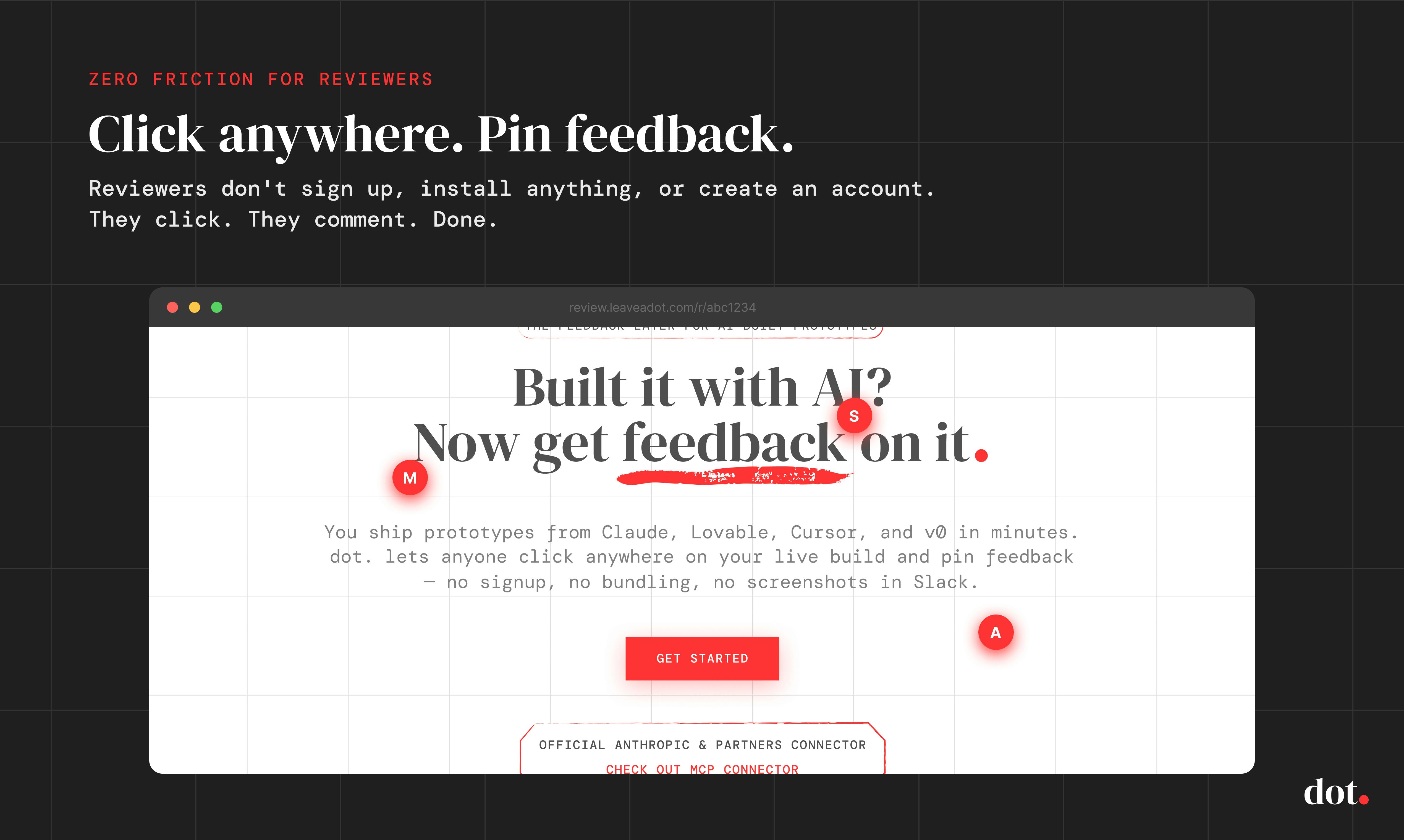
This is the problem dot. aims to solve. Launched recently, dot. positions itself as the essential feedback layer for anything you build with AI. It's designed to integrate seamlessly into AI-powered applications, providing developers and product teams with a structured way to gather, analyze, and respond to user input related to AI performance.
How dot. Works
At its core, dot. provides tools to capture feedback directly within the user experience of an AI application. Instead of generic comment boxes or separate survey tools, dot. allows users to provide context-specific input. This could range from flagging an incorrect AI response, rating the quality of generated content, or suggesting improvements to AI-driven features. The platform is built to understand that feedback on AI isn't just about what users like or dislike, but also about the accuracy, relevance, and usefulness of the AI's output in specific scenarios.
For developers, dot. offers a dashboard where this feedback can be aggregated and analyzed. The platform aims to provide actionable insights, moving beyond raw comments to categorize feedback by AI model, feature, or user segment. This structured approach is critical for iterating on AI models. For instance, if a particular type of query consistently yields poor results, dot. can highlight this trend, allowing engineers to retrain or fine-tune the relevant AI components.
The integration process is designed to be straightforward. dot. typically involves adding a JavaScript snippet or using an SDK, allowing it to hook into existing web or mobile applications. This low-friction entry point means teams can start collecting feedback without extensive engineering overhead. The focus is on making the feedback loop as short and efficient as possible, ensuring that insights are gathered while the user experience is fresh in the user's mind.
Key Features and Benefits
dot. offers several key features tailored for AI product development:
- Contextual Feedback Capture: Users can provide feedback directly linked to specific AI interactions, preserving crucial context.
- AI-Specific Metrics: Beyond general satisfaction, dot. can track metrics related to AI accuracy, relevance, and perceived helpfulness.
- Developer Dashboard: A centralized hub for viewing, filtering, and analyzing feedback trends, identifying patterns in AI performance.
- Integration Flexibility: Designed to work with a wide range of AI models and application architectures.
- Workflow Automation: Potential for connecting feedback triggers to AI model retraining pipelines or developer alerts.
The primary benefit is the ability to rapidly improve AI models based on real-world usage. By understanding precisely where and why an AI falters, development teams can prioritize fixes and enhancements more effectively. This leads to more robust, reliable, and user-friendly AI applications. For product managers, it means a clearer roadmap for AI feature development, driven by direct user validation.
The Broader Impact on AI Development
The launch of dot. signals a growing recognition of the unique challenges in developing and deploying AI-powered products. As AI becomes more pervasive, the need for specialized tools that address its specific lifecycle – from training and deployment to ongoing monitoring and improvement – becomes paramount. dot. fits into this emerging category of AI-specific developer tools.
Consider the difference between debugging a traditional software bug and diagnosing a flawed AI output. A traditional bug might be a logical error in code. An AI