DoorDash's AI Shopping Assistant: A Deep Dive into Production RAG
DoorDash has unveiled the sophisticated architecture powering its AI shopping assistant, dubbed "Ask DoorDash." This system eschews a monolithic LLM approach, instead integrating Retrieval-Augmented Generation (RAG) with a dynamic AI agent mesh to provide a more grounded and efficient user experience. The core challenge DoorDash tackled was ensuring the AI assistant could access and process real-time, product-specific information without solely relying on the LLM's potentially outdated or hallucinated knowledge base. This production-ready RAG architecture is designed for scale and accuracy, crucial for a platform dealing with millions of products and user queries.
At its heart, the system leverages a multi-stage retrieval process. When a user asks a question, the system first identifies relevant product information from DoorDash's extensive catalog. This isn't a simple keyword match; it involves sophisticated semantic search capabilities. The retrieved information is then augmented with the user's query and fed into a large language model. The LLM's role is not to generate an answer from scratch but to synthesize the retrieved data into a coherent, conversational response. This approach significantly reduces the likelihood of factual errors and allows the assistant to provide specific details about product availability, pricing, nutritional information, and more, directly relevant to the user's immediate needs.
AI Agent Orchestration and the Mesh Concept
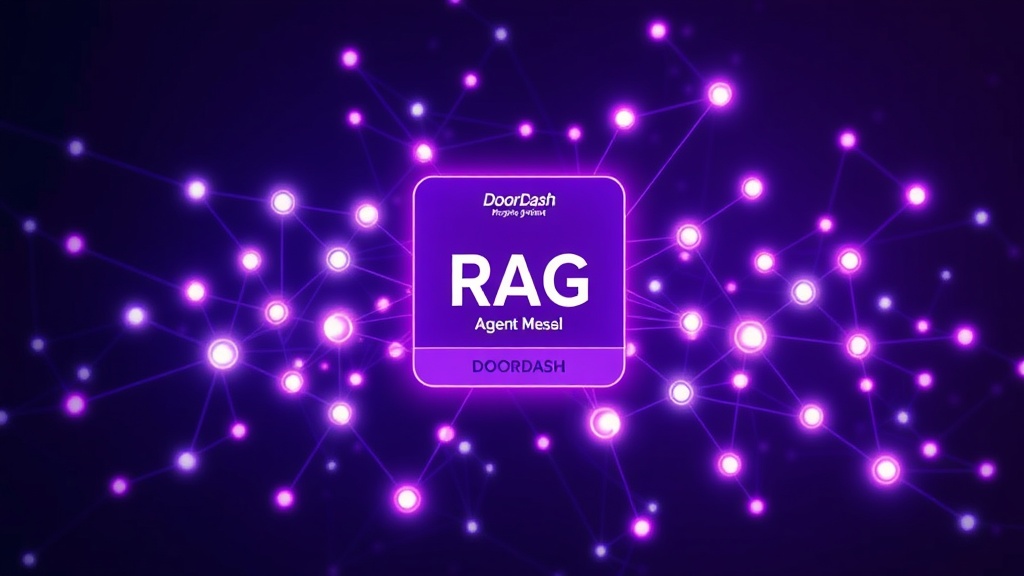
Beyond the RAG implementation, DoorDash is also exploring advanced AI agent orchestration. The concept of an "AI Agent Mesh" suggests a system where multiple specialized AI agents collaborate to achieve a larger goal. Instead of a single, all-knowing AI, the system comprises smaller, task-specific agents. For instance, one agent might be responsible for understanding natural language queries, another for retrieving product data, a third for processing payment information, and yet another for handling delivery logistics. These agents communicate and coordinate through the mesh, allowing for greater modularity, scalability, and resilience. If one agent fails or needs an update, it doesn't necessarily bring down the entire system.
This agent mesh architecture is akin to a highly efficient, distributed workforce. Each agent is an expert in its domain, much like a human specialist. When a complex task arises, like a user wanting to order a specific meal with dietary restrictions, the system can dynamically assign sub-tasks to the appropriate agents. The agent responsible for understanding the query might break it down into components: identify the restaurant, check menu items, filter by dietary needs, confirm availability, and then initiate the order. This collaborative approach allows for more complex workflows and a richer, more interactive user experience than a single-purpose AI could typically provide. The orchestration layer manages the flow of information and tasks between these agents, ensuring seamless execution.
Open-Source Supply-Chain Security Scanner
Complementing its internal AI advancements, DoorDash also highlighted the importance of open-source tools for supply-chain security. The company is a proponent of transparency and collaboration in software development, particularly when it comes to the security of the tools and libraries that power modern applications. A key focus area is auditing open-source dependencies, which can often be vectors for vulnerabilities or malicious code. By promoting and potentially contributing to open-source supply-chain scanners, DoorDash aims to empower the broader developer community to identify and mitigate risks within their own software development lifecycles.
These scanners typically work by analyzing code repositories, package managers, and build artifacts to identify potential security weaknesses. This can include detecting known vulnerabilities in libraries, identifying suspicious code patterns, or verifying the integrity of software components. For organizations building complex software systems, especially those relying heavily on third-party code, such tools are indispensable. They act as an early warning system, allowing security teams to address potential threats before they are exploited. The emphasis on open-source means these valuable security auditing capabilities can be adopted and improved by anyone, fostering a more secure digital ecosystem. This proactive approach to supply-chain security is becoming increasingly critical as software complexity grows and the threat landscape evolves.
Connecting the Dots: AI and Security in Modern Development
The convergence of advanced AI architectures like DoorDash's RAG system and agent mesh, alongside robust open-source security tooling, represents a significant trend in modern software development. As companies increasingly rely on AI for core functionalities, ensuring the integrity and security of these AI systems and their underlying infrastructure becomes paramount. The RAG architecture, by grounding LLMs in factual, retrievable data, offers a more trustworthy AI. The agent mesh provides a flexible and scalable framework for complex AI operations. Simultaneously, the commitment to open-source supply-chain security ensures that the foundational components of these systems are as secure as possible. This holistic approach, combining intelligent automation with rigorous security practices, is essential for building reliable and trustworthy applications in the age of AI.