
HTML to Native Word Docs: Introducing DOM-docx
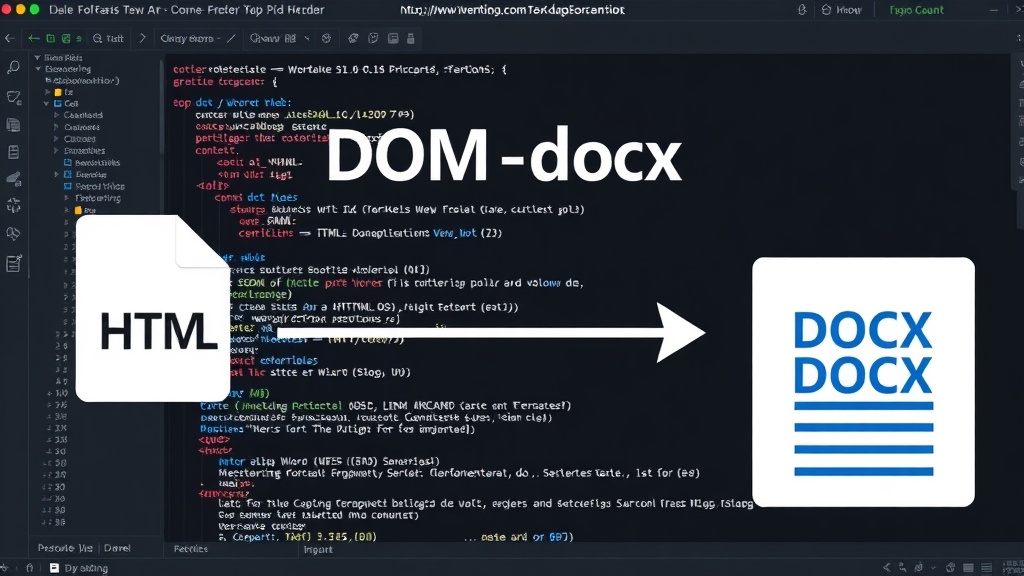
A new open-source tool, DOM-docx, has emerged to tackle the persistent challenge of converting HTML content into native, editable Microsoft Word (.docx) documents. Released under the permissive MIT license, DOM-docx aims to provide developers with a robust solution for generating rich-text documents from web-based content without relying on intermediate formats or proprietary APIs.
The core innovation of DOM-docx lies in its ability to parse HTML and its associated CSS, then translate these elements directly into the complex XML structure that defines the .docx format. Unlike many existing solutions that might convert to PDF and then attempt a PDF-to-Word conversion (often a lossy process), or those that require a full Word installation or cloud service, DOM-docx operates entirely client-side or within a server environment without external dependencies.
This approach means that developers can integrate DOM-docx into web applications, content management systems, or backend services to programmatically generate reports, invoices, articles, or any document requiring a professional, editable Word format. The tool prioritizes preserving the visual fidelity of the HTML, including text styling, tables, lists, and basic image embedding.
Technical Approach and Features
DOM-docx functions by traversing the Document Object Model (DOM) of an HTML string. It interprets HTML tags and CSS properties, mapping them to their corresponding WordprocessingML elements. This direct mapping is crucial for generating accurate and editable .docx files.
Key features include:
- HTML Parsing: Robust parsing of standard HTML structures.
- CSS Styling: Support for common CSS properties such as font family, size, color, bold, italics, underline, text alignment, and margins.
- Table Conversion: Conversion of HTML tables, including cell padding, borders, and basic background colors.
- List Generation: Correctly formats ordered and unordered lists.
- Image Embedding: Allows for the embedding of images within the generated Word document.
- MIT License: Free for commercial and non-commercial use, with minimal restrictions.
The tool handles the intricate XML schema of .docx files, which is a significant undertaking. Microsoft Word's .docx format is essentially a ZIP archive containing a collection of XML files that describe the document's content, structure, and formatting. DOM-docx generates these XML files on the fly and packages them into a valid .docx archive.
Consider the process of converting a simple HTML paragraph with a specific font size and color. In HTML, this might look like <p style="font-size: 12pt; color: #333;">...</p>. DOM-docx must translate this into WordprocessingML, which could involve elements like <w:p> (paragraph) with associated run properties (<w:rPr>) specifying font size (<w:sz w:val="24"/>, where 24 points = 12pt) and color (<w:color w:val="333333"/>). The complexity scales exponentially with more advanced HTML and CSS features.
Use Cases and Target Audience
The primary audience for DOM-docx includes web developers, backend engineers, and software architects who need to automate document generation. This could range from:
- Content Management Systems (CMS): Allowing users to export articles or blog posts in an editable Word format.
- E-commerce Platforms: Generating printable invoices or order confirmations.
- Reporting Tools: Creating detailed reports from application data that can be easily shared and modified by non-technical stakeholders.
- Internal Tools: Automating the creation of internal documentation, meeting minutes, or proposals.
The ability to generate native .docx files is a significant advantage. Users can open these documents in Microsoft Word, Google Docs (via upload), LibreOffice, or other compatible applications and continue editing without loss of formatting or structure, which is often a pain point with PDF conversions or proprietary formats.
Comparison to Existing Solutions
Several approaches exist for converting HTML to Word documents:
- Cloud-based APIs: Services like CloudConvert, DocRaptor, or Aspose offer powerful conversion capabilities but typically involve API calls, subscription fees, and reliance on external services.
- Server-side Libraries (e.g., Pandoc): Tools like Pandoc are highly versatile but often require an external process execution and can be resource-intensive. They might also have their own intermediate format considerations.
- Client-side JavaScript Libraries (e.g., html2pdf.js): These primarily target PDF generation, not native .docx.
- Microsoft's own COM Automation: This requires a licensed copy of Microsoft Word installed on the server, which is often not feasible for web applications.
DOM-docx differentiates itself by offering a pure JavaScript (or Node.js) solution that generates a native .docx file without external dependencies or cloud services. This makes it particularly attractive for developers seeking a self-contained, controllable, and cost-effective solution, especially for applications where data privacy or offline capabilities are important.
The surprising detail here is not the development of another conversion tool, but its MIT licensing and direct .docx generation approach. Many developers have grappled with imperfect HTML-to-Word conversions for years. A simple, MIT-licensed JavaScript library that bypasses the common pitfalls of PDF intermediaries or heavy server-side dependencies offers a genuinely useful alternative for a common developer pain point.
Future Potential and Considerations
While DOM-docx appears to handle common HTML and CSS features well, the complexity of the .docx format means that advanced features like complex CSS layouts (e.g., Flexbox, Grid), custom fonts, embedded objects, or intricate header/footer designs might present challenges. The project's success will depend on its ongoing development and community contributions to expand its feature set and improve its fidelity for more complex documents.
For developers building applications where a direct, editable Word document output is a requirement, DOM-docx represents a promising new option. Its open-source nature and direct conversion method simplify integration and reduce operational overhead compared to many existing solutions.