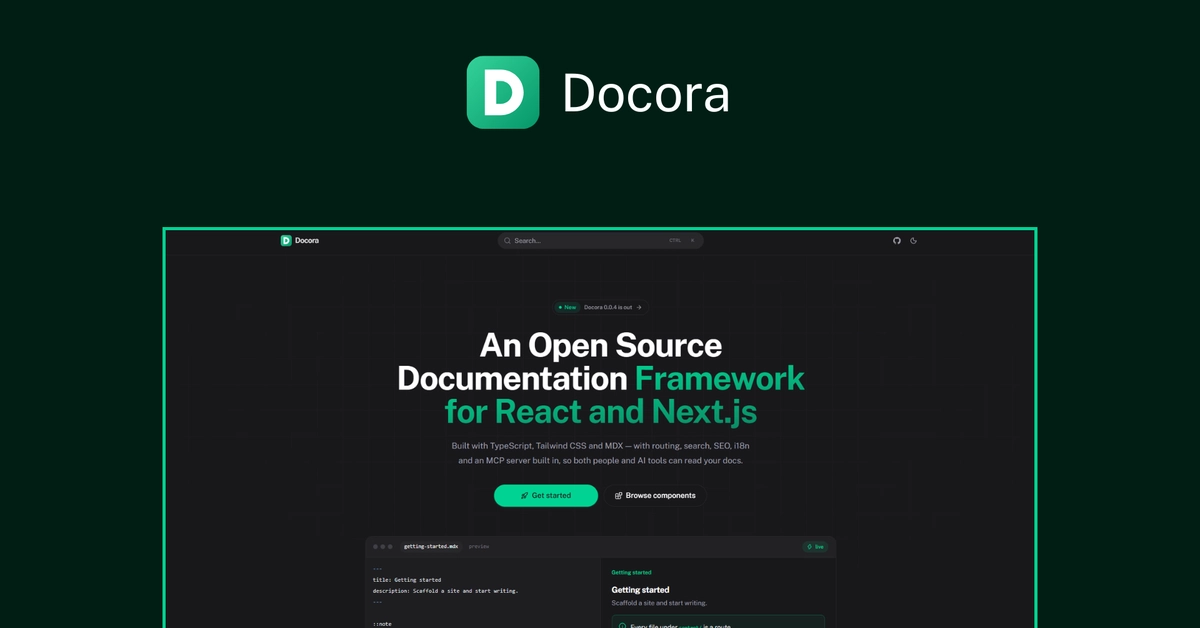
Docora: A New Documentation Framework for the React Ecosystem
A new open-source documentation framework, Docora, has emerged, aiming to streamline the process of creating and managing documentation for Next.js and React applications. Inspired by the success of Docus within the Nuxt ecosystem, Docora is built from the ground up to cater specifically to the modern JavaScript framework stack. Its creator, Ariful Islam, designed it to offer a comprehensive suite of features that address common pain points in developer documentation, from routing and content authoring to search and AI integration.
Core Features and Functionality
Docora differentiates itself with a set of robust, developer-centric features:
File-Based Routing
At its core, Docora employs a file-based routing system. This means that the structure of documentation pages is directly mapped to the file structure within a designated content/ directory. Each file and folder hierarchy translates into a URL path, simplifying navigation and organization. This approach aligns with the developer experience of modern frameworks like Next.js, where file-system routing is a standard practice.
MDC Syntax for Rich Content
Content authoring in Docora leverages Markdown with extensions (MDC syntax). This allows developers to write documentation in familiar Markdown while gaining access to richer content elements like callouts, cards, tabs, and steps without needing to import special components or write complex HTML. This feature streamlines the writing process and enhances the readability and interactivity of the documentation.
Compile-Time Search
Docora includes a built-in search functionality that operates at compile time. This is a significant advantage as it eliminates the need for external, hosted search services. The search is implemented as a command-palette-style interface, providing a fast and efficient way for users to find information within the documentation. This approach not only reduces dependencies but also improves performance and privacy by keeping search processing local.
SEO by Default
Recognizing the importance of discoverability, Docora prioritizes SEO. It automatically generates essential SEO elements such as sitemaps, robots.txt files, and canonical links. Furthermore, it supports the generation of Open Graph (OG) images, which are crucial for social media sharing and previewing links. This built-in SEO capability ensures that documentation is easily found by search engines and shared effectively.
Internationalization (i18n)
For projects requiring multilingual support, Docora offers a streamlined internationalization (i18n) system. Documentation is organized into separate folders for each locale, and the framework automatically includes hreflang tags. Hreflang tags are critical for SEO, informing search engines about the language and regional targeting of a page, thereby improving search rankings for international audiences.
AI Integration for Enhanced Readability
A standout feature of Docora is its focus on AI integration. The framework automatically generates an llms.txt file and hosts an MCP (Machine-Readable Content Protocol) server at /mcp on deployed sites. These components are specifically designed to make documentation easily readable by AI tools such as Cursor and Claude. This allows AI assistants to directly ingest and understand the project's documentation, enabling more intelligent querying and assistance for developers.
Optional AI Chat Widget
Complementing the AI-readability features, Docora includes an optional AI chat widget, branded as "Ask AI." This widget is built using the AI SDK and is routed through AI Gateway, providing an interactive way for users to ask questions and receive answers directly from the documentation. This feature transforms static documentation into a dynamic, conversational knowledge base.
Quickstart and Adoption
The framework provides a straightforward quickstart guide, aiming to lower the barrier to entry for developers looking to adopt Docora. By offering a comprehensive set of features out-of-the-box and adhering to modern development paradigms, Docora positions itself as a compelling solution for Next.js and React projects seeking high-quality, efficient, and AI-ready documentation.
The Broader Impact on Developer Documentation
Docora's emergence signals a growing trend towards more integrated and intelligent documentation tools within the JavaScript ecosystem. By combining familiar development patterns like file-based routing with advanced features like AI integration and compile-time search, it addresses the evolving needs of software development. The framework's open-source nature also fosters community contribution, promising continuous improvement and adaptation to future technological advancements.