
The Analogous Journey to Your Friend's House
Imagine you want to visit a friend. You know their name, not their precise GPS coordinates. You open a map app, type their name, and the app translates that into directions. The internet operates on a remarkably similar principle. This is the core idea behind the Domain Name System (DNS). It's the internet's phonebook, translating human-readable domain names like www.example.com into machine-readable IP addresses (e.g., 192.0.2.1) that computers use to locate each other.
Without DNS, navigating the web would be an exercise in memorization, requiring users to recall long strings of numbers for every site they wished to visit. This would render the internet impractical for widespread use. The system handles the heavy lifting of translation, making the digital world accessible to everyone.
How DNS Resolution Works: A Step-by-Step Breakdown
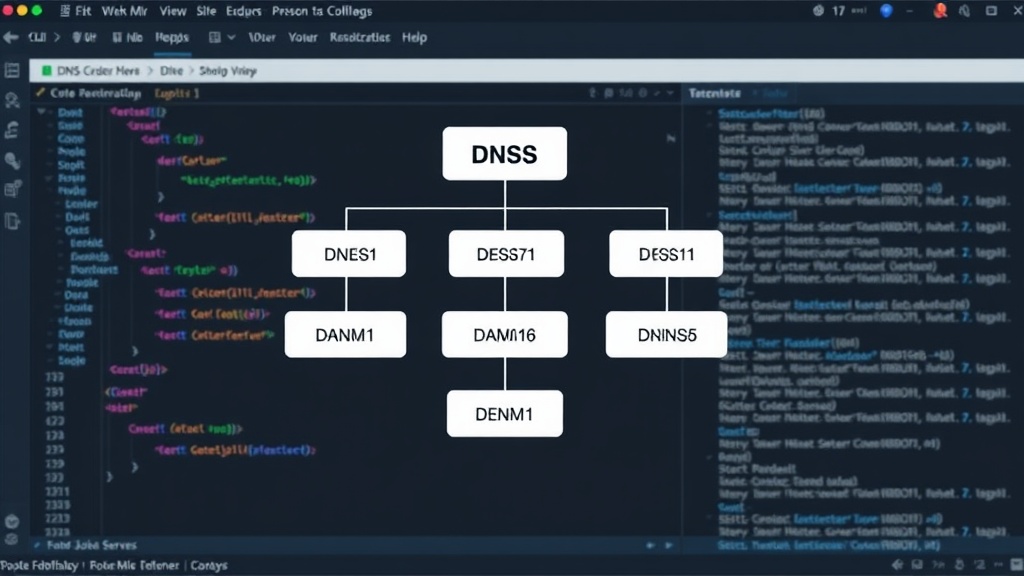
The process of resolving a domain name into an IP address is called DNS resolution. It involves a series of queries between your device and a hierarchy of DNS servers. Here's a simplified look at the journey:
- Recursive Resolver: When you type a URL into your browser, your computer first contacts a recursive resolver. This is typically operated by your Internet Service Provider (ISP) or a third-party service like Cloudflare or Google DNS. Your device asks, "What's the IP address for
www.example.com?" - Root Name Server: If the recursive resolver doesn't have the IP address cached (meaning it has recently looked it up), it contacts a root name server. There are 13 logical root name server clusters worldwide, managed by various organizations. The root server doesn't know the specific IP address but knows which Top-Level Domain (TLD) name server to direct the query to (e.g., the
.comname server). - TLD Name Server: The recursive resolver then queries the TLD name server for
.com. This server, in turn, doesn't know the exact IP address but directs the resolver to the authoritative name server for the specific domain (e.g.,example.com). - Authoritative Name Server: Finally, the recursive resolver contacts the authoritative name server for
example.com. This server holds the actual DNS records for the domain, including the IP address forwww.example.com. It responds to the recursive resolver with the IP address. - Response to Your Device: The recursive resolver receives the IP address, caches it for future use (for a set Time-To-Live or TTL), and sends it back to your computer. Your browser can then connect to the web server at that IP address to fetch the website's content.
This distributed, hierarchical system ensures that even with billions of domain names, resolution remains relatively fast and resilient. Each step in the process is critical, forming a robust chain of information retrieval.
Why DNS Matters: Beyond Simple Website Access
Understanding DNS is crucial for anyone working with the internet, from developers to security professionals. It's not just about getting to a website; it underpins many critical internet functions:
- Email Delivery: DNS records (like MX records) tell mail servers where to send emails for a specific domain.
- Website Hosting and Load Balancing: DNS directs traffic to the correct servers and can be used to distribute load across multiple servers for performance and reliability.
- Security: DNS is a prime target for attacks. Techniques like DNS spoofing or cache poisoning can redirect users to malicious sites. Understanding DNS security is vital for protecting users and infrastructure.
- Content Delivery Networks (CDNs): DNS is used to route users to the geographically closest CDN server, improving content loading speeds.
- Service Discovery: In complex network environments, DNS can help services find and communicate with each other.
The seemingly simple act of typing a URL triggers a complex, yet efficient, global system. Its reliability and speed are often taken for granted, but the underlying infrastructure is a testament to sophisticated engineering.
The Learning Curve and Its Rewards
The journey into understanding DNS can initially feel overwhelming. The jargon, the different types of records (A, AAAA, CNAME, MX, TXT, etc.), and the distributed nature of the system can seem daunting. However, the effort invested yields significant rewards. For developers, a solid grasp of DNS can help troubleshoot connectivity issues, optimize application performance, and understand how their applications interact with the internet at a fundamental level.
For security professionals, DNS is a critical component of the threat landscape. Understanding how DNS works is essential for detecting and mitigating various cyber threats, from phishing attacks that leverage DNS manipulation to securing domain registrations and preventing unauthorized changes. It's an area where a deep dive can reveal subtle vulnerabilities and robust defense strategies.
The initial push to learn DNS, even if it felt like gentle coercion, ultimately provides a foundational understanding that benefits anyone building, maintaining, or securing systems on the internet. It transforms abstract concepts into tangible knowledge, empowering individuals to better navigate and protect the digital world.