The Appeal of Building from Scratch
The ubiquity of PyTorch and TensorFlow in AI development often means working within their vast, intricate ecosystems. While powerful, these frameworks can feel like opaque black boxes to developers who want a deeper understanding of hardware interactions, memory management, and the direct mapping of mathematical operations to GPU acceleration. This lack of granular control and insight has spurred a new wave of interest in building deep learning frameworks from the ground up. Two recent projects, Aakaar and PyGo, illustrate this trend, demonstrating that custom-built solutions can offer not only deeper understanding but also competitive, and in some cases, superior performance.
Aakaar: C++ and CUDA for Raw Speed
Developer Aarav Aggarwal set out to strip away the abstractions by building Aakaar, a deep learning framework developed entirely from scratch using native C++ and CUDA. Aggarwal's motivation stemmed from a desire to bridge the gap between high-level AI development and the underlying hardware realities. By bypassing existing frameworks, Aakaar aims to provide a more direct and potentially faster path for computation.
The core architecture of Aakaar is built upon a purely native C++ backend. This decision is crucial because it allows for fine-grained control over memory allocation, kernel launches, and data movement – areas where high-level abstractions can introduce overhead. Building from scratch means that fundamental components like automatic differentiation (autograd) must be implemented manually. This is a significant engineering challenge, as autograd is central to the ease of use and flexibility of modern deep learning frameworks. Aggarwal's approach involves meticulously hand-coding the mathematical operations and their corresponding gradient calculations, ensuring that each step is optimized for the underlying hardware.
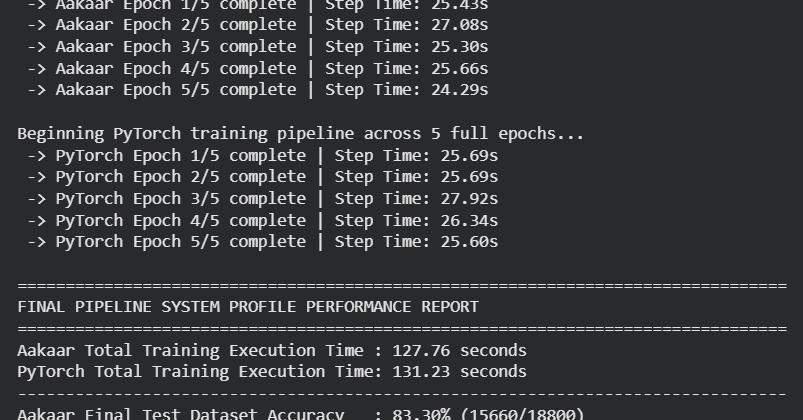
The surprising outcome of this intensive development effort was Aakaar's performance in direct benchmarks against PyTorch. In several key tests, Aakaar managed to edge out PyTorch, a testament to the efficiency gains possible when an entire framework is tailored to specific computational needs and hardware capabilities. This suggests that for certain workloads, the overhead introduced by PyTorch's extensive feature set and abstraction layers can be a limiting factor, and a lean, purpose-built framework can achieve higher speeds. Aggarwal wrapped the C++ and CUDA core in Python for user-friendliness, allowing developers to leverage Aakaar's performance benefits with a familiar API.
PyGo: Go Orchestrates Python and C++
In a different architectural approach, developer Sarkar Agi created PyGo, a deep learning framework that adopts a polyglot strategy, with Go acting as the top-level API. This project embeds CPython within a Go process, allowing Go to call Python, which in turn interfaces with C++/CUDA for heavy computation. The architecture is visualized as:
Go API → CGo bridge → CPython (embedded) → pybind11 → CUDA/AVX-512 kernelsThe key innovation in PyGo lies in its memory management. Instead of relying on inter-process communication or separate memory spaces, tensors are designed to live in shared memory. This zero-copy approach across Go, Python, and C++ layers is critical for maintaining performance, as it eliminates the costly data transfers that often plague multi-language systems. By embedding CPython directly into the Go binary, PyGo avoids the overhead of launching a separate Python interpreter or managing complex sidecar processes, a common pattern in cloud-native ML deployments.
The choice of Go as the primary API is strategic. Go is already a dominant language in the machine learning infrastructure space, powering tools like Kubernetes, Prometheus, and etcd. PyGo aims to make deep learning models first-class citizens within this existing operational stack. This means that ML teams can integrate model serving and management directly into their Go-based infrastructure without needing to rewrite their entire operations tooling. Furthermore, Go's built-in concurrency primitives, particularly goroutines, make dynamic batching—a technique for optimizing inference throughput by grouping requests—a more trivial task to implement and manage.
The current state of PyGo involves a functional integration of these components. While it may not yet offer the same breadth of features as mature frameworks, its architectural design focuses on specific pain points in ML deployment and infrastructure integration. The project highlights a pragmatic approach to building specialized tools that leverage existing strengths of different languages and environments.
The Broader Implications
Both Aakaar and PyGo, despite their different methodologies, signal a growing dissatisfaction with the monolithic nature of current deep learning frameworks. Developers are seeking greater transparency, control, and performance. Aakaar's success in raw speed benchmarks suggests that meticulous, low-level optimization in C++ and CUDA can still yield significant advantages. It provides a blueprint for how to achieve peak performance by understanding and directly exploiting hardware capabilities.
PyGo, on the other hand, addresses the operational and integration challenges faced by teams already invested in Go-based infrastructure. Its approach of embedding Python and using shared memory offers a path to seamless ML integration within existing DevOps workflows. The project demonstrates that polyglot architectures, when carefully designed with zero-copy principles, can be highly effective.
What remains unaddressed by these projects, however, is the long-term maintainability and community adoption for such bespoke frameworks. While they offer compelling advantages for their creators and potentially niche use cases, building and sustaining a comprehensive deep learning ecosystem requires significant ongoing effort and community engagement. The question for many developers will be whether the performance gains and control offered by Aakaar or PyGo outweigh the rich feature sets, extensive documentation, and large user bases of established players like PyTorch and TensorFlow. For now, these DIY frameworks serve as powerful proof points, pushing the boundaries of what's possible in deep learning performance and integration.