From Live Site to Source Code: The Promise of ditto.site
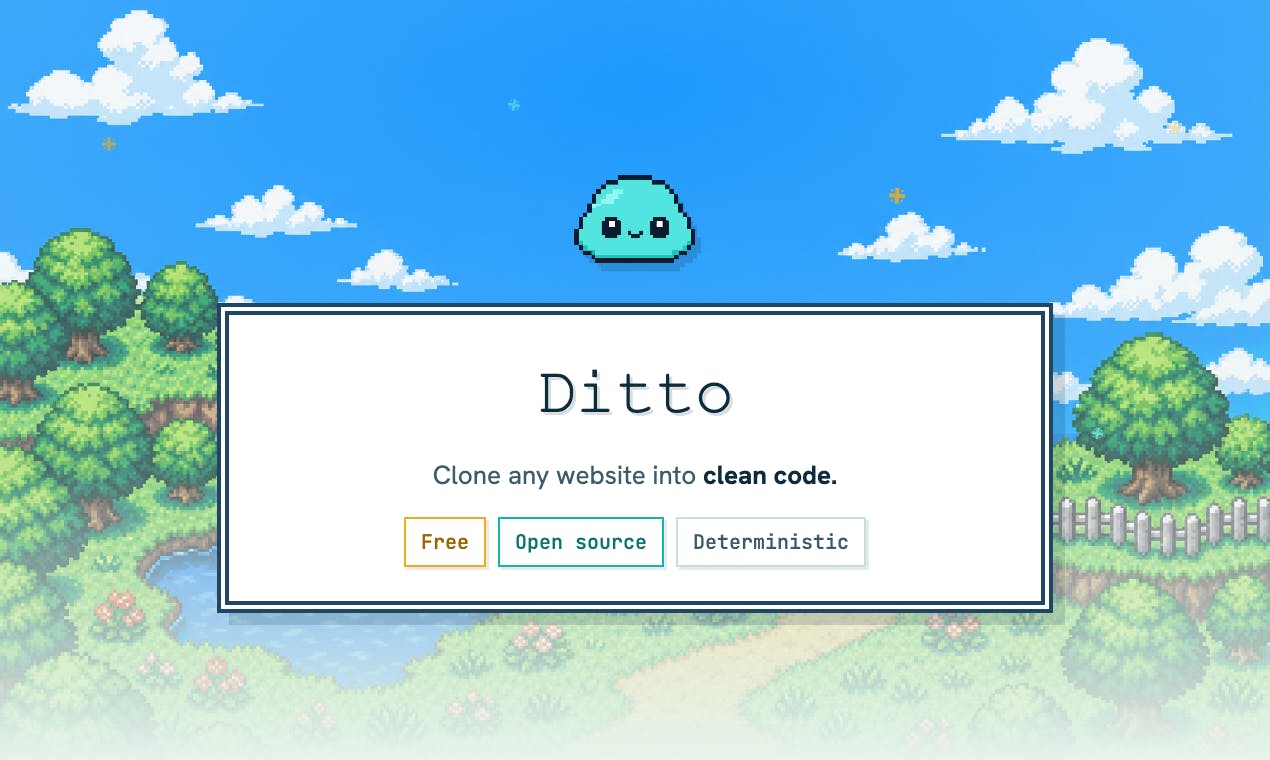
The web development landscape is constantly seeking tools that accelerate the creation and iteration process. A new entrant, ditto.site, promises to do just that by enabling users to clone any live website and transform it into clean, editable code. This open-source project, recently featured on Product Hunt, aims to democratize web development by providing a free and accessible method for dissecting and replicating existing web designs.
At its core, ditto.site functions as a website cloner. Users input a URL, and the tool analyzes the live site, extracting its HTML, CSS, JavaScript, and other assets. The output is a structured codebase that developers can then use as a starting point for their own projects, for learning purposes, or for auditing existing sites. The emphasis on "clean code" suggests an effort to generate well-organized and maintainable files, which is a crucial factor for any developer inheriting or building upon existing codebases.

Understanding the Technology Behind Website Cloning
The process of cloning a website involves several technical steps. First, the tool must perform a comprehensive crawl of the target URL, identifying all linked resources. This includes not just the primary HTML document but also external stylesheets, JavaScript files, images, fonts, and any other assets that contribute to the visual presentation and interactive behavior of the page. Sophisticated crawlers employ techniques like recursive fetching and intelligent link following to ensure that all relevant components are discovered.
Once these assets are gathered, ditto.site likely processes them to reconstruct the website's structure and styling. This could involve parsing the HTML to understand the DOM tree, interpreting CSS rules to replicate the visual layout, and analyzing JavaScript to capture client-side interactivity. The challenge here lies in accurately translating dynamic content, complex CSS layouts (like Flexbox or Grid), and intricate JavaScript functionalities into a coherent and functional code package. For instance, replicating animations, form submissions, or API-driven content requires a deep understanding of how these elements are implemented on the live site.
The "clean code" aspect is particularly noteworthy. Generating code that is not only functional but also readable, organized, and adheres to best practices is a significant undertaking. This implies that ditto.site may incorporate code formatting, linting, and potentially even refactoring steps to ensure the output is developer-friendly. This distinguishes it from simpler scraping tools that might just download raw files without any structural organization.
Potential Use Cases and Target Audience
The implications of a tool like ditto.site are broad, appealing to a diverse range of users within the tech community. For aspiring web developers, it offers an unparalleled learning resource. By cloning websites they admire, beginners can reverse-engineer the design and functionality, dissecting how professional developers have implemented specific features or achieved particular aesthetic goals. This hands-on approach to learning can accelerate skill acquisition far beyond static tutorials.
Experienced developers might leverage ditto.site for rapid prototyping or to gain a quick understanding of a competitor's web presence. If a company needs to quickly replicate a certain design pattern or a functional component seen on another site, ditto.site could provide a significant head start. It could also be invaluable for website audits, allowing developers to quickly obtain a baseline code structure for analysis, performance checks, or security assessments.
Furthermore, the open-source nature of ditto.site is a critical factor. It means the tool is freely available, transparent in its operation, and can be improved upon by the community. This fosters collaboration and allows developers to contribute fixes, enhancements, or even adapt the tool for specialized purposes. The absence of licensing fees and the ability to inspect and modify the source code make it an attractive option for individuals and organizations with budget constraints or a need for custom solutions.
Challenges and Limitations in Website Replication
Despite its promising capabilities, website cloning tools like ditto.site face inherent challenges. The first is the dynamic nature of the modern web. Many websites rely heavily on server-side rendering, client-side JavaScript frameworks (like React, Vue, or Angular), and APIs to deliver content. Simply downloading static files might not capture the full functionality or the intended user experience of such sites. Replicating a single-page application (SPA) with complex state management, for instance, is a far more intricate task than cloning a static HTML brochure site.
Another significant hurdle is intellectual property and copyright. While ditto.site might clone the code, the design, content, and branding of a website are typically protected by copyright. Using cloned code for commercial purposes without permission could lead to legal issues. The tool itself may include disclaimers, but the onus remains on the user to ensure their usage complies with relevant laws and ethical considerations. It's crucial for users to understand that cloning a site for learning or personal reference is generally acceptable, but direct commercial replication without authorization is not.
The accuracy of the cloned code is also a potential limitation. Differences in server configurations, CDN caching, and the specific versions of libraries or frameworks used can all affect how a website renders and functions. A tool that perfectly clones one site might struggle with another, especially if the target site employs unconventional development practices or advanced techniques. Continuous updates and refinements to the cloning algorithm are therefore essential to maintain a high level of fidelity across a wide range of websites.
The Future of Code Generation and Web Development Tools
ditto.site emerges at a time when automated code generation is becoming increasingly sophisticated. AI-powered tools are beginning to write code, design interfaces, and even debug applications. In this context, a website cloner can be seen as a specialized form of code generation, focusing on the visual and structural aspects of web development. Its success will likely depend on its ability to keep pace with evolving web technologies and its effectiveness in producing truly usable code.
The open-source model is also a powerful driver for innovation in developer tools. By making the project public, ditto.site invites contributions and feedback from the very community it aims to serve. This collaborative approach can lead to faster development cycles, broader adoption, and the identification of edge cases that a single development team might miss. For developers, founders, and creators, tools like ditto.site represent a shift towards more efficient workflows, where foundational code structures can be generated rapidly, freeing up human talent to focus on higher-level problem-solving, unique features, and creative design.
As the web continues to evolve, the demand for tools that simplify complex tasks will only grow. ditto.site, by offering a free and open-source solution to a common development challenge, positions itself as a potentially valuable addition to the developer's toolkit. Its ultimate impact will be measured by its accuracy, usability, and its ability to empower developers to build and innovate more effectively.