
The AI Paradox: A Tool Amplifies, But Doesn't Create, Skill
In the rapidly evolving landscape of artificial intelligence, it's easy to get swept up in the sheer capability of new tools. We marvel at AI's power to generate code, summarize documents, and even create art. Yet, a growing realization is surfacing: AI, like any powerful instrument, is only as effective as the person wielding it. The core message echoing from practitioners and observers alike is that discipline, not the AI itself, is the ultimate determinant of success in this new era.
Think of AI less like a magic wand and more like a high-powered telescope. It can reveal distant galaxies and intricate details previously invisible. However, without a skilled astronomer to calibrate the instrument, interpret the data, and understand the celestial mechanics, the telescope is merely a sophisticated piece of glass. Similarly, AI can process vast amounts of information and execute complex tasks at speeds humans cannot match. But it lacks judgment, foresight, and the critical reasoning that underpins true innovation and effective problem-solving. The danger lies not in the AI's potential, but in its unguided application by individuals lacking the discipline to steer it effectively.
This perspective shifts the focus from the technology to the user. The conversation moves beyond simply adopting AI tools to cultivating the human qualities that make AI adoption meaningful. It highlights that the true frontier for leveraging AI isn't in developing more advanced algorithms, but in developing more disciplined and thoughtful users. Without this human element, AI-driven workflows can easily devolve into a chaotic mess of half-baked ideas and uncorrected errors, amplifying mistakes rather than achievements.
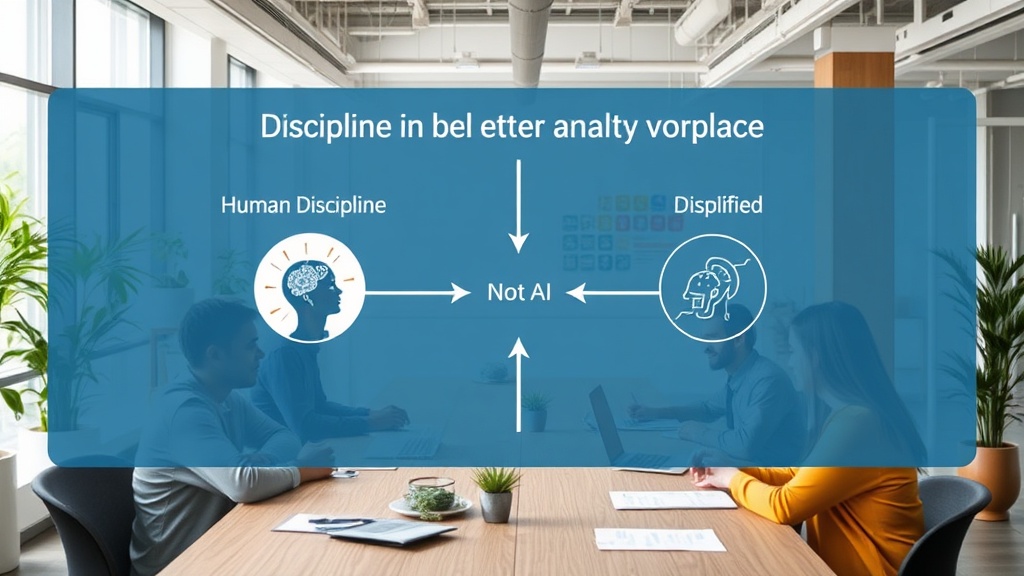
Cultivating Discipline in an AI-Augmented World
The question for many professionals is no longer *if* they should use AI, but *how* to integrate it responsibly and effectively into their existing workflows. This requires a conscious effort to build and reinforce personal and team-level disciplines. One example gaining traction is the practice of deliberate thought-capture. By starting the workday with a structured process of recording thoughts—perhaps by transcribing initial ideas about meetings and tasks—individuals can force themselves to engage in critical reasoning.
This process of articulating thoughts, even if rambling initially, serves a dual purpose. First, it aids in organization, much like AI-generated notes can. Second, and more importantly, it compels the user to identify what is truly important and what is noise. This act of self-imposed prioritization is a fundamental form of discipline. It ensures that when AI tools are subsequently employed, they are directed towards well-defined objectives and meaningful inputs. This purposeful engagement prevents AI from becoming a crutch that masks a lack of clarity, instead making it a powerful accelerator for well-considered plans.
The Discipline of Correction and Iteration
Beyond initial planning and input, discipline is equally crucial in the correction and refinement stages. As much as one might strive to design and document code projects meticulously, the reality of software development—and indeed, many other complex fields—is that errors occur. AI can assist in identifying potential bugs or suggesting code improvements, but it cannot replace the human developer's responsibility for understanding the system's architecture, the project's goals, and the nuanced implications of any change.
This is where the discipline of rigorous testing, validation, and iterative improvement becomes paramount. It means not blindly accepting AI-generated solutions, but critically evaluating them against project requirements and potential side effects. It involves a commitment to understanding *why* a particular AI suggestion works or fails, rather than just implementing it. This deep engagement fosters a more robust development process, where AI acts as a highly intelligent assistant rather than an autonomous decision-maker. The ability to critically assess, correct, and refine AI outputs is a hallmark of a disciplined practitioner, ensuring that the final product is not just functional, but also well-architected and aligned with strategic objectives.
What This Means for the Future of Work
The emphasis on discipline in the age of AI suggests a fundamental shift in the skills that will be most valued. Technical proficiency with AI tools will remain important, but it will be secondary to the underlying human qualities of critical thinking, self-management, and a commitment to rigor. Companies and individuals who prioritize developing these disciplines will be best positioned to harness the full potential of AI, avoiding the pitfalls of its misuse.
This isn't to say AI isn't transformative. It is. But its transformative power is unlocked by human intention and discipline. The ability to frame problems clearly, to direct AI with precision, and to critically evaluate its outputs are the new essential skills. The AI-amplified working world demands not just smarter machines, but smarter, more disciplined humans.