AI-Powered Code Review and Collaboration
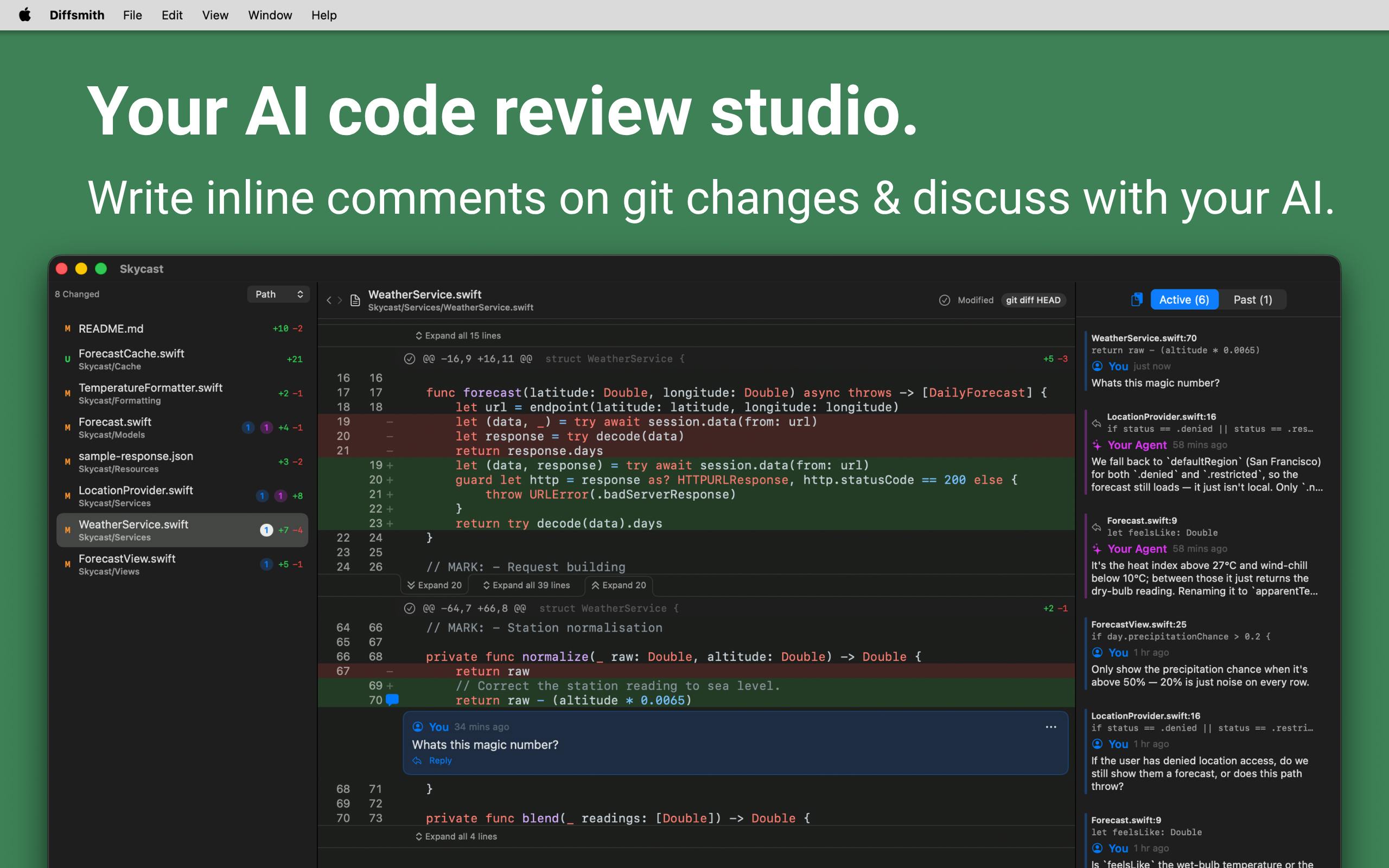
Diffsmith has launched as a new platform designed to enhance the code review process, particularly for AI-generated code. The tool focuses on facilitating collaboration among teams and providing detailed commentary on the output of AI coding agents. This aims to bridge the gap between AI-assisted development and human oversight, ensuring code quality and maintainability.
The core functionality of Diffsmith revolves around its ability to parse and present code changes in a clear, reviewable format. It allows users to comment directly on specific lines or blocks of code, fostering a more granular and efficient feedback loop. This is particularly useful when working with code that might be generated rapidly by AI, where subtle errors or suboptimal logic can be easily introduced.
One of the key challenges in modern software development, especially with the rise of AI coding assistants, is maintaining code integrity and ensuring that generated code aligns with project standards and best practices. Diffsmith addresses this by providing a dedicated environment for human developers to scrutinize, discuss, and approve AI-generated code. Think of it less like a simple diff tool and more like a digital whiteboard specifically for code, where every suggestion and critique is tied directly to the relevant code artifact.
Streamlining AI Agent Development Workflows
The platform is built with the understanding that AI agents are increasingly becoming co-developers. As these agents produce code, the need for robust review mechanisms becomes paramount. Diffsmith provides a structured way to manage this workflow. Developers can submit code generated by an AI agent to Diffsmith, and then invite team members to review it. The system supports threaded discussions, allowing for back-and-forth conversations on specific code sections, similar to how code reviews are conducted in platforms like GitHub or GitLab, but with an added focus on AI output.
This approach helps teams catch potential issues early in the development cycle. Instead of relying solely on automated tests, which may not always capture nuanced logic errors or stylistic inconsistencies, Diffsmith introduces a human-in-the-loop process. The platform aims to make this process as friction-free as possible, reducing the cognitive load on reviewers and speeding up the integration of AI-assisted code into production systems.
The collaboration features are designed to be intuitive. Users can highlight code snippets, add comments, and tag colleagues. The system keeps a history of all discussions and changes, creating an auditable trail of the review process. This is invaluable for debugging, knowledge sharing, and ensuring accountability within a development team that is increasingly leveraging AI tools.
Key Features and Benefits
Diffsmith’s feature set is geared towards improving the efficiency and effectiveness of code review for AI-generated code. The platform offers:
- AI Code Commentary: The ability to directly comment on AI agent code, providing specific feedback and suggestions.
- Collaborative Review: Tools for team members to engage in discussions around code changes, facilitating group decision-making.
- Version Control Integration (Implied): While not explicitly detailed in the initial announcement, a tool of this nature would likely integrate with existing version control systems to track changes and manage code evolution.
- Workflow Management: A structured process for submitting, reviewing, and approving AI-generated code, intended to fit within existing development pipelines.
- Focus on AI Output: Tailored features that recognize the unique characteristics and potential pitfalls of code produced by artificial intelligence.
The benefit for development teams is a faster, more reliable way to integrate AI-generated code. By centralizing the review process and enhancing communication, Diffsmith helps reduce the time spent on manual code inspection and lowers the risk of introducing errors. This allows teams to adopt AI coding tools more confidently, accelerating their development cycles without compromising on code quality.
The platform's emphasis on collaboration is its standout characteristic. It acknowledges that AI is a tool, and human expertise is still critical for validation and strategic decision-making. Diffsmith provides the infrastructure for this human-AI partnership to flourish, turning AI-generated code from a potential liability into a tangible asset.
The Future of AI in Code Review
As AI coding assistants become more sophisticated, they will inevitably generate a larger volume of code. Tools like Diffsmith are essential for managing this influx. They represent a new category of development tools that sit at the intersection of AI and human collaboration. The surprising detail here is not just the existence of another code review tool, but its explicit positioning to solve the unique challenges posed by AI-generated code, a problem that is rapidly growing in importance.
What nobody has addressed yet is how Diffsmith might evolve to proactively identify common AI-generated code anti-patterns or suggest optimizations based on aggregate review data across multiple projects. If the tool can learn from the collective review process, it could become an even more powerful force in shaping the quality of AI-assisted development.
For teams already experimenting with AI coding agents, Diffsmith offers a much-needed solution to bring order to the process. It’s a clear signal that the industry is moving beyond simply generating code with AI to systematically integrating and validating it within professional workflows.