The Ubiquitous Challenge of Backend Logic Planning
Staring down an endpoint with 10 or more business logic steps often triggers a cognitive wall for developers. It's not merely about recalling individual function behaviors; the real hurdle lies in tracking their intricate interactions, understanding the data flow, and managing error propagation across a complex chain. This inherent complexity, known as cognitive overload, frequently leads developers to default to less effective manual methods. These typically involve scribbling on paper or cobbling together documentation in tools like Notion. However, these approaches invariably lead to fragmented logic, preventing a holistic view of the system. The outcome is a collection of disconnected 'islands of code' rather than a cohesive, manageable workflow.
Why Manual Methods Crumble Under Complexity
To understand the failure mechanism of manual methods, consider the process of system design. While decomposing functions is a fundamental first step, manual approaches often fail to adequately represent the critical data flow pathways. For instance, when a developer sketches logic on paper, they might map out sequential steps but miss the nuances of how data is transformed, validated, and passed between these steps. Imagine a scenario where a user registration endpoint involves multiple steps: email validation, password strength check, database insertion, and sending a welcome email. Each step has its own input requirements and output data. A simple flowchart might show the sequence, but it struggles to detail the specific data structures expected at each interface, the validation rules applied, or the precise error codes returned if a step fails. This lack of granular detail in data flow and error handling is precisely where manual methods become insufficient as complexity scales. The system becomes a black box, difficult to debug, refactor, or even onboard new team members to.
The Pitfalls of Fragmented Logic
The core issue with manual, fragmented logic management is the loss of a unified system perspective. Developers end up with a collection of individual functions or scripts that, while functional in isolation, do not present a clear picture of the overall business process. This makes it incredibly difficult to:
- Identify Bottlenecks: Without a clear visualization of the entire workflow, pinpointing performance bottlenecks becomes a guessing game. It's hard to see which step is taking the longest or consuming the most resources.
- Manage Dependencies: Understanding how changes in one part of the logic might impact other parts is crucial. Fragmented logic obscures these dependencies, increasing the risk of introducing regressions.
- Ensure Consistency: Different developers might implement similar logic patterns in slightly different ways, leading to inconsistencies in error handling, data formatting, or security practices.
- Onboard New Team Members: A fragmented system is a steep learning curve. New developers spend excessive time deciphering disparate pieces of logic rather than contributing effectively.
This fragmentation is akin to trying to understand a complex machine by looking at individual gears and levers without seeing how they connect to form a functional whole. The result is not just inefficiency but a breeding ground for bugs and maintenance nightmares.
Towards a Unified Solution: Visualization and Centralization
The path to simplifying complex backend logic management lies in embracing tools and methodologies that provide both visualization and centralization. Instead of relying on disparate notes and diagrams, developers need a platform that can represent the entire backend workflow in a clear, interactive manner. This involves tools that can:
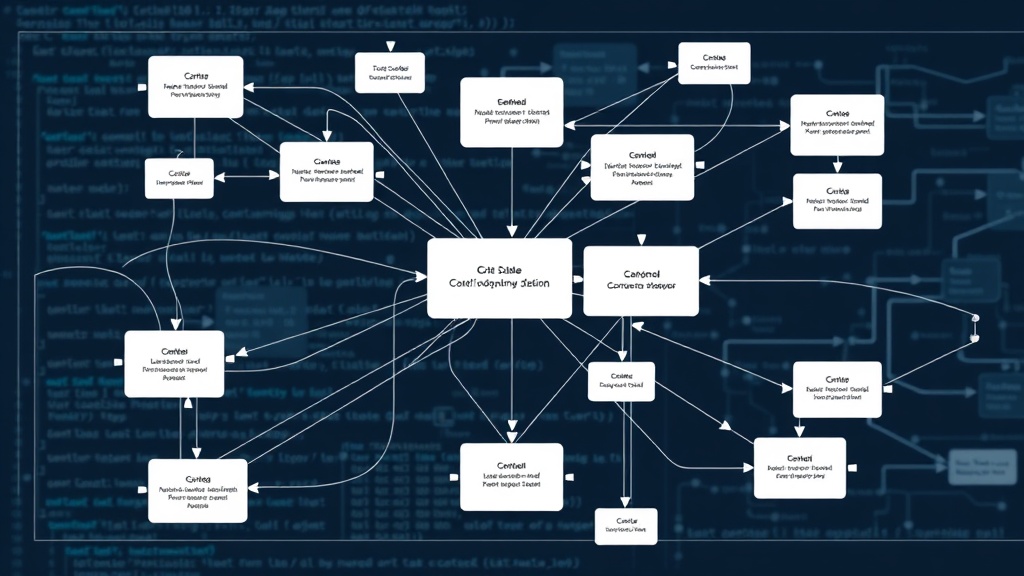
- Model Logic Visually: Representing business logic as a directed graph, where nodes are functions or operations and edges represent data flow and control dependencies. This visual representation makes complex interactions immediately understandable.
- Centralize Logic Definitions: Storing all backend logic definitions in a single, accessible location, rather than scattered across different files, documents, or developer notebooks.
- Trace Data Flow and Errors: Allowing developers to easily trace the path of data through the logic graph and understand how errors propagate, simplifying debugging and impact analysis.
- Facilitate Collaboration: Providing a shared understanding of the backend logic, enabling teams to collaborate more effectively on design, implementation, and maintenance.
Such an approach moves beyond simple code documentation to a dynamic, executable model of the backend. Think of it less like a static blueprint and more like a living, interactive simulation of your backend processes. This allows for proactive identification of issues during the planning phase itself, rather than discovering them during testing or, worse, in production.
The Impact on Planning and Implementation
By adopting a visual and centralized approach to backend logic management, development teams can achieve significant improvements in both planning and implementation efficiency. During the planning phase, complex workflows become comprehensible at a glance. Architects and developers can collaboratively design and refine logic flows, ensuring all edge cases and error conditions are considered. This visual clarity acts as a powerful communication tool, aligning stakeholders on the intended system behavior. For implementation, a centralized, visual model serves as a single source of truth. Developers can refer to this model to understand exactly how their code fits into the larger system, reducing ambiguity and the likelihood of introducing errors. Debugging becomes faster as the visual representation allows for rapid identification of the root cause of issues. Ultimately, this shift from fragmented, manual methods to integrated, visual management transforms the daunting task of handling complex backend logic into a more manageable, efficient, and less error-prone process.
Unanswered Questions in the Evolution of Logic Management
While the benefits of visual and centralized backend logic management are clear, a critical question remains unaddressed: What is the long-term impact on the maintainability and evolution of these visual models themselves? As backend systems grow and change, the visual representations must also adapt. How do teams efficiently manage versioning of these logic graphs? What are the best practices for refactoring complex visual logic without introducing breaking changes? Furthermore, as AI-driven code generation becomes more prevalent, how will these visual logic models integrate with or guide automated development processes? The current focus is on simplifying the human understanding of logic; the next frontier will likely involve seamlessly connecting that human understanding to automated system creation and maintenance.