The Rise of Generative Engine Optimization (GEO)
AI search engines like ChatGPT, Perplexity, Claude, and Google AI Overviews are no longer fringe tools. As of early 2026, they process between 12% and 18% of English-language informational queries, a dramatic surge from less than 2% a year prior. While traditional search still captures the bulk of overall traffic, AI-driven visits exhibit higher conversion rates and operate under a distinct set of principles. This new paradigm demands a new optimization strategy: Generative Engine Optimization (GEO).
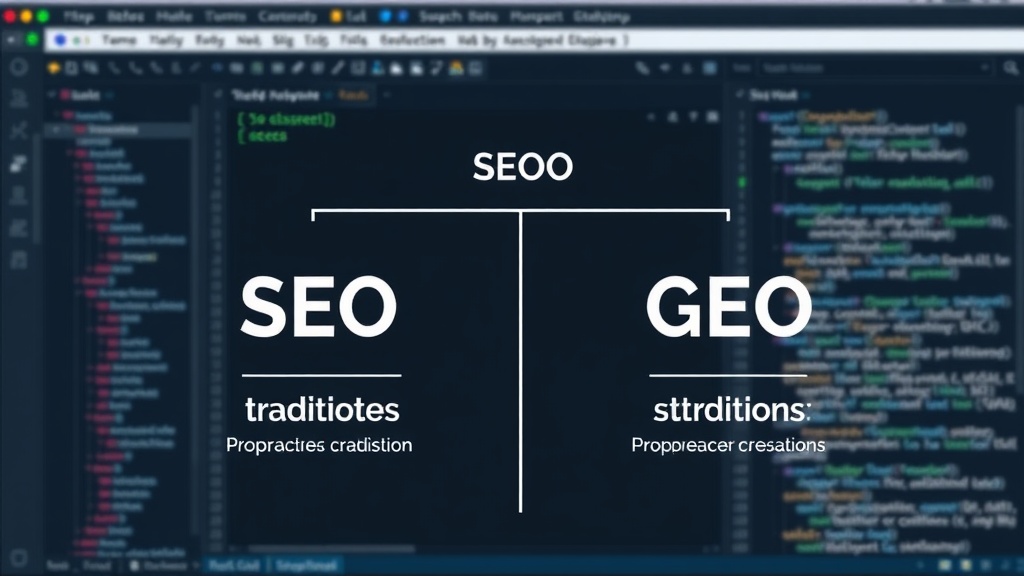
GEO differs fundamentally from conventional Search Engine Optimization (SEO). Instead of aiming for top rankings on a traditional results page, GEO's objective is to ensure your content is selected and synthesized into AI-generated answers. The key differentiator is not domain authority, but the clarity, structure, and directness of your response to a specific user question. The clearest, most structured answer wins.
This shift impacts developers and content creators profoundly. Getting your technical documentation, tutorials, or blog posts featured in an AI overview means direct access to users actively seeking solutions. This isn't just about visibility; it's about becoming the definitive source for an AI's synthesized response.
Technical Layers for GEO Success
Successfully integrating your content into AI search syntheses requires addressing several technical layers. These are not optional; they are foundational for AI crawlers and their interpretation of your site's value.
Layer 1: Controlling AI Crawl Access via robots.txt
The absolute first step is ensuring that the correct AI retrieval crawlers can access your content. Many guides overlook a crucial distinction: the difference between general web crawlers and the specialized retrieval crawlers employed by AI search engines. While your robots.txt file has long been used to manage access for traditional search engine bots, its role is equally, if not more, critical for AI. You must explicitly allow access for AI crawlers, or they may bypass your site entirely, treating it as inaccessible or undesirable content.
This involves identifying the user agents of major AI search providers. For instance, Google's AI crawlers might use specific user agents distinct from its standard Googlebot. Similarly, other AI platforms will have their own identifiers. Whitelisting these specific user agents in your robots.txt file is paramount. Failure to do so means your meticulously crafted content will never even be considered for inclusion in AI-generated answers. It’s akin to building a beautiful library but forgetting to unlock the front door for your most important patrons.
Layer 2: Structured Data and Semantic Markup
AI models thrive on structured data. They need to understand the relationships between concepts, the hierarchy of information, and the precise meaning of terms. This is where semantic markup becomes indispensable. Implementing Schema.org vocabulary, JSON-LD, and other structured data formats helps AI crawlers parse your content more effectively. Think of it as providing a detailed index and table of contents for the AI, making it effortless to extract key information, code snippets, definitions, and factual statements.
For developer sites, this means marking up code examples, API documentation, error messages, and technical explanations with appropriate semantic tags. Use properties like codeSample, programmingLanguage, executableCode, and stepByStepApproach. The more clearly you define the nature and purpose of your content through markup, the higher the probability that an AI will accurately interpret and utilize it in its synthesized responses. Unstructured, free-form text is far less likely to be picked up reliably.
Layer 3: Content Clarity, Conciseness, and Directness
AI synthesizers are designed to provide direct answers. This means your content must be exceptionally clear, concise, and directly address the question posed. Long, rambling introductions or tangential discussions will be detrimental. Developers often write detailed explanations, which is valuable, but for GEO, the core answer or solution needs to be front-loaded and easily digestible.
Consider the user query: "How to implement asynchronous calls in Python with asyncio." An AI will scan for the most direct explanation of asynchronous calls using the asyncio library. Content that starts with a historical overview of concurrency or broad definitions of asynchronous programming will likely be overlooked in favor of a piece that immediately dives into code examples and clear explanations of async def and await.
This also extends to the language used. Avoid jargon where a simpler term suffices, and ensure your technical terms are precisely defined. The AI needs to trust that your content provides accurate, unambiguous information. If your content is perceived as ambiguous or overly complex, the AI will seek answers elsewhere.
Layer 4: Verifiability and Source Attribution
As AI search evolves, the emphasis on verifiability and source attribution will only increase. AI models are being trained to cite their sources, and they prefer sources that are reliable and demonstrably accurate. This means ensuring your content is factually correct, well-researched, and, where appropriate, links to authoritative external resources.
For developer content, this could mean citing official documentation, academic papers, or established best practices. If you are presenting a novel solution or a unique perspective, be prepared to back it up with evidence or clear reasoning. The AI's credibility is tied to the credibility of its sources. If your site consistently provides accurate, verifiable information, it builds trust with the AI's underlying models, making it a preferred source for future queries. This is a crucial differentiator, especially as AI systems face scrutiny over accuracy and bias.
The Business of AI Search Visibility
The growing importance of AI search is not lost on the market. Startups are emerging to help businesses navigate this new landscape. Visiblie, a Belgian startup, recently raised €500,000 via a convertible loan. Their focus is on helping businesses, particularly SMEs, improve their visibility in AI-powered search results. This funding round signals investor confidence in the burgeoning market for AI search optimization services and tools.
While Visiblie's specific methodologies are proprietary, their existence underscores the demand for specialized expertise in GEO. Companies are recognizing that traditional SEO alone is insufficient. They need dedicated strategies and tools to ensure their products, services, and technical content are surfaced by AI search engines. This trend suggests a future where a significant portion of online discovery will be mediated by AI, making GEO a critical competency for any online presence, especially for technical audiences.
The implications are clear: developers and the platforms they rely on must adapt. Ignoring GEO means ceding ground to competitors who are actively optimizing for AI. The challenge for many organizations will be reorienting their content strategy and technical infrastructure to meet the demands of these new search paradigms. The next year will likely see a proliferation of tools and services aimed at helping content creators and developers master Generative Engine Optimization.