The Unseen Codebox: A Spec-Driven Development Experiment
For three months, one developer deliberately avoided reading a single line of code on a solo project. This wasn't an oversight; it was a conscious experiment. The premise: what if the specification, and the tests derived from it, could become the sole source of truth and control for software development? The result is a fascinating exploration into process-driven trust, where the development workflow itself must compensate for the absence of human code review. The project, dubbed backlog-as-data, aims to formalize this approach, offering a reference implementation for those curious about its potential.
The core idea is simple yet profound: the specifications define the tests, and the tests, in turn, dictate the code. The code itself becomes a black box, its internal workings irrelevant as long as it consistently passes the defined tests. This approach forces a rigorous emphasis on the specification and testing phases, as they are the only direct interfaces with the system's functionality. When code is never read, the process must be robust enough to ensure correctness and maintainability. This isn't a universal prescription for software development, but a specific bet on an alternative methodology.
From Backlog to Binary: The 'Backlog-as-Data' System
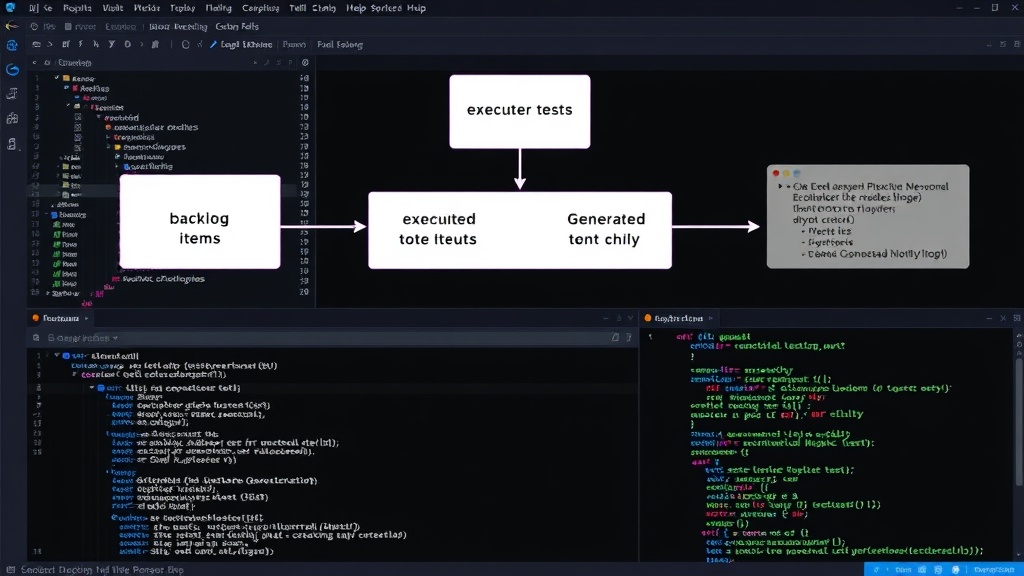
The system hinges on treating the project's backlog not as a list of abstract tasks, but as concrete, executable data. Each backlog item is, in essence, a specification that translates directly into automated tests. The developer, acting more as a conductor than a traditional coder, interacts with the system primarily through these specifications and the resulting test suite. The internal implementation details of the code generated to satisfy these tests are deliberately abstracted away.
This methodology requires a sophisticated understanding of how to define requirements that are both comprehensive and unambiguous. The LLM, in this scenario, is tasked with translating high-level feature requests into detailed specifications and then generating the corresponding test cases. The developer then uses these specifications and tests as the definitive guide for the project's evolution. The code itself is generated or modified to meet these externally defined criteria, ensuring that functionality aligns precisely with the intended specification.
The Role of the LLM and Test Automation
Central to this experiment is the role of the Large Language Model (LLM) and robust test automation. The LLM, in this context, acts as a sophisticated specification generator and test creator. It takes natural language descriptions of desired features and translates them into formal specifications and executable test scripts. This offloads a significant portion of the detailed, granular work of defining test conditions and expected outcomes.
The developer's role shifts from writing code to curating the LLM's output and ensuring the integrity of the specification-test pipeline. This involves defining the initial prompts for the LLM, reviewing the generated specifications and tests for accuracy and completeness, and managing the overall backlog. The continuous execution of these generated tests provides the feedback loop, assuring the developer that the system's behavior remains consistent with the defined requirements.
This is akin to building a house where the blueprints are not just drawings, but also the precise instructions for every automated construction tool. The builder doesn't lay every brick; they ensure the machines follow the plans perfectly. The 'black box' code is the result of these machines acting on the blueprints (specs and tests).
Trust and Process: The New Pillars of Development
When code is never read, the traditional mechanisms of trust – peer code reviews, direct inspection of implementation details, and developer intuition about code quality – are absent. This experiment posits that trust must be re-engineered into the process itself. The integrity of the specification, the robustness of the test suite, and the reliability of the code generation or execution environment become the new pillars.
The developer must have absolute confidence that the LLM accurately translates requirements into tests, and that the code generated or managed by the system reliably passes these tests. Any breakdown in this chain – a flawed specification, a poorly written test, or an unexpected behavior in the code execution – would immediately manifest as a test failure. This makes the testing framework the critical arbiter of correctness. The system is designed such that the process itself enforces quality, rather than individual human inspection of the code.
Potential Applications and Future Questions
The 'backlog-as-data' approach, while experimental, hints at potential applications in areas requiring rapid prototyping, highly standardized development, or situations where developer expertise in specific codebases is limited or transient. It could also be beneficial for teams where the primary bottleneck is not coding speed, but the clarity and completeness of requirements and testing.
However, significant questions remain. How does this model scale for complex, large-scale applications with intricate interdependencies? What is the long-term maintainability of code that is never directly understood or refactored by a human? What happens when the LLM makes subtle, hard-to-detect errors in specification or test generation that only become apparent under specific, un-tested edge cases? The experiment successfully demonstrates that development can proceed for a period without reading code, but its viability as a universal or long-term strategy is yet to be fully explored. The system's reference implementation, available on GitHub, invites further investigation and practical application by the developer community.