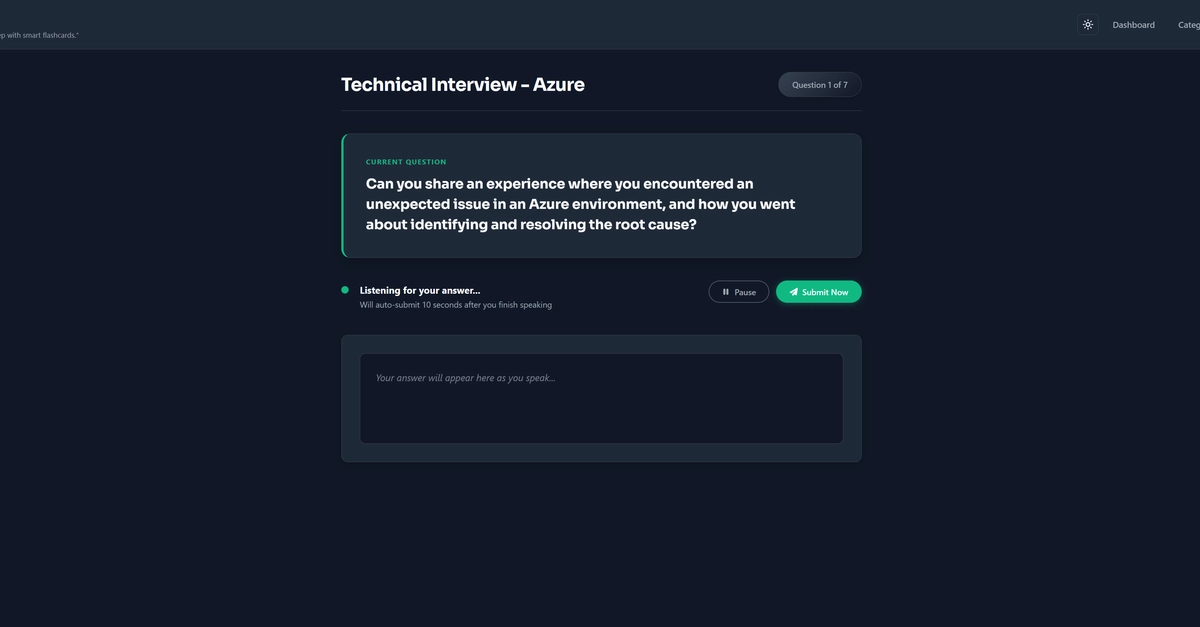
The Silent Killer in Tech Interviews
Many technically brilliant developers falter in interviews, not due to a lack of knowledge, but an inability to articulate that knowledge under pressure. This isn't a rare occurrence; it's a common pitfall. The core issue lies in our preparation methods. We diligently study documentation, grind through LeetCode problems, and perhaps jot down answers in a notes app. This approach builds a robust knowledge base, but it fails to cultivate the crucial skill of speaking confidently and coherently when under the scrutiny of an interviewer.
The act of typing an answer and speaking one are fundamentally different. Typing affords us time to pause, edit, and refine our thoughts. We can delete errors and restructure sentences at our leisure. In contrast, an interview demands simultaneous thinking and speaking. It requires maintaining focus when your train of thought derails, and projecting confidence even as you're formulating your response in real-time.
Why Typing Doesn't Translate to Talking
Consider the cognitive load. When typing, your brain can dedicate significant resources to constructing the perfect sentence, looking up syntax, or verifying a data structure. Your fingers do the heavy lifting, allowing your mind to operate at a more deliberate pace. This is akin to writing an essay; you can meticulously craft each paragraph, fact-check every claim, and polish your prose. The final output is a polished, well-structured piece of written communication.
Speaking, however, is a much more immediate and iterative process. You don't have the luxury of a backspace key or a spell checker. You must access your knowledge, translate it into spoken language, and convey it clearly, all within seconds. This requires a different set of skills: rapid recall, concise articulation, the ability to use filler words strategically (or avoid them entirely), and the mental agility to adapt your explanation based on subtle cues from the interviewer. It's less like writing an essay and more like delivering an impromptu speech on a complex topic, often with limited preparation.
The pressure of an interview exacerbates this difference. The ticking clock, the interviewer's gaze, and the high stakes can induce anxiety, which further impairs our ability to retrieve and articulate information smoothly. What might be a minor hesitation in a casual conversation can become a significant roadblock in an interview setting. This is why developers who ace coding challenges can struggle to explain their thought process aloud, or why brilliant architects might freeze when asked to describe a system they designed.
The Solution: Practice Speaking, Out Loud
The only effective way to bridge this gap is through direct, repeated practice. Developers must move beyond passive knowledge acquisition and engage in active, verbal recall. This means simulating the interview environment as closely as possible, but with a focus on the spoken word.
Simulating the Interview Experience
Start by taking common interview questions—behavioral, system design, and technical—and practicing answering them out loud. Don't just think the answers; speak them. Record yourself. Listen back to identify areas where you stumble, use too many filler words, or where your explanation is unclear. This self-assessment is critical for improvement.
Consider using a rubber duck debugging approach, but for your interview answers. Explain your thought process for a coding problem or a system design challenge to an inanimate object, a pet, or even an empty chair. The act of verbalizing forces you to structure your thoughts in a linear, coherent manner. It helps you identify logical gaps or areas where your understanding is superficial.
If possible, find a peer or mentor to conduct mock interviews. This provides invaluable real-time feedback. Ask your mock interviewer to interrupt you, ask follow-up questions, and probe deeper into your responses, just as a real interviewer would. This trains you to think on your feet and to handle unexpected questions gracefully.
The "So What?" Perspective
Developers must integrate verbal practice into their interview preparation. Focus on articulating solutions and thought processes aloud, not just writing them. This means practicing explanations for common algorithms, system design scenarios, and behavioral questions. Expect to spend significant time recording yourself and listening back, or conducting mock interviews to refine your spoken communication under pressure.
While this advice is general interview prep, a developer's ability to clearly articulate security concepts, potential vulnerabilities, and mitigation strategies under pressure is crucial. Practicing verbal explanations of security best practices or incident response scenarios can improve communication during high-stress security-related interviews.
Founders must recognize that hiring top technical talent involves assessing communication skills, not just coding ability. Encourage interview processes that evaluate verbal articulation and problem-solving under pressure. Investing in training that helps engineers communicate technical concepts clearly can also benefit internal team collaboration and client-facing roles.
Creators who are developers need to practice explaining their technical choices and project architectures verbally. This is vital for pitching ideas, demonstrating prototypes, or collaborating with non-technical stakeholders. Regularly practicing articulating project goals, technical challenges, and solutions aloud will enhance their ability to communicate their vision effectively.
Data scientists must practice explaining complex models, statistical findings, and experimental results verbally. This includes articulating the 'why' behind model choices, the interpretation of metrics, and the implications of findings. Verbal practice helps ensure that insights derived from data can be communicated clearly and persuasively to diverse audiences.
Sources synthesised
- 13% Match