The Genesis of Curiosity
Many developers don't embark on their coding journey with a fully formed product vision. Instead, the spark is often ignited by a simple curiosity about how things work. For many, this starts with a fascination for the web – how do websites function? How are they put together? This initial intrigue propels them into the world of code. The process isn't about memorizing arcane syntax; it's about understanding the underlying logic and problem-solving required to bring ideas to life. This fundamental drive, the desire to understand and create, is the bedrock upon which a developer's career is built.
The Iterative Loop: Learn, Build, Break, Debug
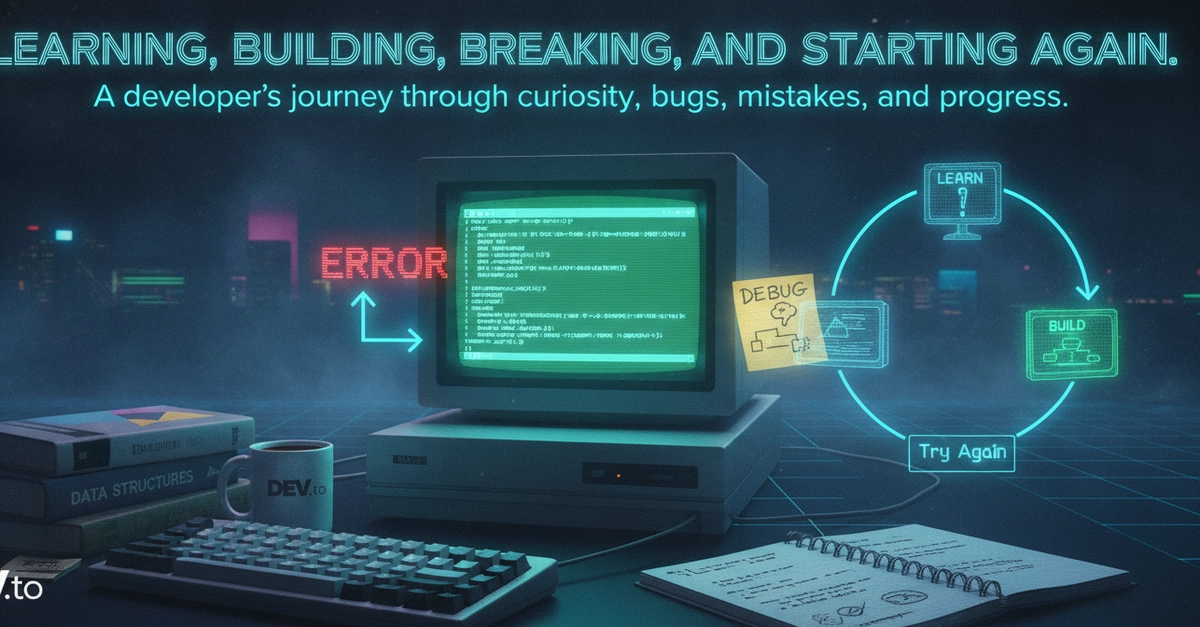
The core of software development is an iterative process, often best described as a cycle: learn, build, break, and try again. This isn't a sign of incompetence, but a fundamental aspect of how complex systems are understood and improved. A developer might learn a new language feature, attempt to integrate it into a project, encounter an unexpected error – breaking the build or functionality – and then spend time debugging to understand the root cause. This debug phase is where deep learning often occurs. It’s not just about fixing the immediate problem, but about internalizing the principles that led to the failure, making the developer more resilient and knowledgeable for the next iteration.
Consider the common pattern:
while (!success) {
    learn();
    build();
    breakSomething();
    debug();
    tryAgain();
}
While not a literal program, this loop captures the essence of the developer experience. Each step is crucial. Learning provides the tools and knowledge. Building allows for practical application and discovery. Breaking things, while frustrating, is an inevitable part of pushing boundaries and uncovering limitations. Debugging is the essential feedback mechanism, transforming errors into lessons. And the persistent attempt to 'try again' is the engine of progress.
Beyond Syntax: The Art of Problem-Solving
A common misconception is that coding proficiency is solely about mastering syntax and memorizing APIs. While a solid understanding of these elements is necessary, true mastery lies in the ability to approach problems systematically. Developers learn to decompose complex challenges into smaller, manageable parts, to identify potential solutions, to implement them, and to evaluate their effectiveness. This problem-solving capability is transferable across different languages, frameworks, and even domains. The skills honed in debugging a tricky JavaScript function can be applied to architecting a scalable backend system or even understanding a complex business logic problem. The ability to think computationally – to break down problems, identify patterns, and devise algorithms – is the real currency in software development.
Expanding Horizons: From Code to Product
The journey doesn't stop at writing code. Many developers, driven by the same curiosity that led them to programming, naturally gravitate towards understanding the broader context of their work. This includes exploring adjacent fields like Search Engine Optimization (SEO), digital marketing, and product management. The motivation is often to bridge the gap between technical implementation and real-world impact. Building products isn't just about functional code; it's about understanding user needs, market demands, and business viability. Developers who engage with these areas can create more effective, user-centric solutions. They begin to see their code not as an isolated artifact, but as a component of a larger system designed to solve a specific problem for a specific audience.
The Long Game: Continuous Growth and Adaptation
The technology landscape is in constant flux. New languages emerge, frameworks evolve, and best practices are continually refined. For developers, this means that learning is not a phase but a continuous state. The cycle of learning, building, breaking, and starting again is not just a method for initial skill acquisition; it's the model for lifelong professional development. Embracing this cycle allows developers to adapt to new challenges, stay relevant, and consistently improve their craft. It fosters resilience in the face of inevitable setbacks and cultivates a mindset that views complexity not as a barrier, but as an opportunity for growth and innovation. The most successful developers are those who remain perpetual students, always ready to learn, build, and yes, occasionally break things, in pursuit of better solutions.