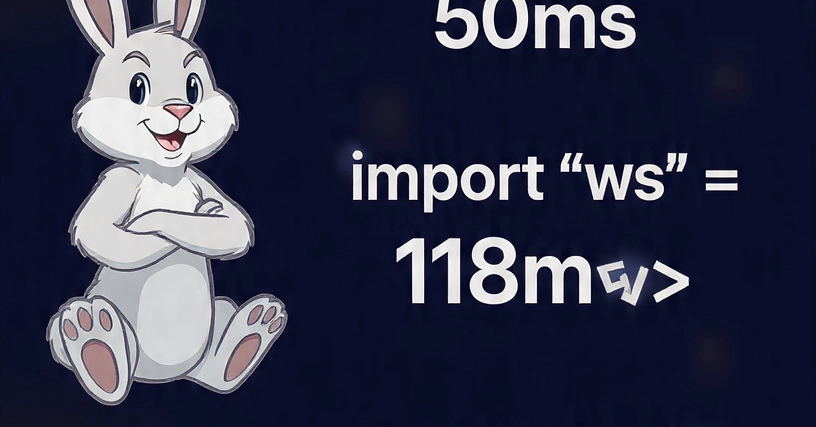
The Enduring Legacy of `ws`
For over a decade, the `ws` library has been the go-to solution for implementing WebSocket functionality within Node.js applications. Its reliability and robust feature set made it an indispensable tool for real-time communication, powering everything from chat applications to live data dashboards. Developed in an era dominated by a single JavaScript runtime, `ws` was designed with Node.js as its primary and, frankly, only target environment. This singular focus allowed its creators to optimize for Node's specific APIs and ecosystem, leading to its widespread adoption and the deep entrenchment it enjoys today.
However, the JavaScript landscape has evolved dramatically. The monolithic Node.js server is no longer the only game in town. Developers are now deploying applications across a diverse range of environments, including serverless platforms like Cloudflare Workers, alternative runtimes such as Bun and Deno, and even edge computing solutions. This fragmentation presents a significant challenge for libraries that were built with a single, older architecture in mind. The classic `ws` library, despite its historical significance, is increasingly showing its age when confronted with these modern deployment strategies and runtime paradigms.
Runtime Fragmentation and Dependency Hell
The core issue lies in `ws`'s reliance on Node.js-specific APIs and its dependency structure. When developers attempt to use `ws` in environments outside of traditional Node.js, they often encounter a cascade of compatibility problems. Serverless functions, for instance, operate on different event loops and have restricted access to native modules. Bun and Deno, while striving for Node.js compatibility, have their own unique APIs and internal architectures. Trying to shoehorn `ws` into these environments frequently requires complex polyfills and workarounds, turning what should be a straightforward task into a frustrating debugging session.
The `ws` library, being a native Node.js module, often depends on Node.js's built-in `net` and `tls` modules. These modules are not available in environments like Cloudflare Workers, which are designed to be lightweight and secure by running JavaScript in a sandboxed environment without direct access to the underlying operating system's network stack in the same way Node.js does. This fundamental difference means that `ws` cannot function out-of-the-box in many modern deployment targets. Developers are forced to either abandon their chosen runtime or spend considerable effort trying to bridge the gap. This often involves intricate conditional logic, runtime detection, and the management of multiple sets of dependencies, which can quickly become unmanageable and introduce subtle bugs.
Consider the developer experience: a team decides to leverage the performance benefits and cost-effectiveness of Cloudflare Workers for their real-time API. They reach for `ws`, a library they've used for years. Suddenly, they are confronted with errors related to missing native modules. The documentation might offer a path forward, but it often involves abstracting away the networking layer and using a different, potentially less mature, API provided by the serverless platform itself. This isn't just inconvenient; it's a significant productivity drain. The time spent wrestling with compatibility issues is time not spent building features or serving customers. This friction point is a clear indicator that the tooling has not kept pace with the evolving needs of the development community.
The Rise of Alternatives and the Need for Agnosticism
Recognizing this growing frustration, developers are actively seeking alternatives. The ideal solution would be a WebSocket library that is truly runtime-agnostic, meaning it can function seamlessly across Node.js, Bun, Deno, Cloudflare Workers, and other emerging JavaScript environments without requiring special configurations or polyfills. Such a library would abstract away the underlying runtime differences, providing a consistent API that developers can rely on regardless of their deployment target. This approach mirrors the broader trend in modern JavaScript development towards universal or portable libraries that work everywhere.
One such effort is the `@rabbx/ws` library, built by developer RabbX. This project explicitly aims to address the limitations of the legacy `ws` package by offering a zero-dependency, runtime-agnostic implementation. By avoiding native Node.js dependencies and focusing on standard Web API interfaces where possible, `@rabbx/ws` seeks to provide a more flexible and future-proof solution. The goal is to eliminate the need for extensive polyfills and the associated complexity, allowing developers to focus on their application logic rather than the intricacies of the WebSocket implementation across different JavaScript engines.
The "So What?" Perspective
Developers using Node.js should be aware that the 'ws' library's reliance on Node-specific APIs can cause compatibility issues in modern runtimes like Deno, Bun, and serverless platforms. Consider alternatives like '@rabbx/ws' for true runtime agnosticism. You may need to refactor networking code if migrating to non-Node.js environments.
The 'ws' library itself is generally considered secure, but its dependencies and the complexity of polyfills required for non-Node.js environments can introduce new attack vectors. Ensure any alternative WebSocket libraries are well-maintained and audited for security vulnerabilities.
The friction caused by outdated libraries like 'ws' can slow down development cycles and increase engineering costs, especially when targeting diverse deployment environments. Investing in or adopting runtime-agnostic tools can improve developer velocity and reduce technical debt, potentially leading to faster product iteration.
For creators building real-time applications, the choice of WebSocket library impacts deployment flexibility. If you're building for edge or serverless, sticking with 'ws' may require significant workarounds. Exploring new, cross-runtime libraries can streamline workflows and simplify deployment across various platforms.
While this issue is primarily about networking infrastructure, the performance characteristics of different WebSocket implementations can impact real-time data streaming. Benchmarking new libraries against 'ws' in your target environment is crucial for ensuring consistent data delivery and low latency.
Sources synthesised
- 6% Match